








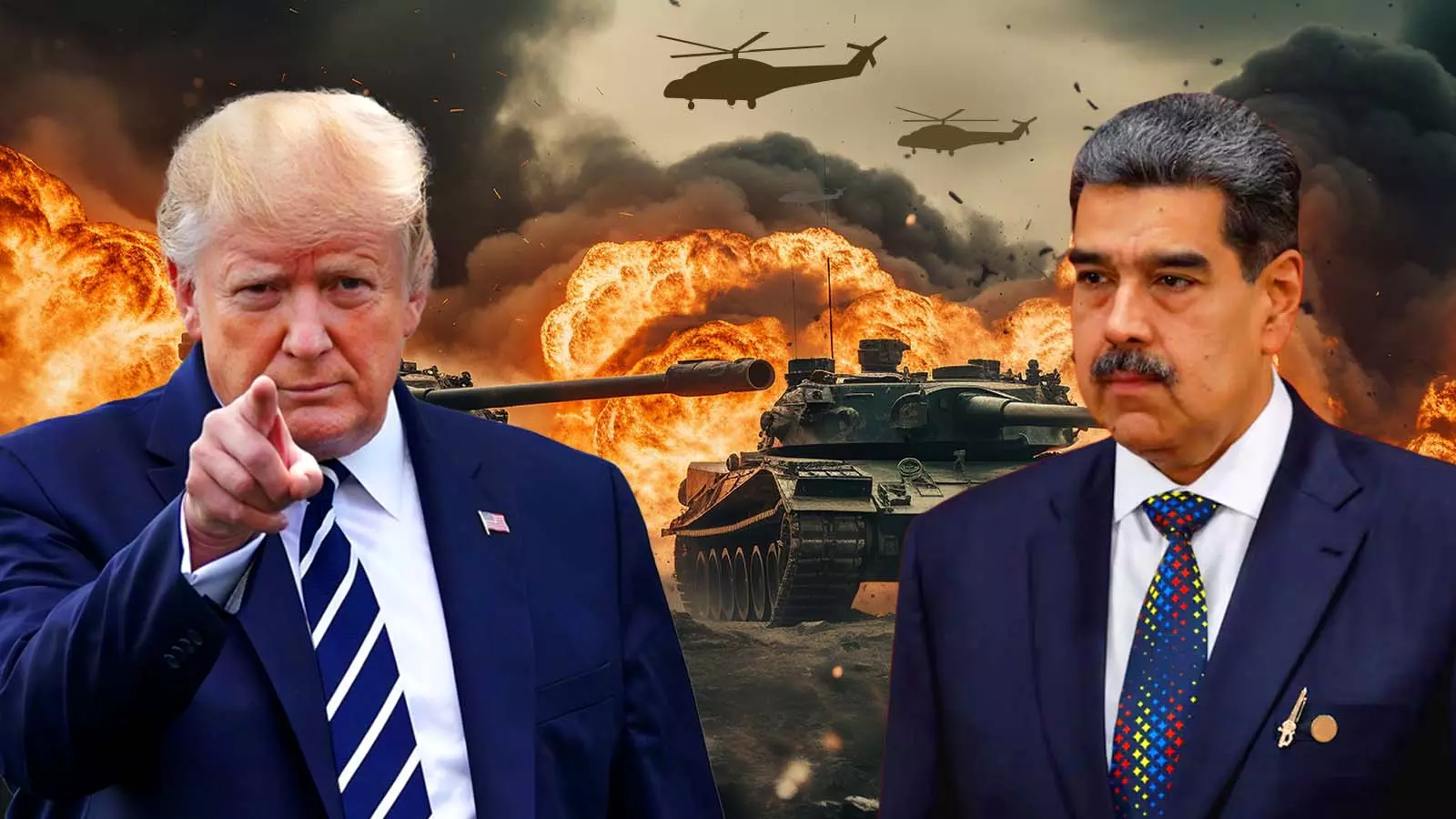
Explained: Why did US attack Venezuela?
Besides ideological enmity, the US has several reasons to target the Nicolas Maduro regime to protect its interests in the Western Hemisphere

The prolonged tension between the US and Venezuela took an explosive turn on the third day of 2026 when Washington conducted large-scale strikes in the Latin American nation, with President Donald Trump declaring that his Venezuelan counterpart, Nicolas Maduro and his wife, First Lady Cilia Flores, had been captured in the capital Caracas and flown out of the country.
Venezuelan Vice-President Delcy Rodriguez said the government did not know where the First Couple were and demanded their “immediate proof of life”.
The Venezuelan leadership, first by Maduro and later by the defence minister, condemned the strikes and decided to mobilise the country’s forces against the American attacks after proclaiming a national emergency following blasts in the national capital.
Also read: Emergency in Venezuela after Caracas blasts; Maduro blames US ‘military aggression’
The US leadership had been targeting Venezuela for some time now under what is termed as Operation Southern Spear (the January 3 mission was codenamed Operation Absolute Resolve), including hitting several speed boats allegedly transporting drugs through Venezuelan waters amid massive military build-up in the Caribbean or attempting to isolate Caracas from the international oil industry through sanctions on companies and vessels that are allegedly involved in carrying Venezuelan oil.
American attacks on suspected drug vessels in the region have resulted in the deaths of at least 115 people so far. The latest attacks, which followed the military build-up (August 2025), maritime blockade (December 2025), and covert land strikes (late December 2025), came after the US kept on pressuring Maduro, one of Venezuela's longest-serving presidents, to step down over accusations of drug-running and a lack of legitimate power.
First US intervention in a Latin American state since 1989
While the US’s confrontation with Latin American nations is not new in the annals of history, it is the first time since 1989 that the US has made such a direct intervention in Latin America. In the late Eighties, it had attacked Panama to topple its former military dictator, Manuel Noriega. The allegations that were brought against him were similar.
Also read: 2025, when Modi's India found Trump 1.0 and Trump 2.0 to be cheese and chalk
But why has the Trump administration targeted Venezuela?
There are various reasons why Washington took such a step against Caracas.
Narco-terrorism accusations
First, the US accused the Maduro administration of being a “narco-terrorist” organisation, which it claims to be the leader of a global trafficking ring that has flooded America with drugs to destabilise it. The US has blacklisted Venezuela-based groups such as Tren de Aragua and Cartel de los Soles as foreign terrorist organisations to justify its charges against the Maduro regime.
Migration threat to US security
The US president has also blamed Maduro, accusing him of “emptying his prisons and insane asylums” and compelling his inmates to migrate to the US, besides using oil funds to back drug-related criminal activities.
Saturday’s strikes also come after a five-month-long pressure campaign to depose Maduro and enforce a complete blockade of the Latin American nation’s oil and minerals. Washington, as said earlier, had seized tankers carrying sanctioned oil from countries such as Venezuela and Iran.
Against drug-trafficking
The US claims the latest strikes were necessary to stop the flow of cocaine and fentanyl into the country. Since September 2025, the US military has conducted over 35 strikes against alleged drug-smuggling vessels in the Caribbean and Pacific, resulting in at least 115 deaths.
Regime change for oil?
Analysts argue the US's ultimate goal is regime change to install a democratic leadership in Caracas and gain access to Venezuela's vast oil and mineral reserves through a favourable government. Venezuela, too, has accused the US of aiming to grab its rich oil reserves, and it has called out the latter’s “imperial aggression”.
While the sanction-hit nation’s current state of infrastructure in producing actual oil might not be too great, Trump's statement to Fox News on Saturday that the US would be going to be "very strongly involved" in Venezuela's oil industry after Maduro's ouster gives a fair picture about Washington's plans.
Last November, US Republican legislator from Florida, Maria Elvira Salazar, said Venezuela would be a field day for America's oil companies. According to her, the American companies could "go in and fix oil rigs and everything that has to do with Venezuelan petroleum companies".
For the US, the Venezuela question is about geopolitics.
The 'Trump Corollary'
One of the major reasons that has made the US’s conflict with Venezuela inevitable is Trump’s assertive doctrine, or rather a recalibration of the doctrines pushed by former presidents James Monroe and Theodore Roosevelt that aimed at making the US the undisputed king of the Western Hemisphere.
Also read: US National Strategy is naked self-interest, shorn of any commitment to collective good
While the Monroe Doctrine of 1823 was more a passive caution to the Europeans against increasing their influence in the Western Hemisphere, the Roosevelt Corollary to that doctrine, which came in 1904, was more assertive. It said the US would step in as a last resort to see that other countries in the Western Hemisphere fulfilled their obligations to international creditors, and as the corollary worked out, Washington used more military force to restore internal stability to nations in the region.
In the mid-2020s, the Trump administration, as a reflection of concern over China’s growing influence, said in its new national security strategy unveiled at end 2025 that the US would reassert and enforce the Monroe Doctrine to restore America’s pre-eminence. A “Trump corollary” was floated, which is essentially a nod to the Roosevelt Corollary.
While historical ideological clashes with socialist Venezuela remain, the current US administration has an added responsibility to fulfil the promises it has made to its domestic constituencies, including the prevention of mass migration and addressing issues such as drug-trafficking, gaining advantages in issues related to trade and mineral resources and the urge to dwarf opponents in an ego clash.
What China, Russia said
China was “deeply shocked” by the US attacks on Venezuela and condemned Washington’s “blatant use of force against a sovereign state”, its foreign ministry said in a statement, news agencies reported.
Accusing the US of displaying a “hegemonic behaviour” to violate international law, the ministry said the act infringed upon the Latin American nation’s sovereignty and threatened peace and security in Latin America and the Caribbean and that China opposes it firmly.
‘Rich scoundrels,’ says Russia leader
Russia also lashed out at the US in unequivocal words. Dmitry Medvedev, former Russian president and currently the deputy chairman of the Russian Security Council, told reporters that “any state needs to strengthen its armed forces as much as possible, not allowing various rich scoundrels to easily change the constitutional system in search of oil or something else,” the TASS news agency reported.
EU calls for restraint
The European Union urged restraint in the explosive situation around Venezuela. European Commission Vice President and EU High Representative for Foreign Affairs and Security Policy, Kaja Kallas, noted on X after a conversation with US Secretary of State Marco Rubio that "The EU has repeatedly stated that Maduro lacks legitimacy and has defended a peaceful transition".
Her boss, Ursula von der Leyen, joined the support for a “peaceful and democratic" transfer of power in Venezuela, allegedly based on international norms, after the abduction of Maduro.
(With agency inputs)