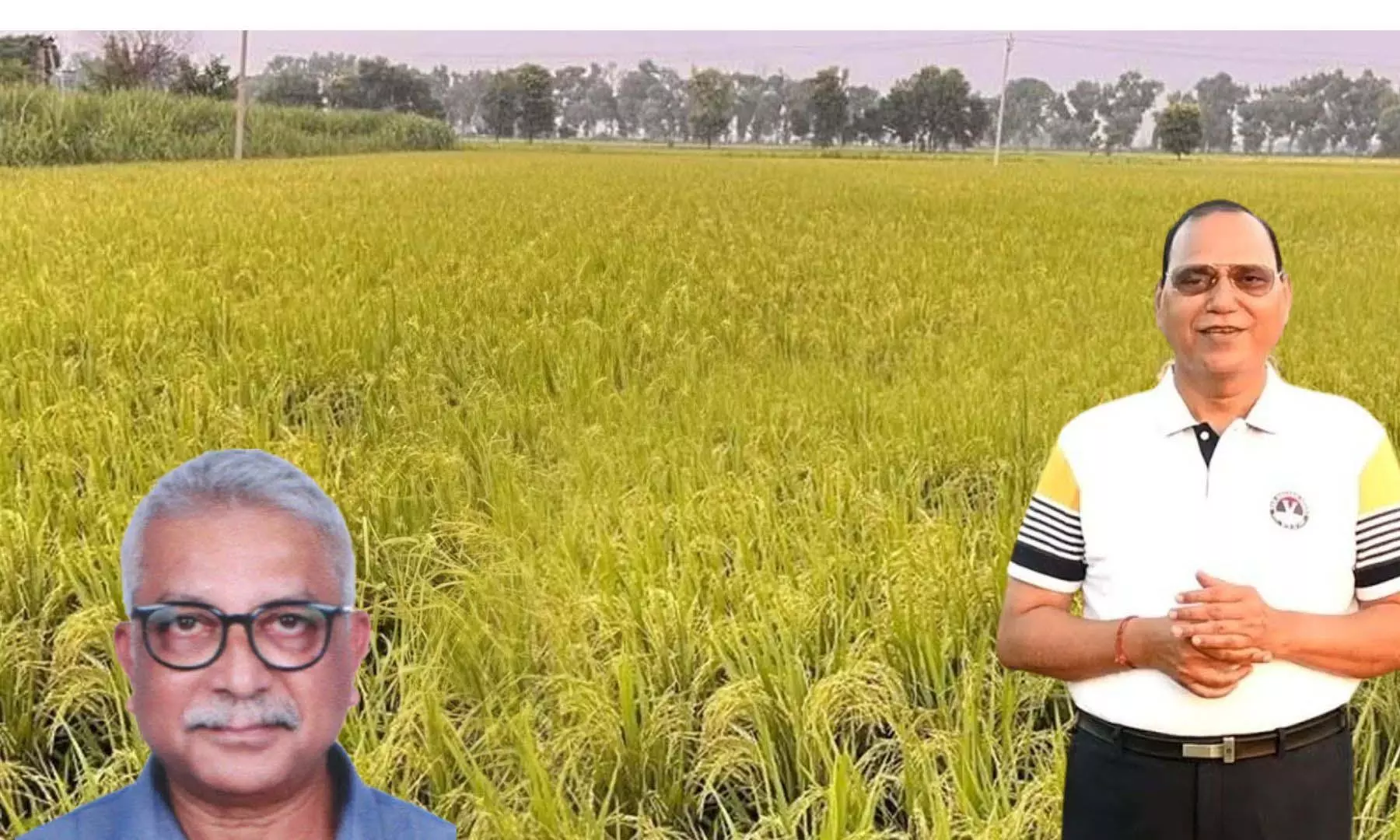
What’s ahead for India’s basmati export empire? Veteran rice breeder explains
Dr Ashok Kumar Singh discusses how new basmati varieties, disease resistance and faster breeding tech could transform India’s basmati production and exports

India could export 30 million tonnes of basmati rice by 2050 if current growth trends continue, says Padma Shri awardee Dr Ashok Kumar Singh, a renowned rice breeder who developed the blockbuster variety Pusa Basmati 1509. The projection highlights the growing global demand for premium rice and the need for sustained scientific innovation to boost yields and resilience.
Basmati exports already generate billions in foreign exchange, and scientific advances in breeding, disease resistance, and water-saving cultivation methods could determine how far India expands its dominance in the global market. The Federal spoke to Ashok Kumar Singh, former director of the Indian Agricultural Research Institute (IARI) and now emeritus scientist at the institute, about basmati research, exports, new breeding technologies, and the future of the crop.
Could West Asia tensions disrupt basmati planting next season?
To be frank, if the conflict ends within a month or so, the shipments currently at sea or at Indian ports will eventually be delivered. These are already committed by importers, so they should materialise.
Also Read: Iran war puts USD 11.8 bn worth of India's farm exports at risk: GTRI
The challenge is the war surcharge that has been imposed. It has gone up to about USD 2,000 per container, which makes it difficult for exporters to sustain if the situation continues. If delays stretch further, demurrage or damage charges on rice stuck at ports could also increase.
The sooner the conflict ends the better. Otherwise, the impact could increase. This year we were hoping for about 6.5 million tonnes of basmati exports. Last year it was about 6 million tonnes.
If you consider that exports average about 5 lakh tonnes a month and around 70 per cent goes to the Middle East, about 3.5 lakh tonnes per month go to that region. Most shipments have already gone out. Only the final quarter remains, and I believe it should still reach its destinations.
Why is the European Union less open to Indian basmati imports compared to West Asia?
We actually export significant volumes of Basmati rice to the European Union. In value terms it is close to Rs 7,000–8,000 crore.
In 2016–17 we exported about 6 lakh tonnes to the EU. That later dropped to about 2.5 lakh tonnes around 2020 because of concerns over pesticide residues.
But things have improved. Most of our current varieties are resistant to bacterial blight and blast disease, which reduces pesticide use. Institutions and exporters also run campaigns and conduct sampling at the field level to ensure there is no residue.
Because of this, exports to the EU have begun rising again. Basmati is a premium commodity and will remain an important export product for that market.
Are the newer basmati varieties developed in India able to meet the EU’s strict phytosanitary standards?
Yes, but the EU standards are extremely stringent. For any pesticide that is not used within the European Union, they fix a default residue limit of 0.01 parts per million.
That is essentially the detection limit of laboratory instruments. To put it simply, it is about one milligram in 100 kilograms of rice.
Also Read: West Asia conflict: India’s edible oil imports, agri exports under threat
In comparison, the United States allows around 3 ppm and Japan allows up to 8 ppm.
With new varieties that are resistant to bacterial blight and blast, the need for pesticides reduces drastically. This helps produce Basmati rice that is essentially free from residues.
Does the EU produce its own aromatic rice and therefore try to protect that market?
No, there is no domestic production of aromatic rice in the European Union.
The rice commonly consumed there is American long-grain rice imported from the United States. There is also some jasmine rice from Thailand, though most of that goes to the United States rather than Europe.
So basmati remains the dominant aromatic rice segment in the EU market.
Has basmati research shifted focus from increasing yield to protecting yields from pests and diseases?
Partly, but not completely. Take the example of Pusa Basmati 1509. It actually produces more yield than Pusa Basmati 1121.
While 1121 yields about 18 quintals per acre, Pusa Basmati 1509 yields about 25 quintals per acre. At the same time it matures faster—around 120 days compared to about 145 days earlier.
Also Read: Why Tirupur exporters are upbeat on US market despite tariff confusion
So we reduced crop duration while increasing yield. That itself is a major gain in plant breeding.
Disease resistance is equally important because it reduces cultivation costs by around ₹3,000 per acre by lowering pesticide use. It also ensures the rice produced is free from pesticide residues.
You are currently working on resistance to the fungal disease Bakanae. What exactly is it?
Bakanae is a fungal disease caused by a fungus that produces gibberellic acid inside the plant.
When the plant gets infected it becomes unusually tall and eventually dries up. The name ‘Bakanae’ comes from a Japanese word meaning ‘foolish plant’ because the infected plants look abnormally tall compared to others.
Almost all basmati varieties are highly susceptible to this disease, with infections of about 10 to 15 percent.
We are screening landraces, farmers’ varieties and wild species to identify genes for resistance. The aim is to map those genes and transfer them into high-yielding basmati varieties.
Historically it took about 24 years to develop the first semi-dwarf basmati variety. Does it still take that long?
You are right that the first cross was made in 1968 when MS Swaminathan was director of the Indian Agricultural Research Institute and EA Siddiq was leading the programme.
The traditional basmati varieties yielded about 2.5 tonnes per hectare. The aim was to combine their quality with high-yielding dwarf rice.
The first breakthrough, Pusa Basmati 1, was released in 1989 with yields of around 6 to 7 tonnes per hectare.
Also Read: Centre push to scrap Kerala paddy bonus triggers federal backlash
Today the time required has reduced significantly. With molecular breeding tools, marker-assisted selection, off-season nurseries and speed breeding, we can develop a new variety in about six years.
Can modern techniques speed up improvement in traits like kernel elongation and aroma?
Speed breeding helps reduce the time required for each generation. Earlier a rice crop took four to five months to complete its life cycle, so we could manage only two generations a year. With speed breeding you can grow up to five generations in a year. But traits like kernel elongation, aroma, fluffiness and mouthfeel still require careful selection.
The advantage today is that we know where these genes are located in the rice genome. All 37,000 genes in rice have been mapped, which makes selection far more targeted than earlier.
Is artificial intelligence being used in plant breeding now?
Yes, artificial intelligence is beginning to play a role in what we call smart plant breeding. With genomic data we can predict the breeding value of individual plants. Instead of phenotyping thousands of plants, we can analyse genetic markers and predict which ones will perform best.
This reduces the amount of field testing required and speeds up the breeding process. We are gradually moving in that direction.
Can basmati cultivation expand further in India?
Yes, there is definitely scope. In 2010 India exported about 2.3 million tonnes of basmati rice. By 2025 exports have reached about 6 million tonnes.
If this growth rate continues, we could be exporting about 16 million tonnes by 2040 and nearly 30 million tonnes by 2050.
Also Read: Why India-EU FTA is unlikely to hurt Indian farmers despite apprehensions
In value terms exports rose from about ₹11,000 crore in 2010 to ₹50,000 crore in 2025. If the same growth rate continues, exports could reach nearly ₹5.9 lakh crore in the future.
Where would this additional basmati be grown?
Basmati is protected under a geographical indication, so it can only be grown in specific regions. In Punjab, about 32 lakh hectares are under rice cultivation but only around 7–8 lakh hectares are basmati. The rest is non-basmati rice.
That non-basmati cultivation could shift to eastern states like Uttar Pradesh, Bihar and West Bengal where water availability is better.
In Punjab and Haryana groundwater is declining rapidly, and basmati actually uses less water than non-basmati rice.
What other challenges must basmati research address?
There are several. Among diseases we still have to tackle Bakanae, false smut, brown spot and viral diseases like Fiji virus.
Among insect pests there are problems like stem borer, leaf folder and brown plant hopper.
We are identifying resistance genes for these stresses and incorporating them into high-yielding varieties.
On the cultivation side we also need to move from puddled transplanted rice to direct-seeded rice. Traditional methods require around 3,000 litres of water to produce one kilogram of rice.
How can direct-seeded rice help?
Direct seeding can reduce greenhouse gas emissions by about 35 percent, save around ₹6,000 per acre in labour costs, and reduce water use by about 35 percent.
The main challenge is weed control. For that we have developed herbicide-tolerant basmati varieties.
These varieties can tolerate specific herbicides that kill weeds without damaging the rice plant.
Should India spend more on agricultural research?
Government spending on research and development has been increasing, but globally many countries spend about one percent of agricultural GDP on research.
In India agriculture contributes around 18 percent to GDP, so one percent of that would be about ₹54,000 crore annually.
We are not yet at that level. But basmati alone brings in about $6 billion in foreign exchange every year. Some portion of the cess collected from basmati exports or mandi fees could be channelled back into research.
Even a small share of that revenue could significantly strengthen agricultural innovation.
The content above has been transcribed from video using a fine-tuned AI model. To ensure accuracy, quality, and editorial integrity, we employ a Human-In-The-Loop (HITL) process. While AI assists in creating the initial draft, our experienced editorial team carefully reviews, edits, and refines the content before publication. At The Federal, we combine the efficiency of AI with the expertise of human editors to deliver reliable and insightful journalism.