Why all Indians, irrespective of caste, owe BR Ambedkar something
On Ambedkar Jayanti (April 14), revisiting the story of the architect of Indian Constitution (the doctrine that governs the world’s largest democracy) and why millions still draw strength from it today

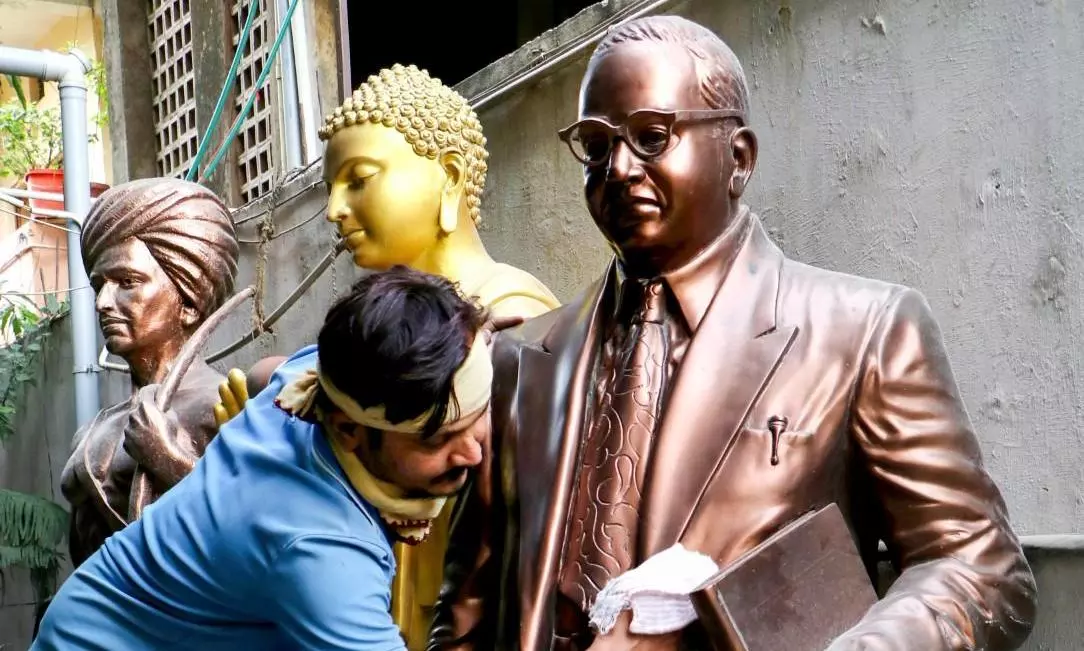
April 14, 1891. A baby boy is born in a military cantonment in the then Central Provinces (modern-day Madhya Pradesh) into a family the world around them calls “untouchable.” His name is Bhimrao Ramji Ambedkar. The British officers’ children can play near the water tank, but little Bhim and his siblings cannot. A separate earthen pot is kept for them and if they touch the common tap, the water is considered ‘polluted’.
Today, across India, millions of people, including students, sanitation workers and software engineers light candles, read his books, and post selfies in front of his statues to mark his birthday. And to remind themselves that the boy who was once denied water went on to write the Indian Constitution that guarantees every citizen the right to dignity.
The boy who refused to stay in his ‘place’
Ambedkar was the 14th child of Ramji Maloji Sakpal, an army subedar in the British Indian Army. His father made sure he studied, but school was a daily humiliation. Teachers refused to touch his notebooks. He had to sit on the floor outside the classroom. Yet he topped every class. A sympathetic Brahmin teacher gave him the surname “Ambedkar” so he could at least sound less “low-caste.”
With a scholarship from the Maharaja of Baroda, he sailed to New York in 1913. At Columbia University he earned doctorates in economics and sociology. Later, at the London School of Economics, he became a barrister. He returned home fluent in multiple languages and armed with ideas that would shake an ancient hierarchy.
The fight that changed India
In 1927, Ambedkar led the Mahad Satyagraha, the first public assertion by “untouchables” that they had the right to drink water from a public tank. When upper-caste crowds attacked them, he told his followers: “We are not fighting for water. We are fighting for self-respect.”
Also read: Caste: A Global Story review: How the hierarchy-driven social order spans the globe
He clashed with Mahatma Gandhi over separate electorates for Dalits. The Poona Pact of 1932 was a compromise, but Ambedkar never stopped demanding real equality. In 1947, when India became independent, Prime Minister Jawaharlal Nehru asked him to chair the Drafting Committee of the Constitution. The document that was enacted on November 26, 1949 abolished untouchability, guaranteed equality before the law, and introduced reservations in education and jobs so that centuries of exclusion could begin to be corrected.
The revolution no one saw coming
On October 14, 1956, just months before his death, Ambedkar converted to Buddhism along with nearly half a million followers in Nagpur. He wanted his people to leave the caste system behind without hatred. He told them: “I was born a Hindu but I will not die a Hindu.”
Today that decision has grown into a global Buddhist revival among communities that were once told they had no place in temples. Walk into any government college hostel or a village anganwadi and you will meet young people whose grandparents could not enter a courtroom or a school.
Also read: How Ambedkar talked about dividing UP and MP into smaller states even in 50s
Their parents benefitted from Ambedkar’s reservations. They themselves are the first in their families to own smartphones, appear for UPSC exams, or run startups. They face new battles (caste-based discrimination on social media, creamy-layer debates, merit-versus-reservation arguments, among others) but they continue to swear by the same mantra: “Educate, Agitate, Organise.”
Blueprint for equality, social justice
Even those who never faced caste discrimination owe him something. The Constitution he gave us protects freedom of speech, women’s rights, and the dignity of labour, ideas that keep India’s democracy alive. We are living at a time when the spirit of the Constitution, Babasaheb’s bold blueprint for equality, justice, and fraternity, is being brazenly violated through majoritarian policies, selective enforcement of laws, and the erosion of checks and balances.
Today, when every key institution from the judiciary and the Election Commission to investigative agencies like the CBI and the ED, and even a large section of the media appears compromised by the ruling BJP, we must remind ourselves that this single document remains the sole, unassailable text that must govern the world’s largest democracy.
No government, no ideology, and no temporary majority should supersede the Constitution; Ambedkar drafted it precisely so that the rights of the last person in the queue would never again depend on the mercy of those in power. On Ambedkar Jayanti, the truest tribute would be our collective resolve to reclaim and defend that Constitution as the only legitimate North Star for India’s future.