



Where the azaan meets the arati: Bengal’s shared Durga Puja traditions
As controversies over biryani, non-vegetarian food and Muslim participation stir debate, family histories across Bengal tell a different story of shared rituals

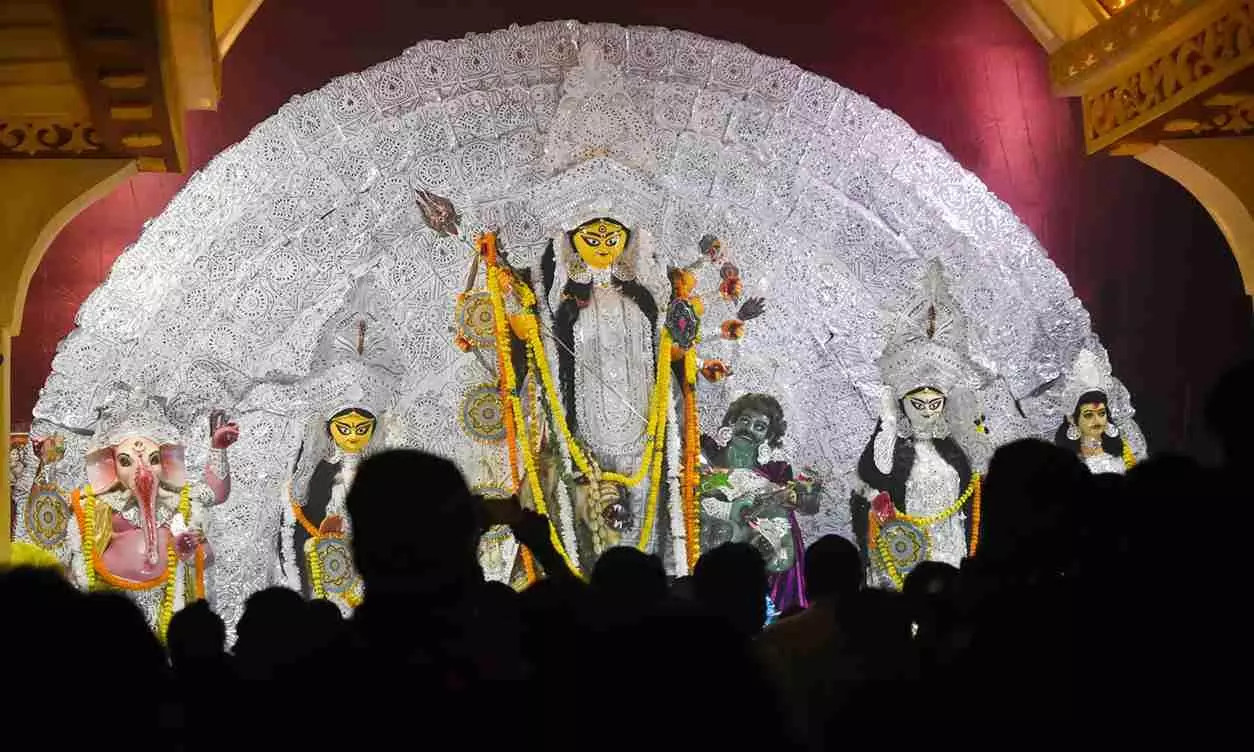
In a Murshidabad village, a Muslim widow’s legacy lives on in the rice once offered to Goddess Durga. In a Hooghly household, the evening azaan rings out alongside the puja arati. And in Malda, Muslim villagers still light the goddess’s path during immersion.
Passed down through generations, these traditions stand in striking contrast to calls to bar Muslims from participating in puja rituals, keep non-vegetarian food away from puja pandals, and protest biryani advertisements featuring the goddess, reigniting a debate over 'religious purity' in West Bengal during the first Durga Puja under a BJP government.
A widow’s legacy
At the 600-year-old Kodakhaki Durga Puja in Bahura village, near Raghunathganj in Murshidabad, the story begins with a poor Muslim widow known as Lokar Ma. Her name survives in the family’s account of how the puja acquired a tradition that brought Muslim villagers into the annual worship of a Hindu goddess.
Also read: Durga Puja 2026: 10 fascinating facts about Bengal’s biggest festival
The puja is organised by the old zamindar Banerjee family.
According to local lore, one of their ancestors dreamt that the goddess wanted an offering from a Muslim widow, Lokar Ma (mother of Loka). When the family approached the widow, she said she was too poor to afford the ingredients. The story goes that the goddess then appeared in her dream and instructed her to collect koda, an old variety of grain. Lokar Ma gathered the rice and prepared koda naru, a sweet offering that gave the goddess her name, Kodakhaki Durga.
Living bond
The widow died centuries ago, but the Muslim community's association with her continued. Milan Banerjee, a ninth-generation member of the family, told The Federal that Muslim residents supplied the special rice after Lokar Ma’s death. “Until my mother died five years ago, a Muslim boy used to come from Char Narukhaki to bring the rice,” Milan said. Char Narukhaki is a riverine island or sandbar in the Raghunathganj-II area.
The connection has endured in other ways, too. Pradip Banerjee (36), Milan’s nephew, recalled that a Muslim visitor from Afghanistan had once come to offer the special rice. “Even today, the Muslim community remains integral to our puja,” Milan said. Muslim women join the welcome for the goddess with sarees, sakha (white conch-shell bangles), pola (red coral bangles) and sindoor (vermilion), traditionally worn by married Bengali Hindu women.
Community participation
About 76 per cent of Bahura’s population is Muslim, according to Pradip. Although no official demographic data is available to substantiate the claim, Muslims accounted for 81.97 per cent of the population of Raghunathganj-II block, where Bahura village is located, according to the last census. “Muslim residents help with the arrangements and provide support throughout the festival. This inclusiveness is the soul of this puja,” he said.
Also read: Kolkata Durga Puja 2026 top 10 theme pandals: Lotus, SP Mookerjee, Partition and more
Pradip acknowledged that communal tensions in recent years could not be ignored. But, he said, they had not affected the inclusive spirit of the family’s celebrations.
Rituals in harmony
There is another interesting feature of the Bahura puja that sits awkwardly with attempts to prescribe a single dietary code for Hindu worship. The family continues the practice of animal sacrifice, in keeping with the Shakta tradition of Hinduism, in which non-veg offerings form part of worship. The sacrifice is followed by kirtan, devotional singing associated with Vaishnavism, whose traditions generally emphasise vegetarian offerings and abstention from animal sacrifice. “In this centuries-old puja, both Shakta and Vaishnava traditions have been fused. We still practise animal sacrifice, adhering to the Shakta tradition. But interestingly, after the sacrifice, there is kirtan, which is integral to the Vaishnava tradition,” Milan Banerjee said.
The combination is part of the family’s inherited practice. It offers a glimpse of the varied rituals that have shaped Bengal’s religious life, where different traditions can coexist within the same celebration. That diversity has assumed greater significance amid this year’s controversy over food and religious identity.
Food and faith
The Vishva Hindu Parishad (VHP) drew controversy in August when it called for Durga Puja to adhere to what it described as traditional Hindu practices and said non-vegetarian food should be kept away from pandals. A VHP representative further said Muslims were welcome to visit pandals and see the idols, but objected to the mixing of religious practices. The organisation later, however, denied issuing any directive on dietary habits, saying there should be no ban on vegetarian or non-vegetarian food.
That, however, did not end the debate. Hindu preacher Dhirendra Krishna Shastri, popularly known as Bageshwar Baba, renewed the call to keep non-vegetarian food away from Durga idols during his visit to the state.
The debate over religious identity and food has also spilled onto the streets. In Siliguri, the Hindu Jagaran Manch put up posters urging people to buy biryani, meat and puja essentials from Hindu-owned shops. One carried the message, “Eat biryani, but from a Hindu shop.” The organisation described the campaign as an appeal to support Hindu businesses, rather than a diktat. The BJP’s Bengal unit distanced itself from the campaign, saying the Manch is an independent body and has nothing to do with the party.
Also read: Bengal's Durga Puja starts with Mahashashthi; pandal-hopping begins
The controversy was not limited to calls to support Hindu-owned businesses. In Hindmotor, Hooghly, local BJP members protested against advertisements by a biryani outlet showing Durga alongside images of chicken biryani, egg and fish dishes. The owner was forced to remove the banners and submitt a written apology to the police.
In Birati, near Dum Dum, objections to a biryani shop’s use of Goddess Durga on promotional hoardings led to police intervention and the removal of the banners. “These controversies undermine Bengal’s older customs, which resisted confining Durga Puja to any one set of practices or traditions,” said litterateur and scholar Dr Ratan Kumar Nandi.
Lighting the way
In Malda, the Chanchal Rajbari Durga Puja is another example of the continuation of this pluralistic tradition, with Muslims participating in the celebrations. At Paharpur’s Chandimandap, the puja is believed to date back more than 375 years, to the reign of Chanchal’s ruler Ramchandra Ray Chowdhury. The royal family has lost its former stature, and the palace has been sold. Much of the responsibilities of sustaining the festival now falls to ordinary residents of Paharpur, Gilabari and neighbouring areas.
On Dashami (Day 10), as the goddess is taken for immersion, Muslim residents still help light her way. Some accompany the procession with lanterns and torches, while others stand on the opposite bank of the Mora Mahananda, a former stream that has since become a pond, and use their mobile-phone lights to illuminate the route.
Partha Chakraborty, secretary of the Chanchal Raj Official Trust and acting headmaster of Chanchal Siddheswari Institution, said local lore traces the custom to a Muslim woman who believed Goddess Chandi had appeared in her dream and instructed her to show a light during immersion. The practice was passed down through generations. Muslim residents also help clean the riverbank and the path leading to the immersion site, Chakraborty said.
A shared tradition
At Sarkar Bari in Bhalia, Hooghly, the evening arati takes place alongside the Islamic azaan. The Sarkar family traces the custom to its ancestor, Babu Ram Sarkar, who is said to have wanted Muslim residents of his estate to be included in the festivities. Hena Sarkar, the eldest member of the present generation, has said the two observances continue beneath the same marquee. “These traditions do not mean that communal tensions have disappeared or that religious boundaries have dissolved. Nor do they resolve the debate over the use of religious imagery in advertisements.
Also read: Bengal CM Suvendu Adhikari urges traditional Durga Puja celebrations
But they show how Bengal’s Durga Puja has been shaped by local customs, family histories and generations of participation that do not always fit neatly into prescriptions about food, faith and ritual,” said Padmanav Chakrabarty, general secretary of the Paschim Banga Rajya Sanatan Brahman Trust.
Whether these practices will endure, he said, will depend not only on the families and communities that have preserved them, but also on how they withstand changing political and social pressures.