Why Gavaskar, Kapil, Vengsarkar petitioning for Imran’s health reminds of a bygone era in Indo-Pak cricket
Sports inculcate a strong sense of camaraderie, even amongst rivals. But given the complex geopolitics of the subcontinent, which have also consequently made cricket relations between India and Pakistan volatile, the participation of former India captains Sunil Gavaskar, Kapil Dev and Dilip Vengsarkar in a petition raising concerns over jailed Pakistani former cricketer and ex-PM Imran Khan's health has grabbed attention.

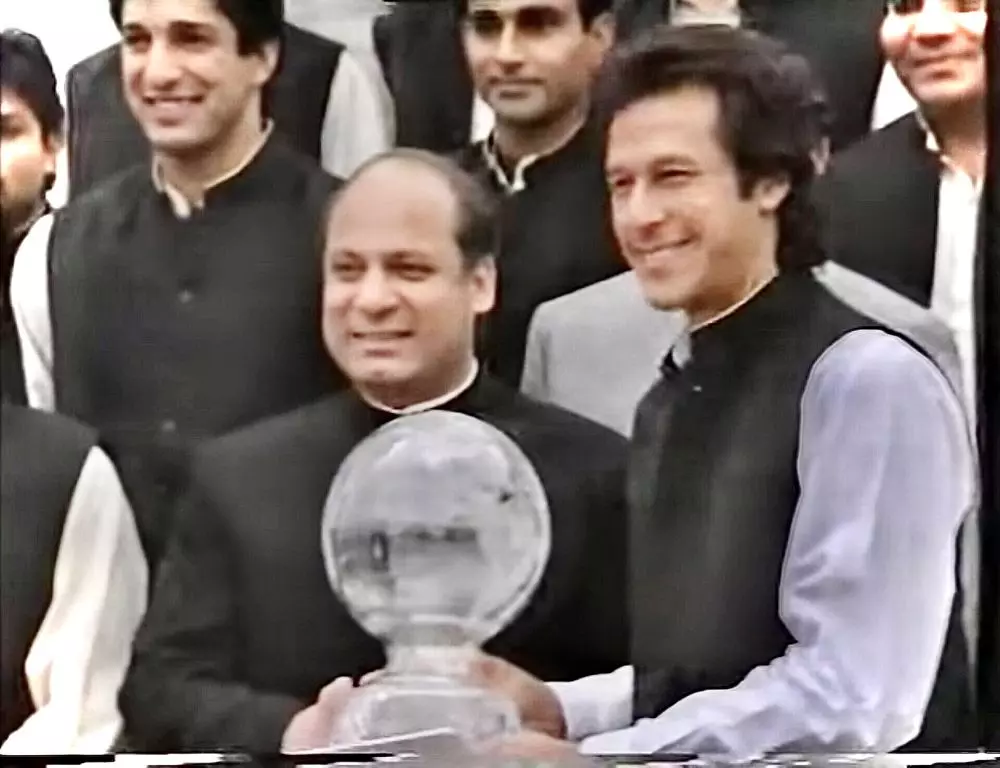
File photo of Imran Khan presenting the World Cup to then Pakistan PM Nawaz Sharif after the country's win in the tournament in 1992. Photo: Wikimedia Commons
A letter to Pakistan Prime Minister Shehbaz Sharif last week and signed by over 20 former international cricket captains — among them Australia’s Greg Chappell — raising concerns about Imran Khan’s deteriorating health, overshadowed everything else that has transpired in cricket recently.
Khan, Pakistan’s World Cup-winning captain and among the game’s great all-rounders, has been in prison for the past three years, purportedly often in solitary confinement. A national hero for his sporting exploits, he moved to politics post-retirement, built a party (Pakistan Tehrik-e-Insaf) ground up, and served as Prime Minister of Pakistan between 2018 and 2022.
In 2022, he was removed by a no-confidence vote and subsequently tried and convicted on multiple cases of graft and corruption and consigned to jail, where he still languishes. Issues related to his incarceration and health have erupted intermittently, reaching a fever pitch in the past few weeks.
Sport inculcates a strong sense of camaraderie, even amongst rivals. But it’s not often — perhaps never before — that so many players of such hefty credentials have come together to prop up a cause of a fellow player: not just in cricket, but any sport.
From all the signatories of the petition, most interest centres around the three from India: Sunil Gavaskar, Kapil Dev and Dilip Vengsarkar. Given the complex and complicated geopolitics of the sub-continent, which have consequently made cricket relations between India and Pakistan also volatile, the participation of these three former India captains in the campaign became the headline-grabber, leaving hawks and on either side of the border fulminating at the whys and wherefores of their support.
India vs Pakistan in cricket
Indo-Pak relations have never followed a linear pattern but waxed and waned according to the political climate in the sub-continent. Acrimony and conflict have often soured cricket engagement. But equally, cricket has also afforded opportunity to mend fences when all other options had come a cropper.
The initial years of cricket between India and Pakistan were onerous for players from both teams. The burden of Partition made them defensive to a fault. Given the extraordinary expectations of political masters and fans, neither side wanted to lose. India won the inaugural series in 1952 1-0, but the matches lacked tempo, colour, and flavour.
The return series played in Pakistan in 1955 saw all five Tests drawn as players and captains of both teams were even more risk-averse. This pattern was repeated in 1961-62 when Pakistan toured India again.
Then came a 17-year hiatus.
Two wars — in 1965 and 1971 — saw Indo-Pak relations nosedive and cricket between the two countries came to a standstill. It was revived in 1978 by the then Janata Party government in India.
Also read: Why for publishers, editing non-fiction is a challenge, more so in charged socio-political settings
The next couple of decades were to redefine not just Indo-Pak cricket, but cricket globally.
Till the 1970s, the Ashes, with its long history, played between England and Australia, was touted as cricket’s main show. By the turn of the century, such grandstanding began to sound hollow. Indo-Pak cricket had become cricket’s pre-eminent contest.
This was the period in which Indo-Pak cricket grew by leaps and bounds, the frequency of matches allowing creating space for mutual respect and also allowing friendships between players from either side to bloom.
To contextualise this in light of recent developments, Gavaskar, Kapil Dev and Vengsarkar pitching support for Imran Khan in the petition manifests an important phase in the evolution of Indo-Pak cricket. It’s not a knee-jerk reaction to score PR points or instant attention.
The game-changing decades
The 1980s were a heady period for sub-continent cricket. Gavaskar and Javed Miandad were part of the then elite ‘Fab Four’ among batsmen, the others being Greg Chappell and Viv Richards. Kapil Dev and Imran Khan were vying for the tag of ‘Best All-rounder’, with Ian Botham and Richard Hadlee.
Through that decade, Gavaskar, Miandad, Imran, Kapil — along with a supporting cast that boasted Vengsarkar, Zaheer Abbas, Mohinder Amarnath, Ravi Shastri, Sarfraz Nawaz, Mohsin Khan and Abdul Qadir, to name a few — were to take Indo-Pak cricket rivalry to dizzying heights. Fantastic skills and razor-sharp competitiveness allied with the star value of these players produced some scintillating moments, capturing the imagination of cricket lovers in the subcontinent and beyond.
It took a cricket-obsessed sheikh from the UAE, Abdul Rahman Bukhatir, reared in Karachi, to actualise and exploit the demand for Indo-Pak matches globally. The Cricketers Benefit Fund Scheme (CBFS) tournaments Bukhatir organised in Sharjah right through the 1980s and ‘90s till it got enveloped in notoriety and ground to a halt became a stellar fixture in the cricket calendar.
In hindsight, it is amazing that the International Cricket Council (ICC) was so late to latch on to the humungous appeal of Indo-Pak cricket, which is now the sport’s biggest blockbuster. Not till 1999 were India and Pakistan seeded to meet each other in the initial phase of a One Day International (ODI) World Cup. Prior to 1999, fearing disruptions and/or other problems, the two teams were always cast in different groups, which made it possible for them to meet in the knock-outs, but not earlier.
An Indo-Pak match today is the blue riband event of any multi-nation cricket tournament. With supernormal box-office returns guaranteed, the ICC plots its tournament itinerary in a way which makes two matches between the arch rivals eminently possible and even a third plausible.
As cricket between India and Pakistan proliferated from the late 1970s, so did friendships between the players. But this did not dim the rivalry. On the field of play, the battle was fierce, often bitter. However, cricket etiquette was seldom flouted. On the contrary, mutual admiration found regular expression.
In the 1982-83 Test series, India were routed by Pakistan 3-0, primarily by Imran Khan’s high-pace swing bowling. When Sunil Gavaskar, then India captain, was asked how India could have fared better against Imran, he quipped, “place the sightscreen between him and the batsmen’’, using humour to alleviate his disappointment, but making no excuses.
In 1987, Imran led Pakistan to their first-ever series win in India, despite Sunil Gavaskar’s epic knock of 96 in the last Test at Bengaluru (then Bangalore). Imran was overjoyed, but instead of gloating over the victory, he chose to first acknowledge Gavaskar’s virtuoso effort, which almost won the match for India. “This is the greatest innings by an opening batsman that I’ve seen,’’ he said, without qualification.
How the Boards did their bit
It's not just players who gave Indo-Pak cricket a fillip in this phase. The respective cricket boards, the Board of Control for Cricket in India (BCCI) and Pakistan Cricket Board (PCB), connived and colluded, then convinced their respective political establishments to get the ODI World Cup out of England, reshaping the power matrix of cricket forever. When it comes to cricket politics, for the most part, BCCI and PCB have been part of the same power bloc.
Socio-cultural similarities between the two countries have generally helped players and the cricket establishments in India and Pakistan to tide over political tugs and pulls. Cricket on the field has always been uncompromisingly intense, but off-the field relations — personal and professional — have been warm, accommodating, often filled with bonhomie.
For instance, the transfer of tips and expertise between players has never been unbridled by other considerations. So Virat Kohli will not refuse advice to Pakistani cricketer Babar Azam on how to cope with crises of form. Nor will former Pakistan captain Wasim Akram shy from helping Zaheer Khan iron out a technical flaw. The spontaneity, wit, to go with deep analyses and a strong regard for each other made Ravi Shastri and Wasim Akram, both extroverted characters, becoming a hit pair in the commentary box.
Also read: Why Symphony Orchestra of India's 20th anniversary is all about Western classical music's journey in
Indo-Pak cricket relations are currently at an all-time low. Bilateral contests are at a standstill. India and Pakistan haven’t played a Test since the Mumbai terror attack in 2008. An ODI and T20 series were last played in 2013.
In ICC tournaments, the two countries do play, but since the Pahalgam Terror attack in 2025 and India’s Operation Sindoor in response, India’s players don’t shake hands with their counterparts after a match. In return, Mohsin Naqvi, the Asian Cricket Conference head, who is also Pakistan Cricket Board chief honcho, in September 2025 declined to present India the Asia Cup winners Trophy in September, which remains locked in his office in the ICC’s precincts in Dubai.
Improving Indo-Pak cricket relations from this grim situation is beyond the ambit of the petition in support of Imran Khan signed by Gavaskar, Kapil Dev and Dilip Vengsarkar. But it does remind us how different things were not too long back.