How Tagores of Pathuriaghata, Kolkata, replaced ritualistic worship of Durga with cultural festival
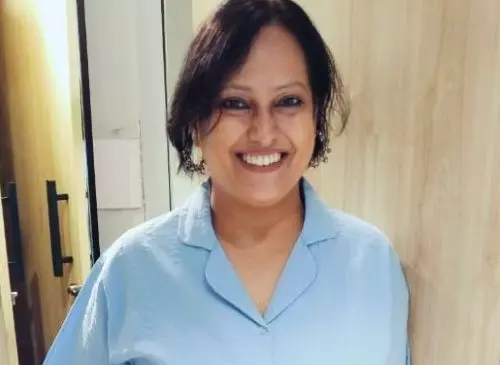
Thakurbarir Sarodotsav (The Tagore Family’s Autumnal Festival) is the brainchild of Souraja Tagore, teacher and Bharatanatyam dancer. She came up with the idea during the Covid pandemic of 2020-21. The 20206 celebration marks the fourth year of the initiative.

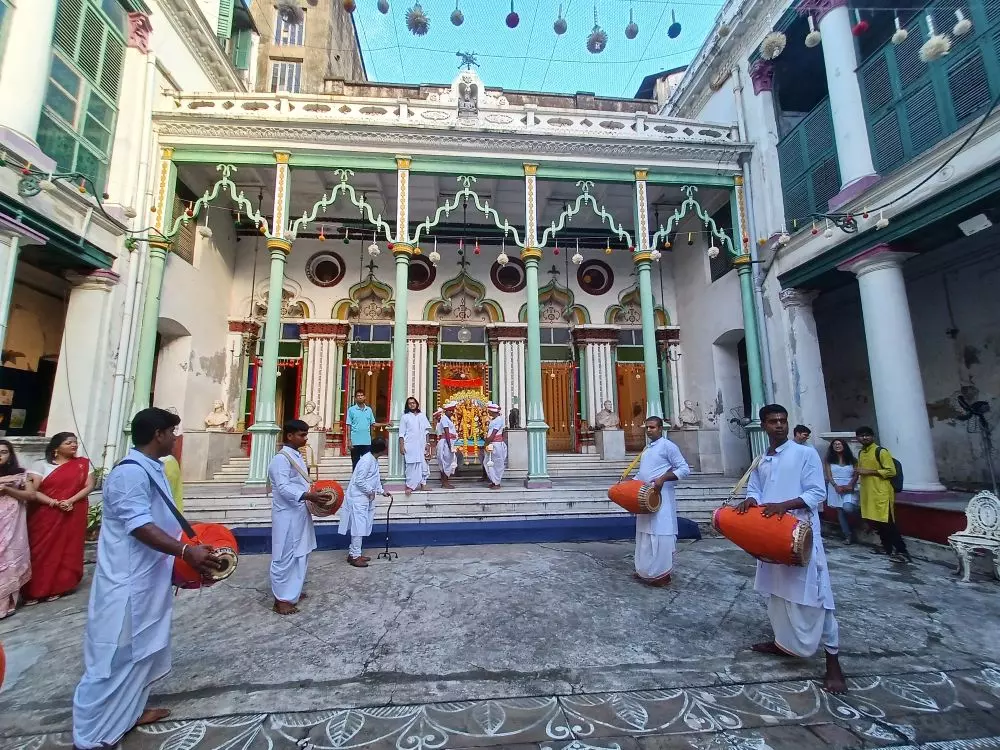
Durga Puja at Tagore Palace Pathuriaghata. Photo: By special arrangement
When Souraja Tagore’s mother Soumya got married into the illustrious Tagore family, residents of the Pathuriaghata Tagore Palace, in the 1980s, Durga Puja at the family home would be a grand affair. Despite the arts being an integral part of their lives — the Tagores of Pathuriaghata share the same family tree as the Tagores of Jorasanko (both old Kolkata neighbourhoods), of which Rabindranath Tagore was a part — Durga Puja at Pathuriaghata Palace was a traditional, ritualistic worship.
The Tagores originally identified themselves as Kushari or Rarhi Brahmins (a sub-caste of the Bengali Brahmin community that traces its origin to a village named Kush in West Bengal), though sections of the family later became Brahmo (a socio-cultural, progressive religious movement founded by Raja Ram Mohan Roy in the early nineteenth century).
“Only Brahmins were allowed to cook the bhog [offering] for the goddess Durga. Apart from women belonging to Brahmin families, others were not allowed to walk up to the mandap or participate in the rituals of the sanctum sanctorum,” recalls Soumya Tagore, now in her sixties. “Even though I immersed myself in this annual affair, I was not in complete agreement with the rigidity of rituals that we were expected to follow. My mother-in-law Maharani Suniti Tagore was actively involved in organising Durga Puja and I worked closely with her. Most people in the Tagore household followed Brahmin rituals even though [Rabindranath] Tagore himself had been committed to doing away with the system of caste distinction,” said Soumya.
That old Pathuriaghata Durga Puja tradition was put to rest following Suniti Tagore’s death sometime before the Covid pandemic of 2020-21.
Also read: Durga Puja 2026: 10 fascinating facts about Bengal’s biggest festival
“When my mother-in-law passed away, we took a conscious decision to do away with the traditional Durga Puja norms in the house. By then Souraja [her daughter, a school teacher and Bharatnatyam dancer] had become an accomplished artiste in her own right and she had several shows and dance workshops to attend during the puja vacation. Also, my husband was the only child of his parents and after my mother-in-law, the entire responsibility of organising the Puja fell on my shoulders. [It was too much work for one person]. The interference of priests and the rigid customs, too, steered us away from traditional rituals. I found it quite disturbing considering the time and age we lived,” explained Soumya.
File photo of the Tagore Palace, Pathuriaghata. Photo: By special arrangement
Souraja, director of the Tagore and Tagore Arts and Culture Foundation, recalls that while for her and the rest of the family Durga Puja would be a holiday period, a time to relax and bond with each other, for her mother, busy in organising the Puja, things would be very different. “I remember feeling very sorry for her at that time even though I could do nothing about it then. At the end of the day she would be very tired and worn out,” recalled the dancer.
It was sometime during the Covid pandemic of giving the family’s traditional Durga Puja a cultural makeover.
“There was this one night when I was very ill. I told myself that if I could somehow survive this Covid 19 pandemic, I would dedicate myself to the arts. I promised to build a platform for artistes from across the country and give them exposure into the world of art and culture through my foundation. Thakurbarir Sarodotsav (The Tagore Family’s Autumnal Festival), which is four years old now, is a step in that direction. My brother, Pramotha Mohan Tagore, a sarod player, is also actively involved in the endeavour,” said Souraja.
An offering of arts
Though the Tagores of Jorasanko are better known, in a great measure owing to Nobel Laureate Rabindranath Tagore, the Pathurighata branch made its own contribution in the field of arts and culture.
Jotindra Mohun Tagore, a member of this family, is credited with founding the Pathuriaghata Bangla Natyalaya, a public theatre located opposite this residence.
It was also in Jotindra Mohun’s court, with the collaboration of his younger brother Sourindra Mohun, that an Indian orchestra modelled on European principles was established. Jotindra Mohun’s son, Prodyot Kumar Tagore, was an intellectual, a polyglot and an ardent collector of art. He also possessed a keen interest in photography and maintained a personal studio within the Tagore palace.
Now, the Durga Puja cultural fest keeps up the family’s generations of involvement with the fine and performing arts.
Souraja Tagore with her mother, Soumya. Photo: By special arrangement
The celebration seeks to replace pushpanjali, or the floral offering made to the deity as part of worship, with shilpanjali, or an artistic offering. Artistes from all across the country are invited to perform in the almost week-long event. Mahalaya, which marks the beginning of Devi Paksha (the day before the beginning of Navratri), sees the beginning of the Anana Mela (joyful fair), with food stalls set up in the courtyard and the inauguration of the cultural festival. Performances (music, dance etc) are held daily between Saptami (the seventh day of Navratri and second day of the five-day Durga Puja) and Dashami, or Dussehra.
“We do have a Durga idol which stays in the house and is taken out for immersion once in three years. Artistes who have performed here have all felt a connection with the goddess. On Dashami, the idol is returned to the family temple,” added Souraja.
What’s on the cards
The dress code for the festival days is traditional for both men and women.
On October 10, the 2026 festival was opened by women dhakis (those who play the dhak) from Kolkata Mohila Dhaki, as they thundered their way onto the stage. The group was followed by Anukalpa Lahiri on mandolin and Sumanta Sadhukan on the tabla. Dhumketu Puppet Theatre also put up a show and there were renditions of Rabindrasangeet. The line-up from Saptami to Nabami (October 17-20) includes stotra path (chanting of hymns), sarod recitals and dance performances..
For artistes who have performed at the Pathuriaghata Tagore family’s unique Durga Puja celebration, the memory remains a fond one.
“The ambience here is such that one cannot help but feel touched. There is so much of creative energy all around the place that nothing else really matters. It is the energy of this place that brings back people every year,” said Sadhukan.
Added vocalist and Rabindrasangeet exponent Manoj Murali Nair, one of the artistes performing at Tagore Palace this year, "I come here for the stage and the lovely audience. Souraja's endeavour to promote artistes from all over the country, especially from rural areas, is a great contribution to the performing arts scene in Bengal.”
An open-to-all event, for visitors, it is a departure from usual pandal hopping.
“The most important attraction is definitely the artistes who come from rural areas,” said Rajib Roy, a chartered accountant who has been visiting the event for the past two years.
On Dashami, as Bengalis prepare to bid adieu to the goddess for another year, a cultural procession will set out from the gates of Tagore Palace to Prasanna Kumar Tagore Ghat in the city. “We set out with great pomp and show onto the streets and sing ‘Rangiye diye jao’ along with other Rabindrasangeet. Many people have told me that this song is meant to be sung during Dol Utsav [Holi]. But if we look at the essence of the lyrics, we will notice that it is asking people to stay grounded in keeping with the spirit of the divine energy,” said Souraja.
She added: “People might be immersing Durga idols in the Ganges, but we pray for her divine energy to remain with us throughout the year.”