Left confused by all the Gen Z ‘skibidi’? Check out this guide for a quick language ‘glow up’
The recent students’ protest for reforms and accountability in education has mainstreamed words so long dismissed as Gen Z lingo. For all those struggling to fit in, here’s a list of the most popular Gen Z words and how to use them in conversation. Read and ‘slay’ or remain ‘mid’.

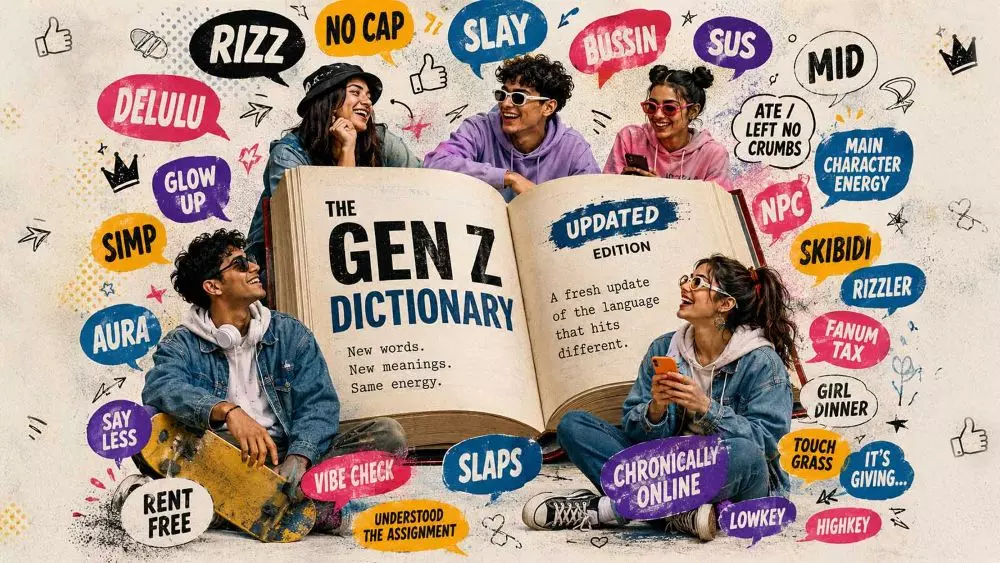
If someone tells you an outfit slaps, calls their latest crush ‘delulu’, says the new movie was mid and then bitches about their friend having main character syndrome, congratulations! You’ve just had a perfectly functional Gen Z conversation.
The past month has seen the Gen Z (those born between 1997 and 2012) lingo travel from Delhi’s Jantar Mantar — as student protestors demanding reforms and accountability in education following the NEET paper leak scandal in May — ditched the traditional dialect of dissent to take on the system with their own characteristic rizz, to the Indian parliament as MPs were heard branding each other ‘delulu’ (Gen Z for delusional).
For those wondering why the youth can’t speak plain English, 20-year-old college student Niharika (identified by first name only) explains, “It's not about being lazy with words, it's about belonging”. As she put it, Gen Z lingo "creates a sense of community among us and makes everyday conversation way cooler". She sees it as a kind of shorthand for identity; the specific way you address someone or name something instantly signals which group you belong to.
What strikes her most is how the lingo changes the emotional weight of a sentence. She says, “Take the word delusional. Say someone 'is delusional' in plain English and it looks like a diagnosis or an insult. But flip it into Gen Z phrasing, ‘he is delulu’. When it's dropped casually into conversation, it stops sounding harsh altogether. It eases out the tension; a word that used to sting now just gets a laugh.”
It may look like a collection of internet nonsense, but behind the memes and abbreviations is something linguists have seen for centuries: a generation taking the language it inherited and making it its own.
“Gen Z uses words which they have picked from varied sources such as films, series, popular TV shows, anime, etc, famous characters, incident-based words, sports, technology... It is a language domain where there is so much to know and understand,” says Ambika Padmanabhan, faculty, Department of English, Amrita University, Coimbatore. “One example is their use of the word GOAT to mean the ‘greatest of all time’. People of my generation have no idea about these terms and what they imply. We need to explore more about GenZ language and we understand there is Gen Alpha [those born between 2011 and 2024] and other such emerging terms for each generation and their respective language.”
As linguists would point out, no language has ever been static. Long before social media birthed its own brand of dialect, people were still experimenting with languages, borrowing words from other cultures, shortening expressions, giving old words new meanings and inventing new ones to describe things that did not exist before. English itself is a product of this constant mixing, shaped over centuries by Germanic languages, French, Latin, Norse and countless other influences.
What has changed for Gen Z is the environment in which this evolution takes place. Social media has turned language into something almost alive: a phrase can emerge in one corner of the internet, pick up a new meaning somewhere else and become mainstream within days. A 2025 study, ‘Language Change in the Communication of Generation Z ’, points to the influence of social media platforms such as TikTok and Discord on Gen Z communication, moving linguistic change beyond traditional spaces such as classrooms, books and newspapers.
Also read: Skinny to oversized, why India's denim wardrobe is seeing a happy coexistence of fits and styles
Yet the ingredients of that change are surprisingly old. Another study, published a year before in 2024, and titled ‘Morphological Innovations in Gen Z Language’, shows how Gen Z relies on familiar ways of forming words: blending two words, shortening existing ones, borrowing from elsewhere, creating acronyms, inventing terms and deliberately altering spelling.
The bigger revolution, according to some, is who gets to shape language and how quickly everyone else can pick it up. In the past, newspapers, publishers, broadcasters and cultural institutions acted as filters for which expressions reached a wider audience. The internet has largely removed that gatekeeping. A 2023 research on ‘The Gen Z Internet Slang and EFL Speakers’ shows how social media comment sections can become spaces where ‘slang’ spreads rapidly, allowing expressions to move from niche online communities into everyday speech.
But language does not evolve only by creating new words. Sometimes the more interesting change is what happens to old words. A word can gradually become more positive, more negative, more humorous or completely detached from its original meaning depending on how speakers use it. The 2025 research paper, ‘A Semantic Analysis of Slang Words Used by Gen Z on Social Media’, states that slang can do more than describe something; it can communicate irony, affection, criticism and humour, or come to define irreverence as in the recent Gen Z protests.
And this is perhaps the most important point about linguistic evolution: words survive because people find new uses for them. Some expressions disappear when the generation that popularised them moves on. Others escape their original communities and become ordinary language. “Cool”, “okay”, “selfie” and “meme” all travelled through different eras and technologies before becoming familiar parts of everyday speech.
Gen Z slang is simply the latest layer. The internet has made the process faster, more democratic and far more visible. What once took generations to spread can now happen between breakfast and lunch.
And if you are still struggling to keep up, here’s a quick tutorial on the latest and most popular Gen Z words, what they mean and how to use them in conversation. Go slay.
Rizz
Meaning: Charisma, especially in flirting or romantic situations.
Usage: He walked up to her with zero rizz and somehow still got her number.
No cap
Meaning: No lie; I’m being serious.
Usage: I studied for six hours straight last night, no cap.
Cap
Meaning: A lie, or the act of lying.
Usage: He said he ran a marathon last weekend. Total cap.
Slay
Meaning: To do something excellently.
Usage: You handed in that presentation and honestly, you slayed.
Bussin
Meaning: Really good, usually used for food.
Usage: This canteen sambar is bussin today. No idea what changed.
Sus
Meaning: Suspicious or questionable.
Usage: He’s been oddly quiet about the group project. Kinda sus.
Photo: iStock
Mid
Meaning: Mediocre or average.
Usage: Ngl, the new season was mid. Expected way more.
Ate / Left no crumbs
Meaning: Did something perfectly.
Usage: She answered every interview question and ate, left no crumbs.
Glow up
Meaning: A positive transformation, usually in appearance.
Usage: Bro’s glow up since first year is actually unreal.
Ghosting
Meaning: Suddenly cutting off communication with someone.
Usage: He read the text on Tuesday and just started ghosting after.
Simp
Meaning: Someone overly attentive towards a crush.
Usage: He’s such a simp. He’s carried her bag for three semesters straight.
Vibe check
Meaning: Assessing someone’s mood or energy.
Usage: New roommate just moved in. Time for a vibe check.
Main character energy
Meaning: Behaving with the confidence of the lead in your own story.
Usage: She walked into the exam hall like it was her personal movie. Full main character energy.
NPC
Meaning: Someone behaving robotically or without independent thought, borrowed from “non-player character” in gaming.
Usage: He just nods along to whatever the group says. Total NPC behaviour.
Delulu
Meaning: Delusional, usually in a light-hearted way.
Usage: I’m delulu enough to think I’ll finish this assignment by midnight.
Skibidi
Meaning: Nonsense word used ironically or for humour, popularised by the Skibidi Toilet animated web series.
Usage: He said “skibidi” in the middle of the meeting and nobody blinked.
Rizzler
Meaning: Someone with a lot of rizz.
Usage: That dawg’s an office rizzler. HR should really look into it.
Fanum tax
Meaning: Taking a bite of someone else’s food, from streamer Fanum.
Usage: I left my fries unattended for one second and paid the Fanum tax.
Girl dinner
Meaning: A small, random assortment of snacks eaten as a meal.
Usage: I need my girl dinner to get my brain to factory reset.
Photo: iStock
Touch grass
Meaning: Go outside and get off the internet for a while.
Usage: I’ve been on my phone for six hours, I need to go touch grass.
It’s giving…
Meaning: Something has the vibe or energy of something.
Usage: This outfit is giving “I woke up like this but tried”.
Lowkey
Meaning: Somewhat or secretly.
Usage: I’m lowkey nervous about talking to him.
Highkey
Meaning: Openly or definitely.
Usage: I’m highkey so mad at her.
Understood the assignment
Meaning: Did exactly what was required and did it well.
Usage: She wore the exact theme colours to the party. Understood the assignment.
Rent free
Meaning: Something you can’t stop thinking about.
Usage: That one meme from 2022 still lives rent free in my head.
Also read: Spider-Man to Gemini, how Haryanvi is having its moment in the spotlight
Say less
Meaning: I understand; no further explanation needed.
Usage: Are skinny jeans still tacky? Say less.
Slaps
Meaning: Something that is really good, especially music.
Usage: This remix genuinely slaps. Put it on repeat.
Aura
Meaning: Someone’s overall vibe or perceived presence, which can supposedly be gained or lost through actions.
Usage: He tripped in front of everyone and lost ten aura points instantly.
Chronically online
Meaning: Someone deeply immersed in internet culture, sometimes to the point of being out of touch with offline life.
Usage: Only a chronically online person would know what “skibidi” even means.
Quick recap?
Rizz? Slay. Delulu? Absolutely. That movie? Mid. Your outfit? Ate.
If you decoded that without scrolling up to check the list, you are all set for a Gen Z conversation.