'Neglect of artefacts' to fading memory, why many Gen Z ‘know little’ about young martyr Khudiram Bose
In Muzaffarpur (Bihar), where revolutionary Khudiram Bose was tried and executed by the British for his role in the 'attempt to assassinate Magistrate Douglas Kingsford', a 'discarded wooden witness box' and a bustling market are witnesses to a 'neglected' chapter of India's freedom movement.

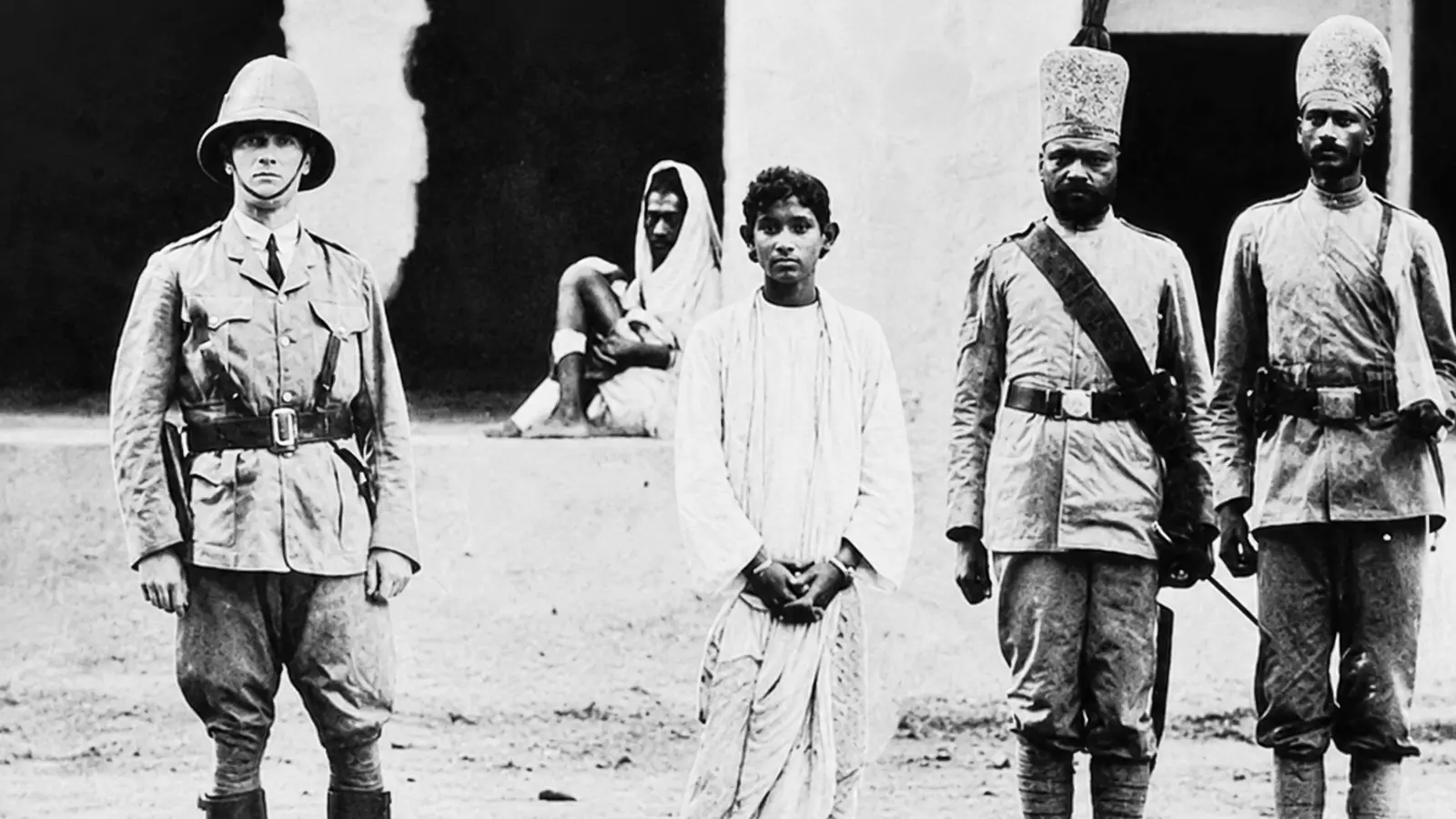
Khudiram Bose in captivity. Photo: Wikimedia Commons
One of many poignant moments in India’s struggle for Independence from British colonisation came on August 11, 1908, when an 18-year-old Khudiram Bose was hanged by the British for his role in the Muzaffarpur Conspiracy Case. According to available accounts, Bose and his accomplice Prafulla Chaki — members of the revolutionary groups Anushilan Samiti and Jugantar — believed they were bombing a carriage carrying British judge, Magistrate Douglas Kingsford. Kingsford survived, however, as he had been travelling in a separate carriage and it was two British women who lost their lives in the bombing instead.
While Chaki shot himself before he could be arrested, Bose was captured and after a trial, sentenced to death.
Where Khudiram once stood
Among the youngest of the many who were martyred in the course of India’s freedom struggle, Bose’s hanging had drawn both attention and sympathy at the time; Pitambar Das, a Bengali poet, wrote the song ‘Ek baar biday de ma ghure ashi…’ — imagining a valiant Bose seeking farewell from his beloved motherland as he is executed. The song has since passed into the country’s cultural heritage, sung as an expression of patriotism in films and shows.
Unfortunately, however, the legacy of the young rebel himself is little remembered, even less celebrated.
Earlier this week, a memorial function was held for Bose in Muzaffarpur (now in Bihar), where he had been executed. But sources in the Bihar government told The Federal that material artefacts from the time, associated with the freedom fighter, are lying in a state of neglect.
One such is a wooden witness box (kathghara) from the local court which is believed to be the one where Khudiram had stood during his trial.
Also read: How a nationalist media braved British suppression to mobilise masses, play role in India's freedom
“Owing to decades of neglect, the witness box has suffered breaks or cracks at several parts. Unless urgent measures are taken to preserve it, it may not survive at all,” said a district official speaking on condition of anonymity. Talking about the present fate of the witness box, the official claimed that it has been lying in neglect with other discarded furniture in a storeroom of the district mining department. Old official building records show that the court where Bose’s hearing had taken place stood in the same spot where the mining department has its office today.
“This witness box should be declared a national heritage; its place is in a museum, not in a dark room of the mining department,” rued SK Jha, a Muzaffarpur-based advocate and human rights activist. He further alleged: “Even Khudiram Bose’s case diary of hundreds of pages is missing. We have no information about its whereabouts.”
Khudiram Bose. Photo: Wikimedia Commons
The Federal reached Muzaffarpur district magistrate Kumar Gaurav over the alleged neglect of historical artefacts linked to Bose and was told by Gaurav that he had instructed concerned district officials to inform him in detail about the issue and that necessary steps would be taken to “preserve the wooden witness box”.
The witness box is, however, not the only thing associated with Bose in Muzaffarpur that is claimed to be suffering from official apathy.
The spot where the bombing was said to have taken place is identified as Company Bagh in Muzaffarpur town. While an adjacent area, close to the present-day civil court, bears a plaque in Bose’s memory, with the line, “Bharat Ke Sabse Kam Umar ke Krantikari Amar Sahid Khudiram Bose Ka Smarak Sthal” (a memorial to India’s youngest revolutionary Khudiram Bose), the bombing spot is now a market selling meat and chicken.
Lamenting the widespread ‘neglect’, Pankaj Kumar Roy, a professor of history at the Babasaheb Bhimrao Ambedkar Bihar University, Muzaffarpur, regretted that the younger generation “was not being aware of a revolutionary like Khudiram Bose and his contribution in the freedom movement”. He added: "The government should set up a permanent gallery for exhibiting the life of Khudiram Bose and preserve things related to him, including the decaying wooden witness box. Youths and students would get an opportunity to know him and connect to him.”
Khudiram as a Gen Z
Interestingly, Bose, just 18 when he was martyred, would have been a member of the country's Gen Z if he had been born in the present. The generation (roughly those born between 1997 and 2012, and aged between 14 and 29 years today) has consistently been in the news, first for the widespread students’ agitation last month for accountability and reforms in education and now, for the ongoing protests in Jharkhand against job recruitment examinations.
Born decades after the country’s independence from British colonialism, their lived reality is nothing like Bose’s; what does bind them, possibly, however, is the spirit of standing up for what they believe to be right.
At the students’ protest at Jantar Mantar last month, however, while many carried photographs of revolutionary freedom fighter and martyr Bhagat Singh and the father of the Indian Constitution, BR Ambedkar, those among the Gen Z that The Federal spoke to recently showed little knowledge about Bose.
A stamp of Khudiram Bose. Photo: Wikimedia Commons
While 20-year-old student Aariz Haque confessed not having heard of Khudiram Bose at all, adding that he knew about “Bhagat Singh, Chandra Shekhar Azad and Ashfaqullah Khan”, Kiran Kumari, who had been part of last month’s student protests, said she had read about him in school. “He was the youngest revolutionary hanged by the British,” she recalled.
Her fellow Gen Z, 21-year-old Sushant Kumar, who had also participated in the students’ protests in Patna (in support of the Jantar Mantar agitation in Delhi), admitted that he knew more about Bhagat Singh than Khudiram Bose. “Singh is better known. In school, teachers, too, focus more on him. We got to know about Bose only because of his link to Muzaffarpur,” he said, but added: “The blood in our veins is not different from that of Khudiram and Bhagat Singh. We consider them our ideal and are inspired by them. The only difference is that they revolted against the British to free India and we [students] have raised voices against [purported] irregularities and corruption in the education system.”
Also read: How RSS, its ally Hindu Mahasabha, opposed Quit India Movement, tricolour national flag
It is said Bose, born in a Bengali family in Medinipur (then part of Bengali presidency, now in West Bengal), smiled when he heard the death sentence passed against him by the judge in the Muzaffarpur Conspiracy Case. Newspapers of the time reported that on the day of his execution he walked to his death erect, “smiling and cheerful”. If transported by a time machine to the present, the Gen Z lingo of ‘delulu’ and ‘kuchu puchu’, which made the language of dissent at Delhi’s Jantar Mantar, may be as lost on him, at least initially, as it was on our current authorities. But it perhaps would not be wrong to imagine that he would exhibit the same spirit of irreverence that the Gen Z did, when allegedly faced with not just batons, but tear gas and pellet guns.