How nonagenarian Manik Varadkar survived Partition, went to prison for Marathi-speaking state
Born in Quetta (Balochistan) in 1931, in a prosperous Konkani Maharashtrian family, she saw her home burn in the riots surrounding Partition, survived a fraught journey across the border and days in refugee camps, before eventually settling in Mumbai and participating in Samyukta Maharashtra agitation of the ‘50s, for a separate Marathi-speaking state.

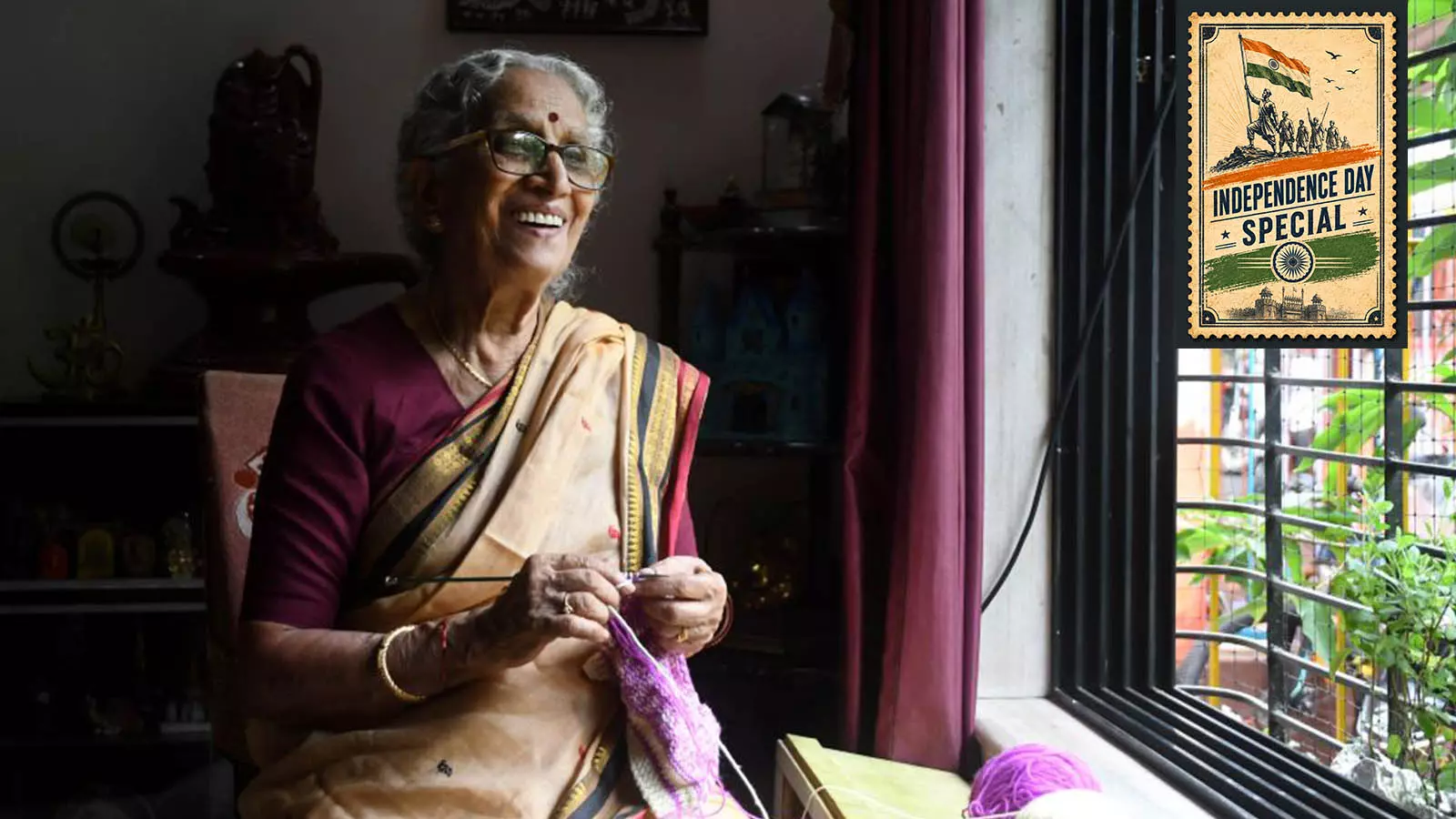
Manik Varadkar, 94, at home in Mumbai. Photo: By special arrangement
Every year, as India unfurls its tricolour on 15 August, another anniversary flickers beneath the official one: the memory of Partition, the aftershocks of which continue to travel through family histories like buried fault lines.
In her Borivali (Mumbai) home, Manik Varadkar, now 94, sits by the window knitting a sweater for her two-and-a-half-year-old great-granddaughter, Mukta. Nothing in her composed face hints at the astonishing geography of loss she has crossed — Quetta (Balochistan) before the deadly 1935 earthquake, Quetta after the earthquake, the inferno of the 1947 Partition of India, refugee trains, prison camps, prison cells during the Samyukta Maharashtra agitation (1956-1960, for a separate Marathi-speaking state), and finally the slow dismantling of prejudices she says she had carried for decades.
“I don’t see my life as extraordinary in any way whatsoever,” she says, without a trace of drama. “Destiny simply gave me the fortitude to deal with the ups and downs.”
Life before and after the earthquake
She was born Manik Khanolkar on 4 September 1931, into one of Quetta’s most prosperous Konkani Maharashtrian families. The Khanolkar mansion was less a house than a small, self-contained world: more than 30 relatives under one roof, two motor cars, a horse buggy, four horses in the rear stable, and a constant hum of help, visitors, patients and children, she recalls.
Presiding over much of this bustle was Gopal Singh, an elderly Malvani-speaking Garhwali retainer whose loyalty to the family had already become the stuff of domestic legend.
“There was always movement — someone arriving, someone leaving, horses being fed, utensils clattering, children running through the corridors,” Manik recalls, her eyes briefly brightening at the memory. “Yet despite the prosperity, the household retained a certain Konkani simplicity. Waste was frowned upon. That frugal lifestyle was how the family wealth had grown.”
Also read: How RSS, its ally Hindu Mahasabha, opposed Quit India Movement, tricolour national flag
The idyll ended in the small hours of May 31, 1935.
At 2.33 am, Quetta — the Raj’s celebrated ‘Little London’ — was struck by an earthquake of 7.7 magnitude. The city collapsed with terrifying suddenness. According to reports, more than 30,000 people were killed.
Among them were 13 members of the Khanolkar household: Manik’s parents, siblings, cousins, aunts and uncles, along with several household staff.
She survived by accident. On that particular night, the four-year-old was sleeping on the terrace with other children, beneath the open sky.
“Sometimes I wonder whether God kept me alive only so that I’d remember them. I was too young to understand death, but I remember crying for my mother. And I distinctly remember Gopal Singh’s voice, trying to comfort me while everything around us was rubble. That voice has never left me.”
Her surviving paternal uncles — Vishwanath, Vishwamber and Vinod — rebuilt part of the shattered mansion and insisted that the children remain in Quetta. The decision was practical as much as emotional: their medical practices were flourishing again, the girls were settled in school and uprooting them seemed an unnecessary second trauma.
So life resumed, though never quite in the same key.
And then Partition…
By the early 1940s, the tremors shaking the subcontinent were political rather than geological. The Quit India movement had erupted; Nehru, Gandhi and Jinnah dominated newspaper headlines. Yet Quetta, perched on the north-western frontier, still felt oddly distant from the fever gathering in Delhi, Lahore and Karachi.
“We were aware of the freedom movement, but it seemed to belong to another landscape,” says Manik. “I remember once seeing Frontier Gandhi [Khan Abdul Ghaffar Khan], in a procession, but politics had not yet entered our daily lives.”
But when the summer of 1947 descended on Quetta, the city seemed to simmer with two kinds of heat. There were the familiar furnace winds that swept through Balochistan, carrying dust and the smell of baked earth. And there was a newer, more ominous heat: the rising temperature of communal hatred.
“It felt as though the hot winds and the violence were competing with each other,” the nonagenarian recalls.
Hindu families began leaving in increasing numbers. Shop shutters stayed down longer. Conversations stopped when certain neighbours approached. At school, the atmosphere curdled into something recognisable only in retrospect, she says.
“Some girls in school joked that Yashomati [her cousin] and I would soon become their bhabhis [sister-in-laws],” Manik remembers, shaking her head faintly. “Though I was only 16, one understands mockery before one understands politics.”
The original family home in Quetta. Photo: By special arrangement
Not everyone turned hostile. Their immediate neighbours, the Sayyeds, a family with roots in Karachi who sold prayer caps, remained steadfastly protective. The children had grown up crossing each other’s thresholds; festivals, illnesses and everyday domestic concerns had long blurred the neat boundaries that politicians and bureaucrats were now drawing across maps.
By September 1947, however, the atmosphere had become too dangerous to ignore. Most of the women and younger children were sent to the Varadkars’s ancestral home in Vengurla on the Maharashtra coast. Manik, her cousin Yashomati and their three uncles stayed behind, reluctant to interrupt the girls’ academic year and still clinging to the hope that the unrest was temporary — a passing political storm — after which ordinary life would reassemble itself.
That hope lasted barely a month.
One evening in October, Manik remembers, the Sayyeds arrived in visible distress. Mobs from Peshawar were moving through Quetta, identifying Hindu homes and attacking them.
The uncles initially refused to leave their house. The Sayyeds argued with unusual urgency, reminding them that two teenage girls were now at the centre of the danger. At last, the Khanolkars slipped across to the neighbouring house and were hidden in the zenanakhana (the women’s quarters) where male outsiders were forbidden to enter.
From behind those walls, they heard their own world being dismantled.
First came the shouting, then the crash of furniture, then the unmistakable sounds of trunks being broken open and jewellery being seized. Finally came the smell of smoke. The mansion that had already survived one apocalypse was set ablaze.
“There were my grandmother’s gold-zari Paithanis, the most exquisite saris I’ve ever seen,” Varadkar says. “But by then the saris no longer mattered. We were waiting to hear whether the mob had discovered us.”
The attackers eventually came to the Sayyed house, demanding to know where the Khanolkars were hiding. The Sayyeds swore on the Quran that no Hindu family was sheltering there. It was a lie that could have cost them their own lives.
At dawn, when the mob had dispersed, the Khanolkars emerged to find the house they had painstakingly rebuilt after the 1935 earthquake reduced once again to a blackened shell. Even the uncles, men who had endured bereavement, professional ruin and years of reconstruction, broke down at the sight.
Fleeing Quetta
By evening they had decided to flee to a refugee camp before darkness made escape impossible.
They packed what little they could into two tin trunks. Just as they were finishing, Habiba Sayyed, Manik’s close friend back then, arrived carrying two new saris that Manik had lent her a few weeks earlier for a family occasion.
“She said she was afraid to keep them because they would be a giveaway that the Sayyeds had given us refuge and feared they might be targeted,” Manik recalls.
The saris were tossed carelessly on top of the already overflowing trunk.
In the strange arithmetic of survival, those two pieces of cloth — returned in friendship, packed in haste, almost forgotten in the panic of departure — would soon become the difference between suspicion and safety, perhaps even between life and death.
The journey to the refugee camp began in a tonga that seemed to carry not luggage but fear itself. Nobody spoke. The girls wore Baloch salwar kameezes, their heads covered in the local style; the uncles had dressed with equal care, anxious not to draw attention.
Another Hindu family from the neighbourhood followed in a second tonga. The father, whom Varadkar remembers simply as Rane Kaka, who sold ice cream, had refused to abandon his customary draped dhoti.
At the camp they learned that the entire Rane family had been killed on the way. “We had known them for years,” she says. “That was the moment when the reality of what was happening around became impossible to deny.”
Also read: 79 years after Independence, what a ‘free’ India looks like to Gen Z
Ordinarily, the route from Quetta to Maharashtra was straightforward: 24 hours by train to Karachi, three days by boat to Bombay, then another coastal steamer to Vengurla. In the chaos of Partition, those routes had collapsed. The Khanolkars were put aboard a special refugee train heading towards India.
The train moved through a landscape that seemed suspended between war and exodus. At stations, crowds surged towards the carriages shouting abuse. Stones and bottles crashed against the metal sides. Army sepoys on horseback repeatedly cleared mobs from the tracks. A journey that should have taken 24 hours stretched beyond 42 hours without even covering half the expected distance.
What unsettled the family most, however, was not the hostility outside but the growing unease inside the train.
Passengers stared persistently at Manik and Yashomati. Their Baloch clothes, uncovered foreheads and lack of bangles or bindis made them appear, to many exhausted refugees, indistinguishable from local Muslim girls.
A Congress worker finally approached one of the uncles and asked in a lowered voice whether the girls were Pakistanis being trafficked into India.
“He told my uncle that people were becoming suspicious,” Manik recalls. “Everyone on that train had lost something. They were frightened, angry, uprooted. Fear makes people imagine enemies everywhere.”
The family had nothing with which to transform the girls’ appearance.
Then a young Manik remembered the saris Habiba had returned.
The cousins draped them awkwardly over their salwars, pulled the pallus across their heads, and began chanting Sanskrit stotras aloud in trembling voices. “We were trying to reassure ourselves as much as the others,” she says. “But gradually the staring stopped. People began to relax. Those two saris saved us twice, once through Habiba’s courage and again on that train.”
After Marwar Junction (present-day Rajasthan), the family was moved through refugee camps in Bharatpur and Gwalior. The conditions were harsh and returning immediately to coastal Maharashtra was considered unsafe.
Life in the new India
One uncle heard that the remote Bundelkhand town of Kulpahar had no doctors and moved there to establish a practice. The practice flourished; Manik did not.
“I had lost my school halfway through Class VIII. There were no good schools there, no girls of my age with similar ambitions. After Quetta, Kulpahar felt like the end of the world.”
By late 1948, communication with relatives in Maharashtra had finally been restored. The family learned that Manik’s eldest brother, Madhusudan Khanolkar, a magistrate, had survived Quetta and had been evacuated by special aircraft. Believing his family dead, he had accepted a posting as commandant of the vast refugee settlement outside Kalyan – today’s Ulhasnagar.
Maniks Major General Vikram Khanolkar, with his wife, Eva Yvonne Maday de Maros, later known as Savitri, who is known for being associated with the designing of the Param Vir Chakra. Photo: By special arrangement
Manik began writing him a steady stream of plaintive letters, describing her loneliness and frustration. Eventually he arrived in person to take her away from Bundelkhand.
After several months in Kalyan, she was sent to Delhi to live with her uncle Major General Vikram Khanolkar, then a senior army officer. His own life read like an improbable footnote to imperial history: while serving with the Allied forces in France during World War II, he had fallen in love with a Swiss aristocratic woman, Eva Yvonne Maday de Maros. She defied her family, came to India, learned Sanskrit, adopted the name Savitri and later became associated with the design of India's highest military honour, the Param Vir Chakra.
For a brief period, Delhi offered Manik a glimpse of stability and a wider world than the one that had been shattered in Quetta.
Then tragedy struck yet again.
The general, transferred to Kolkata, died suddenly of a massive heart attack. His widow was willing to keep Manik with the family, but she was already struggling to raise three children on her own. Relatives in Bombay intervened and soon afterwards Manik was married to Manohar Varadkar, who came from a family deeply involved in the freedom struggle.
For a Marathi-speaking state
If her childhood had been shaped by the upheavals of empire, her adulthood became entangled with the unfinished arguments of the new republic.
Living in Mumbai’s western suburb of Goregaon, she grew close to socialist leaders like Mrinal Gore, Pramila Dandavate, Kamal Desai and Ahilyabai Rangnekar and threw herself into the Samyukta Maharashtra movement.
At one point she spent more than a fortnight in Yerwada prison while her eldest son, Shekhar, was barely 18 months old.
“Perhaps I’d inherited some fighting spirit,” she says with a smile. “Or perhaps after surviving what I had, prison did not seem particularly frightening.”
The battles that followed were quieter but no less demanding.
When Shekhar was struck by a severe viral infection after his Class X examinations and lost the ability to walk for more than a year, Manik abandoned everything else to care for him until he recovered. Decades later, when her youngest daughter, the celebrated Odissi dancer Shubhada Varadkar, was diagnosed with cancer at the age of 40, Manik offered not sympathy but a challenge. “I told her: ‘You are Manik’s daughter. You have to fight.’”
No wonder Shubhada took to the stage to dance after every chemotherapy session.
A young Manik, with her freedom fighter husband, Manohar Varadkar. Photo: By special arrangement
Only towards the end of our conversation does Manik speak about the wound that proved hardest to heal. “I had buried my anger and bitterness very deep,” she says slowly. “Because I dislike conflict, it emerged not as hatred but as avoidance. I avoided Muslims whenever I could.”
The confession hangs in the room for a moment. Then she tells me about Rubeena Sayyed, the full-time caregiver the family hired for her about a decade ago.
Though the surname startled her at first, living with Rubeena day after day forced her to confront a truth she had resisted for nearly 70 years. The memories of Habiba and the Sayyed family returned with increasing insistence: the hidden room, the lie sworn on the Quran, the returned saris, the risk they had taken for their Hindu neighbours. “I realised I’d been unfair,” she says. “Yes, there were mobs that wanted to kill us. But there were also people who risked their own lives to save ours. Habiba’s family could have given us up. Instead, they protected us. There are good and bad people everywhere. Religion does not guarantee either.”
Outside her window, contemporary India continues its noisy arguments about religion, nationalism and belonging. Inside, the 94-year-old survivor of Quetta, Partition and several private catastrophes has arrived at a conclusion far simpler: “Human beings can’t be sorted as neatly as mobs would like them to be.”