



The rise of ‘cli-fi’: How climate change is reshaping Indian fiction
As climate disasters become daily reality, Indian writers are turning to cli-fi, using fiction to imagine futures shaped by heat, floods and ecological upheaval

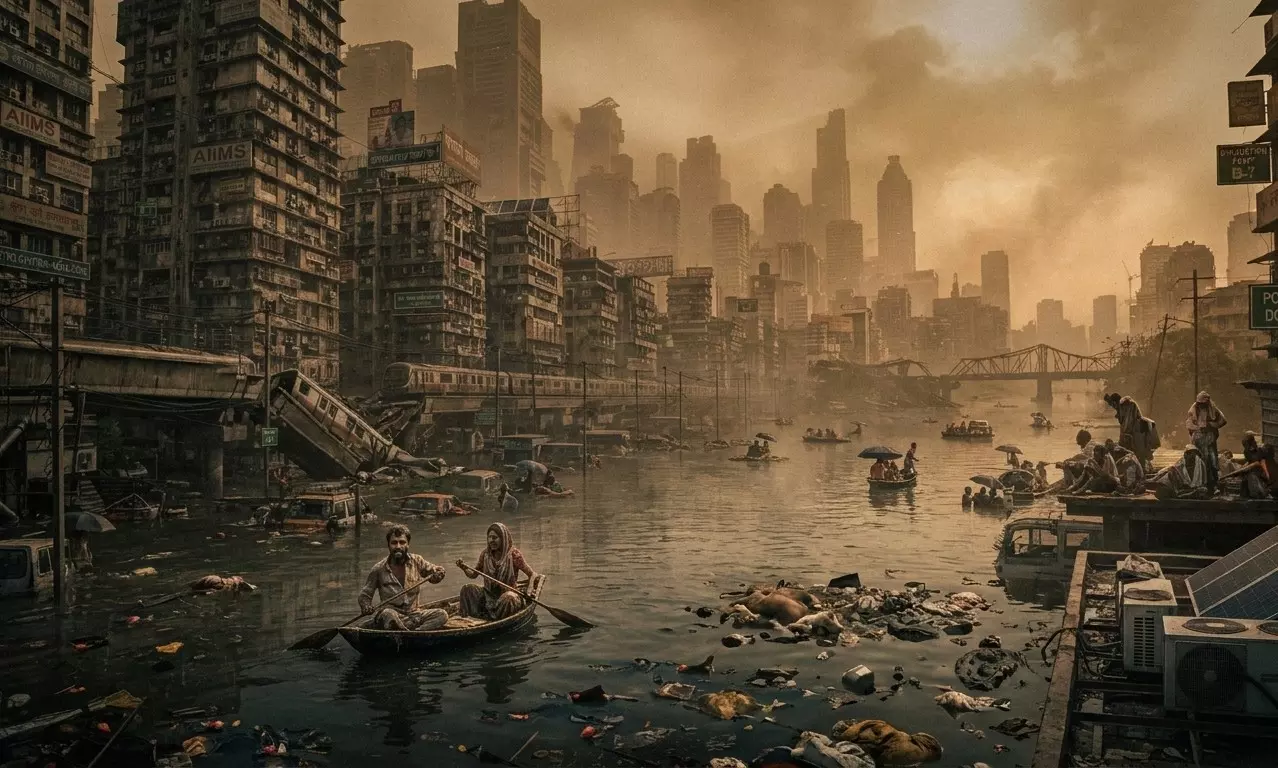
For billions around the world, climate change is a lived reality: soaring temperatures, rampant wildfires, and erratic monsoons. As events like the Nepal floods and a developing super El Niño show the crisis worsening, fiction is rapidly catching up with reality.
Climate fiction — or cli-fi — has emerged as a major subgenre of speculative fiction, including in India. Megha Majumdar’s A Guardian and a Thief (2025) is a chilling tale set in near-future Kolkata ravaged by heat, flooding, and food shortages, following a family with ‘climate visas’ trying to escape. Sheela Tomy’s Malayalam novel Valli (English translation 2022) shows indigenous communities grappling with ecological destruction in Wayanad. Rajat Chaudhuri’s Spellcasters (2023), set in smog-ridden Aukatabad, views the crisis through a psychological thriller lens.
Fiction meets reality
“I was finding it increasingly more difficult to write neat entertaining stories while the world around us was falling apart because of overlapping and intertwined crises,” says Chaudhuri, who is also a climate activist. Out of his dozen or so books, including edited works and translations, about half are climate fiction and sub-genres like solarpunk (a sub-genre depicting positive futures driven by clean energy).
Chaudhuri soon realised street activism alone was not enough; he needed to "engage with the sphere of imagination" of his readers. His debut climate novel, The Butterfly Effect, explored the systemic links between technology, politics, and environmental disaster. In Wonder Tales for a Warming Planet (2025), he brings these stakes to young audiences through stories of renewable energy quests and friendly ghosts battling predatory land developers.
The Climate Crossroads by Rajat Chaudhuri
Yet, mainstream recognition remains an uphill battle. "A section of mainstream media and the literary 'ecosystem' often tend to pretend our books are invisible," Chaudhuri notes. His latest work, The Climate Crossroads: Literature’s Encounter with a Planet on Fire (2026), directly addresses this gap, exploring how climate stories can retain rich literary aesthetics without flattening into dry science or political pamphlets. Chaudhuri is currently compiling a new solarpunk story collection and has co-authored a narrative non-fiction book for the Club of Rome on hope and educational paradigm shifts during planetary upheavals, launching internationally in January 2027.
How Indian cli-fi took root
Author, editor, and scholar Tarun K Saint attributes the rise of Indian cli-fi to “the increasing awareness of the climate crisis in the Indian author community.” He notes that Kim Stanley Robinson setting part of The Ministry for the Future (2020) in India — where protagonists encounter a deadly heatwave — “may have provided further stimulus for creative engagement with the climate crisis here”. Anthologies like Alina Gufran’s Earthbound: Climate Stories from South Asia and Ecoceanic (which he co-edited) “provided a platform for writers to articulate their concerns in imaginative form, besides earlier novels like Rajat Chaudhuri's The Butterfly Effect and stories by Vandana Singh.”
Saint’s interest in climate fiction was piqued while editing the two volumes of The Gollancz Book of South Asian Science Fiction. “The immediate trigger [for Ecoceanic] was the experience of being stung by jellyfish in Goa, which, as Amitav Ghosh has pointed out, are increasingly coming closer to the shore due to the warming of ocean water,” he explains. Saint cites Amitav Ghosh, Vandana Singh, Rimi Chatterjee, Gigi Ganguly, Janice Pariat, Easterine Kire, and Rajat Chaudhuri as key cli-fi figures in India today who “[have] contributed in important ways to the corpus of and debate about climate fiction in recent years.”
The new normal in fiction
Science fiction writer Samit Basu — whose novel, The Pictures of Darpan Ray, comes out in November 2026 via HarperCollins — notes that science fiction was factoring climate into storytelling long before cli-fi became a trend, citing Lavanya Lakshminarayan’s Analog/Virtual (2020), Vandana Singh’s Ambiguity Machines and Other Stories (2018), and Prayaag Akbar’s Leila (2017).
Savi and The Memory Keeper by Bijal Vachharajani
“Climate change (like AI, and late-stage capitalism) has become pretty much a requirement for contemporary or future-set fiction,” he says. “I've certainly used a lot of climate research in my last two books, The City Inside/Chosen Spirits (set in Delhi a decade in the future) and The Jinn-Bot of Shantiport (set in a far-future city heavily inspired by Kolkata). In both of these, rapid and extensive climate change features heavily in not just everyday life — food, clothes, objects, architecture, urban adaptation — but also overall world conditions — political, social, economic, technological.”
Publishers bet on the genre
Indian publishers are bullish on climate fiction, though they view it as an emerging category. Riti Jagoorie, MD of Hachette India, says, “We have been publishing books in this space, but most of them have been non-fiction. We do, however, have some very strong climate fiction titles on our list.”
The Pralaya Prophecy by Mridula Ramesh, was published earlier this year. The Tiger’s Share by Keshava Guha — published last year — was shortlisted for the Climate Fiction Prize 2026. Bijal Vachharajani won the Best Children’s Author award at The AutHer Awards 2023 for Savi and the Memory Keeper.
“The genre is still budding, we do not primarily market these books as ‘climate fiction’ the way we might market a ‘sci-fi’ title. The story and its primary genre remain the focus when we pitch the book. For instance, The Pralaya Prophecy was marketed as a thriller with the climate angle giving it a distinctive identity.”
Saint, currently editing a HarperCollins (2027) volume on forests and forest dwellers under climate change, believes the genre can drive positive change: “Climate stories can serve as cautionary tales, alerting us to both present and future threats to come.”