Why Jyotiba Phule’s 171-year-old Marathi play, Trutiya Ratna, continues to hold a mirror to society
According to Rohini Mokashi-Punekar, who has translated the play into English, Phule uses the ‘third eye’ as a metaphor for education, which "enables the oppressed to see through structures of exploitation that have been naturalised by religion and custom". At a dramatised reading of the English translation recently, director Sharmistha Saha says she found the audience surprised and bewildered by the sheer boldness of Phule's writing.

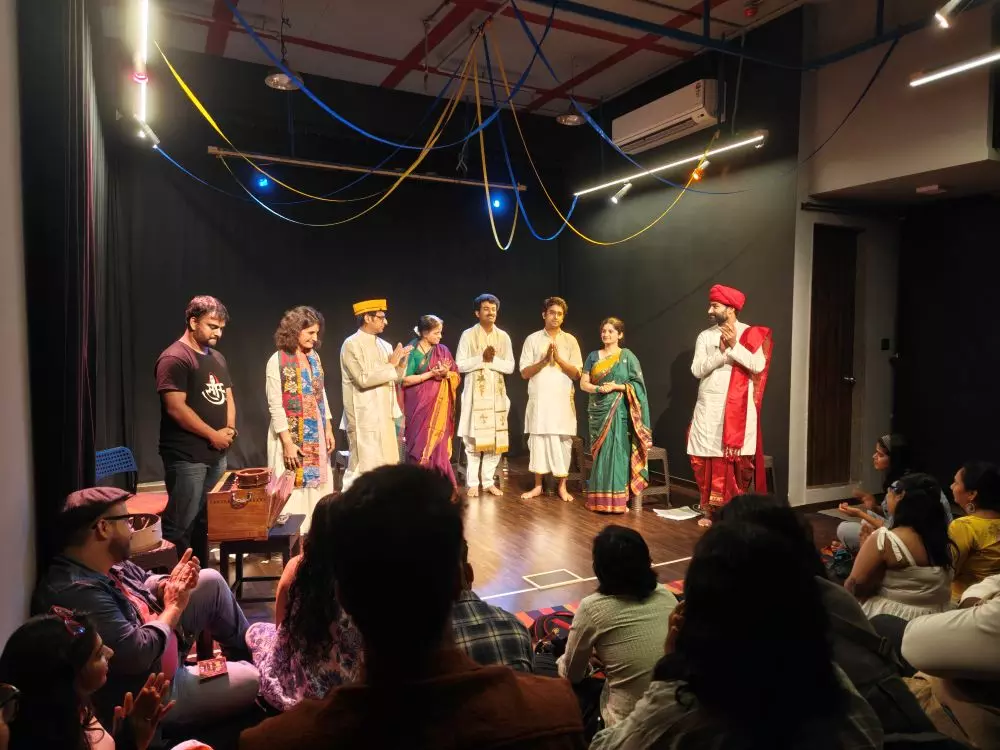
The recently held dramatised reading of the English translation of Trutiya Ratna in Mumbai. Photo: By special arrangement
At Studio Tamasha in Mumbai last month, the audience had gathered for what might have appeared, at first glance, to be an act of literary archaeology: a dramatic reading of Trutiya Ratna (TR, The Third Jewel), the 1855 play written by Jyotirao Phule (or Jyotiba, as he is also known) and recently translated into English by scholar Rohini Mokashi-Punekar.
But as the reading unfolded under the direction of theatre practitioner Sharmistha Saha, it became increasingly difficult to treat the text as a relic from colonial India. The questions crackling through the room sounded startlingly contemporary: Who controls knowledge? Who is excluded from it? What happens when education teaches the oppressed not merely to read, but to question?
Over 170 years after Phule wrote the play, India is once again consumed by debates over curriculum, language and access to higher education. TR turns out not to be a forgotten curiosity from the 1850s, but a prism through which contemporary India can examine its unresolved struggles over caste, religion, and education.
Hidden in plain sight
The first surprise about TR its obscurity. This 1855 Marathi play is arguably among the earliest modern plays published in any Indian language. Yet it remained largely inaccessible to non-Marathi readers for more than a century and a half.
For Mokashi-Punekar, the delayed translation raises uncomfortable questions about “India’s literary memory”.
“Phule is widely celebrated as a social reformer, educator, and anti-caste thinker, but far fewer readers encounter him as a dramatist.” She sees the translation as “both a literary recovery and a political intervention: an attempt to restore a foundational anti-caste text to conversations from which it has long been excluded”.
According to her, the challenge was not simply linguistic. “Translating Phule meant carrying across his satire, the caste-coded rhythms of everyday speech and the sharpness of his political argument without domesticating its force.” What emerged from the process, she notes, was “a deeper appreciation of Phule’s central metaphor: education as a ‘third eye’ that enables the oppressed to see through structures of exploitation that have been naturalised by religion and custom.”
Also read: How songs of resistance have bound protestors at Jantar Mantar with generations of past dissenters
That metaphor, she believes, is precisely what gives the play its contemporary urgency. “Yes, of course,” she says when asked whether she sees echoes of Phule’s concerns in today’s debates around curriculum, access to education and social exclusion. “This is the reason I translated the play, which I’ve dedicated to all my students on the wrong side of divides: modern and endemic.”
She points out that the concluding essay in her translation traces “the trajectory of secular modern education in this country from the early nineteenth century,” comparing educational initiatives in the Bengal and Bombay Presidencies before focusing on the interventions made by Jyotiba and his wife, Savitribai Phule, also an educator, reformer and poet. The play, in Mokashi-Punekar’s reading, cannot be separated from that larger history of educational exclusion and resistance.
1855’s radicalism
To understand why the play still feels explosive, sociocultural historian Mukund Kule argues, one must return to the world in which it was written. “Phule and Savitribai Phule had only recently begun their pioneering schools for girls and for children from oppressed castes in Pune. Most social reform discourse in western India [at the time] was still focused on upper-caste concerns such as widow remarriage or the reform of domestic customs.”
He underlines how Phule went much further and describes TR as making a structural argument: caste hierarchy is sustained through the control of knowledge, and that control is exercised through priestly authority. “The Brahmin priest in the play is not merely an individual hypocrite; he represents an institutional order that keeps ‘Shudras’ economically vulnerable, intellectually dependent, and spiritually intimidated. The denial of education is therefore shown not as a social deficiency, but as a deliberate political technology of domination.”
This triangulation of caste power, religious authority, and educational exclusion, Kule points out, was extraordinarily radical for the 1850s. “Where many reformers sought to purify religion while leaving hierarchy intact, Phule suggested that the monopoly over sacred knowledge itself was implicated in oppression.”
Jyotirao Phule. Photo: Wikimedia Commons
That insight gives the play a startling modernity.
The title, TR, is often translated as The Third Eye, but Kule cautions against reading it as a mystical metaphor. “For Phule, the third eye signifies critical consciousness acquired through education.”
The oppressed characters gradually realise that ignorance is not their natural condition; it is the product of a social order designed to keep them subordinate. In this sense, Kule sees the play as containing the conceptual seeds of the anti-caste educational politics that would later be developed by Savitribai Phule and, in a more systematic constitutional form, by Dr BR Ambedkar.
Ambedkar’s famous call to “Educate, Agitate, Organise” echoes the same foundational insight: education is the first condition of liberation because it enables the oppressed to challenge the ideological basis of caste rule. No wonder when read today, TR feels less like a precursor and more like an early manifesto of emancipatory pedagogy.
Dramatist behind the reformer
Many readers encounter Phule primarily through polemical works such as Gulamgiri (Slavery) or Shetkaryacha Asud (The Farmer’s Whip). Mokashi-Punekar argues that the dramatic form of TR reveals a different dimension of his genius.
“In the long essay introducing the translation,” she says, “I argue that Phule’s enormous talent as a literary innovator has not received the recognition it deserves. The play is unique and should be celebrated for the innovation of its form.”
She further observes: “At a time when Indian, especially Marathi theatre, was dominated by the immensely popular sangeet natak (musicals) tradition, he produced a drama driven not by spectacle or music, but by argument, social critique, and the clash of ideas.”
That assessment reframes TR not merely as an important anti-caste document, but as a pioneering experiment in modern Indian dramaturgy.
Theatre of ‘protected ignorance’
For director Sharmistha Saha, the shock was discovering “how thoroughly the play had been excluded from mainstream theatre history”.
She invokes scholar YS Aloney’s phrase “protected ignorance” to describe this erasure: “The unwillingness of privileged castes to acknowledge the intellectual contributions of oppressed communities”.
That absence is itself part of the story the play tells.
Saha’s staging choices highlighted another dimension of Phule’s radicalism: his reworking of theatrical convention.
“The play is highly polemical, yet it is also deeply aware of performance traditions,” she says. “The Vidushak, or clown, is traditionally an upper-caste male figure who reveals hidden truths through humour. Phule subverts this convention by turning the Vidushak into the inner voice of the oppressed Kunbi family.”
Saha extended the subversion further by casting the role as a female voice and drawing on the trope of ‘atihasya’ (exaggerated humour), historically associated with lower-caste performance traditions.
“I wasn’t merely aiming at a contemporary adaptation, but a deliberate inversion of caste privilege embedded within theatrical form itself,” she explains. “Humour, in this reading, becomes a weapon of epistemic rebellion (the act of rejecting who gets to decide what is true, claiming your own lived experience as a valid source of facts, and breaking free from old rules that count certain people as invisible or ignorant).”
Also read: Why contemporary Hindi cinema seems to have little new to say about Partition
During the performance, Saha says she found herself repeatedly watching the audience rather than the actors. What she saw was surprise and bewilderment at the sheer boldness of Phule’s writing, she recalls.
“The most striking aspect for me was not the play’s advocacy of education; I was already familiar with Phule’s educational thought through works such as Vhay, I Am Savitribai Phule (Yes, I Am Savitribai Phule). What astonished me was the play’s fearless representation of religion.”
Phule does not treat religion as a delicate domain beyond criticism. He weaves together religion, caste oppression and educational exclusion into a single structure of power. Saha claims, with some irony, that “the 21st century often seems less willing to sustain such frank public discourse about religion than Phule was in 1855”.
Mirror, not museum piece
Playwright and theatre thinker Ramu Ramanathan, who moderated the post-performance discussion, situates TR within the broader history of socially engaged Indian theatre.
“This 171-year-old play pushes back the chronology of modern Indian drama,” he argues. “Phule does not use theatre for courtly entertainment, mythological spectacle, or linguistic refinement; he uses it as a political instrument to expose caste oppression, priestly exploitation, and the denial of education to Dalits and women.”
For Ramanathan, the play’s significance lies not so much in its formal sophistication as in its radical reimagining of what Indian drama could do. “Its importance lies in its redefinition of theatre as a means to democratise knowledge and provoke social transformation,” he says.
Asked why TR has not occupied the same canonical space as many other 19th-century dramatic works, Ramanathan points to the politics of literary preservation. “Canon formation is never purely literary,” he explains. “Universities, publishing networks, critics, and cultural gatekeepers shape what gets preserved, taught, and celebrated. A play written in accessible Marathi for oppressed communities was far less likely to enter elite institutional circuits than works associated with urban upper-caste theatre traditions.”
Its overt anti-caste thrust, he argues, is central to understanding that marginalisation. “TR directly attacks Brahmanical authority and questions the monopoly over sacred knowledge. Such a frontal critique sits uneasily within narratives of Indian cultural continuity that prefer to celebrate reform without confronting structural caste power,” he claims.
The unfinished conversation
The most revealing moment of the Studio Tamasha event came during the audience discussion. According to Ramanathan, listeners did not respond to the play as “a historical artefact”.
The scenes that generated the strongest engagement involved humiliation justified in the name of tradition, manipulation by religious authority and the transformative promise of education. “Audience members repeatedly connected these moments to present-day experiences,” he says.
That response suggests something important: the play is not simply being rediscovered; it is being recognised as a mirror reflecting tensions that remain unresolved in contemporary India.
“Phule understood that exclusion from knowledge was the mechanism through which hierarchy reproduced itself,” Ramanathan underlines. “That insight remains painfully relevant.”
Kule feels that recovering vernacular anti-caste literature through translation is essential for understanding the broader history of Indian modernity. “Conventional narratives of modern India have been disproportionately shaped by English-language archives, colonial administrative records, and upper-caste reformist writings,” he says. “This creates the misleading impression that ideas such as equality, rights, rationality, and social justice entered India primarily through colonial institutions or elite nationalist discourse.”
Texts like TR reveal a different genealogy. They show oppressed-caste intellectuals generating powerful critiques of hierarchy, religion, labour, and knowledge from within Indian society itself.
“Translation, therefore, is not merely a linguistic exercise,” Kule argues. “It is an act of intellectual restitution. It restores to national consciousness thinkers who lacked institutional power, print capital, and access to dominant languages, but who nevertheless articulated profound visions of democracy and social equality.”
Without such recoveries, he warns, we end up with a truncated history in which the makers of modern India are only those who possessed cultural authority.
Finally, this was not simply a tribute to a 19th-century reformist hero, but a reminder that some of the most urgent questions facing 21st-century India were articulated with astonishing clarity and foresight by a playwright writing in Marathi in 1855. The third eye that Phule offered was never meant to be a mystical jewel. It was “the dangerous possibility that the excluded might learn to see”.
And once they see, the play suggests, the old order can never again appear natural.