How the all-women team of Khabar Lahariya journalists survived risks, jibes and misogyny
In their new book, The Good Reporter: A Memoir of Journalism in the 21st Century, A Collective Biography, the team writes of the personal stories beyond their widely feted public work. It includes ruminations and experiences of the women behind the pioneering rural news network, who, with no real formal training in journalism, have been covering 'issues that matter' for over two decades.

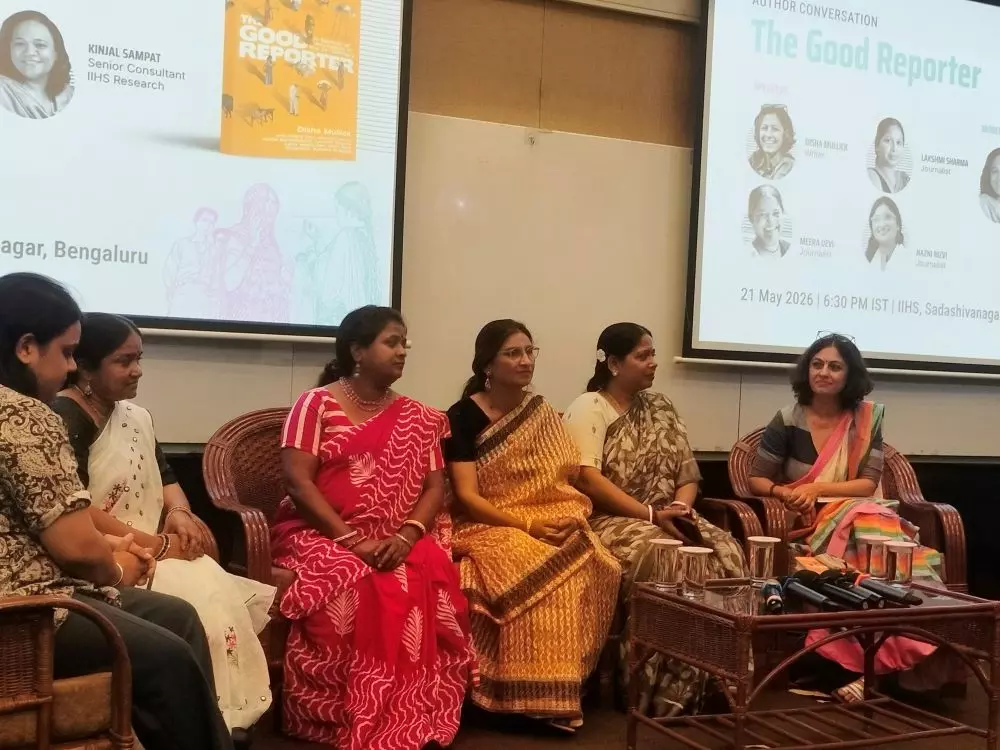
The team of Khabar Lahariya at the event at Bengaluru. Photo: The Federal
Their work has nothing to do with “heropanti” (heroism), they say.
For the all-women team of journalists of Khabhar Lahariya — a pioneering rural news platform — whether it is uncovering a tuberculosis crisis in a hamlet deep inside Bundelkhand’s Banda district in Uttar Pradesh (UP), questioning the growing influence of self-styled ‘godman’ Dhirendra Krishna Shastri in Madhya Pradesh, or having to face quarry mafia, leering political leaders and tracking Bundelkhand’s notorious dacoits, it’s all in a day’s work.
But behind the public reports are personal stories of a band of courageous women from marginalised communities in feudal Bundelkhand in UP and how they fought deeply-embedded prejudices, a long history of exclusion and jibes of ‘Badi Aayi patrakar’ [here comes the journalist], which have scarred but never broken the team.
It was the decision to open up on these personal narratives which resulted in the writing of “The Good Reporter: A Memoir of Journalism in the 21st Century, A Collective Biography”, published by Simon & Schuster India and launched by Khabar Lahariya recently. The book focuses on the ruminations and experiences of the women behind the network, who, with no real formal training in journalism, have been covering “issues that matter”.
The cover of the Khabar Kahariya book, The Good Reporter: A Memoir of Journalism in the 21st Century, A Collective Biography.
It also marks the slow transformation of Khabar Lahariya, which traces its origins to a humble broadsheet produced at a Banda literacy centre workshop by women and distributed to rural communities. From a no-profit venture – a ‘newspaper with no bylines’ – selling for Rs 2, Khabar Lahariya has morphed into a private digital news channel, which also produces multi-media content.
Today, this digital outlet, which had “captured the imagination of people” since its inception as a broadsheet in 2002, boasts of a network of about two dozen reporters across 16 districts of the north-central regions of Uttar Pradesh and Madhya Pradesh.
Building trust and credibility
In a conversation with The Federal in Bengaluru earlier this month, on the sidelines of the launch of their memoir at the city’s Indian Institute of Human Settlements (IIHS), Kavita Bundelkhandi, co-CEO and managing editor of Khabar Lahariya explains what prompted them to write the book. “We have had a lot of media coverage with films (which include an Oscar movie) made about us. People saw the challenges we faced from society, the government, our families, but our personal stories behind the screen, no one knows.”
The book throws light on the challenges faced by the all-women team, their bonding, the fun they derived from their work, and sometimes the suffering and loneliness. “It has nothing to do with heropanti,” stressed the journalist.
Chief reporter Nazni Rizvi opened up about having to fight her inner anxieties about being a “good woman”, when seen talking to sex workers while reporting.
The others visiting team members also revealed how they desperately held their own when men taunted them, asking if they were also available for a fee, while rushing around selling their newspaper for Rs 2. And, struggling to articulate their anger when male political leaders made fun of their questions, devaluing them.
They also spoke about having to battle fear and unease, while reporting on the death of workers in quarries owned by powerful men. What stood them in good stead was their close connection to the people they wrote about.
“Who better than us to understand a Dalit’s pain?” asked Meera Devi, managing editor. “I am a farmer’s daughter, so I understand their troubles. We lived among dacoits, so we know what it is like. All we are trying to do is carve a niche for ourselves in the media landscape,” she stressed.
Faced with questions from the audience about how they tackled threats posed by the powerful forces against them, Lakshmi Sharma, a senior producer who joined the network in 2010, answered, “Journalists had lost credibility in the Hindi heartland. So, we built a lot of trust with the people and officers in the system. We don’t run behind leaders, and we show people that we stand for a village’s progress. We spend a lot of time with them, understanding their problems.”
Grassroots journalism
In talking to The Federal, the team elaborated and gave the example of Sadhana Patil, a woman dacoit, who had cases of robbery, dacoity, and kidnapping registered against her in UP and MP. The mainstream media portrayed her as ‘Dasyu Sundari’, depicting her as a glamourised Bollywood character like a 'bandit queen', they said. But when the Khabar Lahariya team visited the dacoit’s home, they recalled how a very different image emerged; of a dutiful daughter. The Khabar Lahariya story was published setting the record straight stripping the story of all “sensationalism”, they claimed.
A panel introducing the Khabar Lahariya team at the Bengaluru event. Photo: The Federal
Another critical story that won them applause involved the expose of a serious tuberculosis (TB) epidemic unfolding in Gopra village in Banda district in 2016, under the very eyes of anganwadi workers. It was a story Geeta and Meera Devi stumbled upon, recalled the team and when their story of a TB crisis in a single village hit, it shook the administration and exposed the hollowness of the government’s free health care scheme in the area.
It also put the highly-priced private TB hospital there on the defensive. The Khabar Lahariya team, they claim, were threatened by the hospital authorities, while the village administration castigated them for defaming the village, and the district hospital authorities snatched their reporter IDs.
However, their investigative report led a sympathetic district magistrate in Banda to quickly set up a TB detection camp in the village.
“Many of the villagers got treated and we became good friends. We felt good that we had helped to save lives, though the young man Kallu, who had led us to this story, sadly died,” Meera recalled.
Meera’s personal story too, is inspiring as she initially joined Khabar Lahariya because she needed to fund her college fees. She never really thought of becoming a journalist and, like “most girls at that time”, was bent on becoming a teacher. That was till she got hooked to the “exciting world of journalism”.
Arrival of social media
Like many media houses, the Khabar Lahariya team too struggles to survive the onslaught of social media and the arrival of YouTubers.
“If there is a reporter in every house, where will the real reporter go? Anyone with a phone is a reporter today. We get news from YouTubers and influencers, but much of their content is inciting and provokes violence against women. Wat is worrying is that we see a misogynistic lens that is harmful,” Meera told The Federal.
Despite being a big brand to reckon with, their budgets have tightened and they face many challenges to stay afloat, admitted Kavita.
So how do they tackle the competition?
The team claims they stay relevant by staying the course, sticking to covering hyperlocal news and following the rigours of good journalism.
“We don’t post news stories after speaking to one person – when we write an article, we interview government officers, three to four locals, and ensure we publish the ‘right’ news. I may not get as many views as the influencers do, sitting at home spinning out news or like popular influencers relying on second-hand news but my story has credibility,” said Nazni.
Meera added that the social climate is such today that their story on the growing influence of ‘babas’, or ‘self-styled godmen’ like Dhirendra Krishna Shastri [leader of Bageshwar Dham] on young people in Madhya Pradesh, went viral on their channel. “There is even a 16-year-old ‘baba’ in the area. We wanted to highlight how this trend of blind faith in religious leaders is wrong, but the story picked up a lot of traction for other reasons," she added.
“The government is destroying our hills and changing the climate in the area and the focus should be on these issues like the Ken-Betwa river link project (to transfer surplus water from the Ken in Madhya Pradesh to the Betwa river in Uttar Pradesh and Madhya Pradesh)," Meera pointed out.
"There is widespread resentment among protesting farmers and tribal families. We would rather report on the protests against the project."
Staying relevant
To remain relevant and keep the brand alive, the holding company — the socially-focused Chambal Media — launched Chambal Academy in 2021, an online journalism course for women. Over the years, it has trained several rural women, many from marginalised communities, to become reporters. Chambal Media also provides audiovisual and written content on gender, media, and development for non-profit and corporate clients.
According to Disha Mullick, director and co-founder of Khabhar Lahariya's parent company, they sustain their news channel with revenue streams such as these. “The memoir is also to show that we may look cool and glam on the outside, but it has been a tough journey,” she said.
Disha added: “In the past two decades, we've struggled with the political, financial, technological changes and we've also produced journalism that's quite distinct, so we wanted to bring back what it actually means to collectively produce news or content in a world which has become so individualised. It’s a personal story of survival as a media house.”
Khabar Lahariya’s offering now includes mobile journalism, short documentaries and paid commissioned content for like-minded people. “All of that sustains our news channels. Our news content is on a subscription model, with paid exclusive content like ‘Khabar Hatke’,” explained Meera.
Lakshmi, meanwhile, talked about the Khabar Lahariya team being a “role model for village women”. “We have trained 600 girls so far from 2021 [at the Chambal Academy]. We are proud that one girl started her own news channel, three joined video journalism and another works at a community news network. We are preparing a new generation of journalists.”
‘Not Anti-BJP’
There was a time when people positioned them as anti-BJP. But the team members assert that they were clear from the very beginning that they were neither anti-BJP nor anti-Bahujan Samaj Party (BSP), or Congress.
“It’s not as if all government systems are good; some are questionable in the areas of religion and social media. But we stick to our focus, which is to raise questions about local politics in villages, we cover real issues that are ignored by the mainstream media,” insisted Kavita.
Added Disha: “There are issues with the current establishment, so we do some stories which are quite critical, but we also balance that with other reportage that is not critical. Because it's a vulnerable newsroom and all newsrooms are vulnerable at this point. But Khabar Lahariya, as a women-run [organisation], [one run] by a lot of marginalised women, is even more at risk. We fear that it can be shut down or there will be physical intimidation and other kinds of cases, which we don’t want. So, there is a lot of strategy involved.”
She continued, “A lot of journalism now has just become opinion. But we actually do real ground reporting, and Khabar Lahariya has a lot of credibility with local administrations for making the effort to report from the ground; it makes a difference.”
And “making a difference” is what this team of women have been doing right from the day they started.