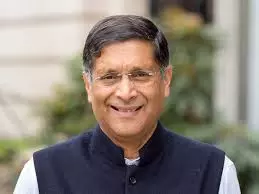
In this excerpt from 'A Sixth of Humanity', Devesh Kapur and Arvind Subramanian write how the challenges of building a multinational State would often be precipitated by Centre’s lack of forbearance to restrain itself

One of the most potent instruments of nation-building is a common means of communication, a ‘national language’. Given India’s linguistic diversity, its rich history of regional languages that were the fountainheads of their cultures and sub-nationalisms, this posed the most formidable challenge in the 1950s. The challenges of constructing a multinational State would return periodically, often precipitated by the central government’s lack of forbearance to restrain itself. And, in turn, the issue was linked to India’s federalism.
Federalism in India was distinctive in several respects. First, it was a ‘union’ — a ‘holding-together’ federalism — and not a ‘federation of states’, unlike the US, which has been described as a ‘coming-together’ federalism. The Constituent Assembly was clear that India was ‘a union because it is indestructible ... the country is one integral whole’. The ‘integral whole’ was underpinned by uniformity in certain basic matters, including laws, a single judiciary and an all-India civil service.
The conflict between Hindi and Tamil
While the Constitution disproportionately empowered the union by empowering Parliament to create new states, this also allowed the federation to evolve and respond to sub-national aspirations, evident in periodic changes to India’s internal political geography. The initial changes — in 1947, 1950, 1952 — were responses to the absorption of the princely states. Starting with Andhra State in 1953 (carved out from Madras), the States Reorganisation Act, 1956, led to twenty-eight constituent units of the Indian Union (Parts A, B and C states and Part D territory-the Andaman and Nicobar Islands) amalgamated into twenty units — fourteen states and six Union Territories. Sixty-three years later, after the revocation of Jammu and Kashmir’s statehood in 2019, India had twice as many states (twenty-eight) and eight Union Territories.
Also read: The Federal launches 'Voices That Count' featuring Arvind Subramanian, Devesh Kapur
A common medium of communication — a lingua franca — has always been one of the most potent instruments of nationalism and nation-building. English was the language of the elite (barely 1 per cent of the population spoke English in the 1951 census), who were largely upper castes. Moreover, for a country with such rich linguistic traditions, making the colonizer’s language the official one had few takers. As the great Kenyan writer Ngũgĩ wa Thiong'o later put it, ‘The colonised trying to claim the coloniser’s language is the sign of the success of enslavement.’
Given the desirability of a common means of communication among the masses, there was considerable pressure to make Hindi the common language, which (along with languages closely allied to it) was the mother tongue of around 44 per cent of the population as per the 2011 census. But pushing a single language too strongly in a multilingual nation, with rich histories of other languages, can also make it a potential instrument of disintegration (as happened with Urdu in Pakistan), with regional nationalism rooted in linguistic identities.
The push for Hindi as the common language was, unsurprisingly, strongly resisted by the southern states as well as Bengal. Its most zealous proponents undermined their own cause by an obdurate refusal to adopt the broader lingua franca, Hindustani, zealously purging it of vocabulary from Persian, insisting on using the Devanagari script and refusing to consider a simplified Roman script for non-Hindi speakers that could have provided a more level playing field across the country.
While other countries such as Switzerland and Yugoslavia were also multilingual, India was different in that the various languages also had individual scripts, as well as rich literary histories. Language-related conflicts erupted in the 1950s in Madras (Tamil versus Telugu) and in Assam, where it was directed against the use of Bengali by the large Bengali population of that state.
However, the most serious conflict was between Hindi and Tamil. It arose in Madras (later Tamil Nadu), where the Dravidar Kazhagam (DK, and subsequently its offshoot, the DMK)-led Dravida movement built its identity from anti-South Indian Brahmins to anti-Hindi to anti-North Indians, cleverly linking the first to the latter two. The power of ‘linguism’ to generate large scale protests was led by college students, egged on by the ambitious regional elite.
English as a language of emancipation
The basic problem was one that has been alluded to in Chapter II: a rapid expansion of higher education without a commensurate expansion in jobs. The stress on language was as much to raise entry barriers and limit competition as due to fears of losing the vitality of their cultural heritage. The linguistic reorganization of states in 1956 only partially resolved this problem. The 1961 census found that no state/UT in India had fewer than twelve mother tongues (the number of mother tongues ranged from 12-410). Thus, basically all states were multilingual entities, notwithstanding the drawing of state boundaries on uni or bilingual criteria.
Also read: The Federal kicks off new ideas series ‘Voices That Count’ at Great Lakes campus on Dec 3
But if there were strong voices in the south against the imposition of Hindi, with a preference for English as the official language, there were equally vehement protests against English in northern states, a language that the backward castes there resented as further entrenching the hegemonic power of the upper castes. In contrast, from social revolutionary Savitribai Phule in the late nineteenth century to the Dalit intellectual Chandra Bhan Prasad more than a century later, English was seen as a language of emancipation for Dalits.
Socialist leader Ram Manohar Lohia believed that the three primary characteristics of India's ruling elite were caste status, wealth and English education. After his protégé Karpoori Thakur abolished English as a compulsory subject for passing matriculation in Bihar, the representation of rural students from backward castes in higher education sharply rose.
But the benefits of widening access in Bihar were shortchanged by a sharply deteriorating higher education system. The backward castes did not so much get a poisoned chalice as an empty chalice. Languages have to be dynamic to thrive. The destruction of universities in northern India dried the wellsprings of a rich Hindi literary tradition. Efforts at translating the best textbooks in STEM fields from English to Hindi were also minimal. Hindi did spread, but primarily through non-state transmission channels, from Bollywood films and music to migrants from south India going to the north for jobs in the latter half of the twentieth century and then the reverse in the following century, as well as efforts by civil society organizations. However, instead of incentivizing these trends, a renewed perception of coercion by the central government threatened to light up linguistic fires all over again.
(Excerpted from A Sixth of Humanity: Independent India’s Development Odyssey by Devesh Kapur and Arvind Subramanian, with permission from HarperCollins India. The authors will be in conversation with The Federal's editor-in-chief S. Srinivasan as part of its new ideas series, ‘Voices That Count,’ at Great Lakes campus in Chennai on December 3)