Freedom vs aesthetics: What artists, curators, gallerists say about self-censorship, morality in art
A recent attempt to digitally cover up the bare torso of the Indus Valley Civilisation’s iconic ‘Dancing Girl’ statue in a school textbook demonstrates nothing is immune to moral policing. According to reports, following criticism, the modified image will be replaced with that of the original. But not before the move had ignited a familiar debate on censorship in art.

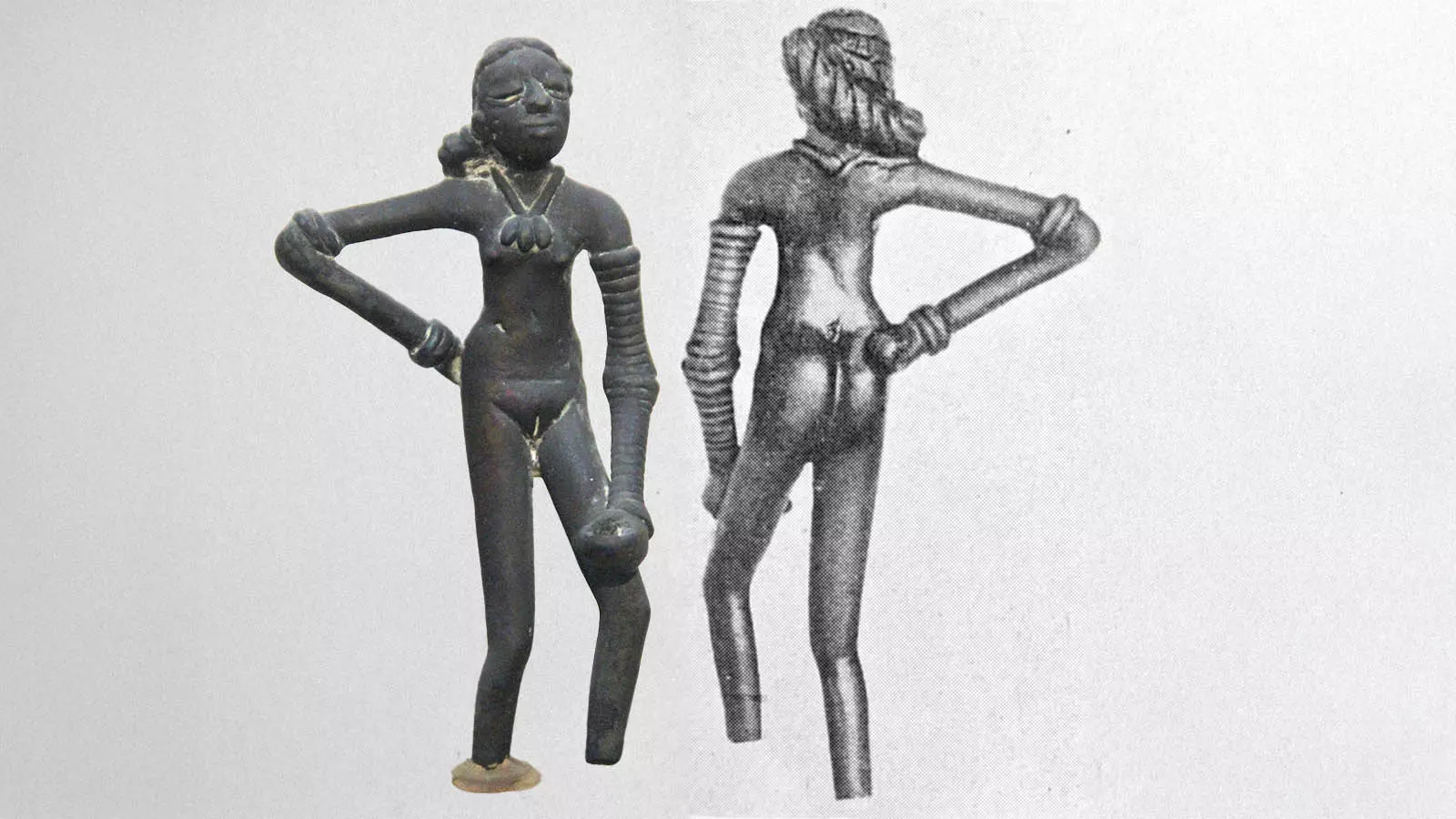
Nudity has always existed in art, but in modern renditions it perhaps unsettles viewers more, as the subjects are often regular folks with non-idealised bodies. The Dancing Girl though wasn't immune to censure.
In late December 2025, there was an uproar at the sixth edition of the Kochi-Muziris Biennale. Artist Tom Vattakuzhy’s painting Supper at a Nunnery, part of Edam, a Biennale-adjacent exhibition with a focus on artists from Kerala, had outraged Christian groups.
The painting depicts Dutch exotic dancer and courtesan Mata Hari’s last night at a nunnery before her execution during World War I by the French on charges of spying for Germany. Mata Hari sits at the centre of the composition with her breasts exposed, surrounded by 12 nuns. The visual parallel with The Last Supper is difficult to deny. The venue where the artwork was showing had to be closed for a few days. When it reopened, the painting was no longer on display.
The Kochi Biennale Foundation said in a statement that “the curator of Edam and the artist concerned have decided to withdraw the painting from the exhibition respecting public sentiments and in the interest of the common good. The Kochi Biennale Foundation, which has always stood for artistic and curatorial freedom, respects their decision”.
The painting itself was a decade old and had accompanied a play by C. Gopan (itself inspired by 'Narthaki', a poem by the celebrated poet Vyloppilli Sreedhara Menon about Mata Hari’s last night) in the December 2016 issue of Bhashaposhini, a Malayalam literary magazine with a venerable heritage which was first published in 1892. There was a similar uproar about the painting then and the issue had to be withdrawn by the publishers Malayala Manorama.
In India, artistic freedom seems permanently at loggerheads with the status quo. For Vattakuzhy, “the painting issue is long behind us, and life has moved on”. He does, however, feel that broader concerns around censorship remain and it is the role of the artist to challenge the established order.
You’d expect classical Indian art would be spared, but as the recent attempt to digitally cover up the bare torso of the Indus Valley Civilisation’s iconic ‘Dancing Girl’ statue in a school textbook demonstrates, nothing is immune to our moral policing. According to reports, following criticism, the modified image will be replaced with that of the original. But not before the move had ignited a familiar debate on censorship in art.
As Vattakuzhy says, “The boundary between art and obscenity is a very fine one, and in many ways it’s blurred. In classical art, nudity was usually presented as an idealised form of beauty, an expression of the divine, or as part of a mythological or allegorical narrative.”
Take the sculptures of Khajuraho (Madhya Pradesh) or ancient temples across India, for example.
Vattakuzhy continues: “Because it was seen within that broader cultural or spiritual context, people generally did not find it objectionable. But even that seems to be changing. The recent controversy over the Dancing Girl of Mohenjo-daro suggests that our society is becoming intolerant even of images that are part of our cultural heritage.”
Nation of fragile sensibilities
Talking about his Edam experience, the artist adds: “My recent experiences as an artist have left me feeling that the space for fearless artistic expression is gradually shrinking. Increasingly, artists feel compelled to censor themselves, fearing backlash or threats from organised groups. At the same time, emotions and sentiments often seem to carry more weight than reasoned debate or dialogue. The result is a growing sense of caution. People think twice before speaking, creating, or asking difficult questions because they fear outrage or repercussions. To me, that's the real concern. It suggests we're slowly drifting away from the democratic values of openness, tolerance, and the free exchange of ideas,” he says.
Art has the power to question our assumptions, and bring uncomfortable truths into the open, feels Vattakuzhy. “That's why it often becomes the subject of criticism or controversy. The real question is not whether art provokes debate, but how we respond to it. I don't think the answer is censorship or suppression. Instead, we need more spaces for open and thoughtful dialogue, where difficult ideas can be discussed with openness, critical reflection, and mutual respect,” he says.
Vattakuzhy’s reference to self-censorship and caution among artists touches a raw nerve with many. It also circles back to the often posed question on whether there is indeed a line between artistic freedom and decency, and who decides what’s art and what’s not.
A little over a year before the Biennale controversy erupted, advocate Amita Sachdeva visited ‘Husain: The Timeless Modernist’, a show at DAG, Delhi on December 4, 2024. She found two paintings, depicting the Hindu gods Hanuman and Ganesha but also featuring nude female figures, offensive. Sachdeva photographed them and filed a police complaint, alleging her religious sentiments had been hurt. Acting on her complaint, the police seized the two artworks. In a ruling in January 2025, however, a Delhi court found no cognizable offence and refused to initiate an FIR against DAG. DAG said in a statement that “during the course of the exhibition, the gallery received about 5,000 visitors including scholars, academicians, collectors, students and art enthusiasts as well as journalists, garnering positive reviews in the press as well as from the public…It is noteworthy that no other person among about 5,000 visitors at the gallery raised any objection to any of the artworks displayed in this exhibition”. A revision petition was dismissed in August 2025.
Sachdeva is a serial litigant whose bio on X states that she “will pursue legal action against anyone who insults Sanatan Dharma”. But she is certainly not the only one. We are a nation of fragile sensibilities, waiting for the slightest opportunity to be outraged, and art is an easy target. Over the years, some of our most celebrated artists—including Raja Ravi Varma, Amrita Sher-Gil, FN Souza and Akbar Padamsee — have been at the receiving end of our ire.
As a gallery which deals with a wide variety of artworks, DAG has to keep an open mind. Giles Tillotson, senior vice president, DAG, says, “It's really difficult to draw a firm distinction between what's beautiful and what's vulgar because standards about these things vary hugely between cultures, time periods and individuals. What to one person might look sensual or erotic to another is just pornographic, so it's not like there are objective standards which you can apply. Secondly, I certainly don't think it's the job of gallerists or curators to protect the public from things that might be considered vulgar. If you don't like it, walk away. It's not our job as a gallery to be a gatekeeper of public morality.
Talking about the Dancing Girl controversy, Tillotson adds: “The third question is whether it's the Government of India's job to do that, and that's why this question has arisen, because obviously some government-appointed officials in the realm of education have decided that the Mohenjo-daro Dancing Girl is vulgar. My thought is if that's your view, don't show it to children, but don't cover it up.”
The Austrian-Sri Lankan contemporary artist Raki Nikahetiya’s approach to the aesthetics-vulgarity debate is, expectedly, nuanced.
“There are certain universal and biological responses—for example, our perception of proportion, patterns such as the golden ratio [believed to be aesthetically pleasing], or the ways we respond to particular colours, sounds, scents, and textures. But our ideas of beauty, aesthetics, and vulgarity are largely shaped by culture and continually evolve over time,” says Nikahetiya, also the director and co-founder of the upcoming sā Ladakh Biennale (1-10 August 2026), positioned as the world’s highest regenerative art biennale. In a landscape as physically and culturally fragile as the Trans-Himalaya, sensitivity is everything.
Nikahetiya added: “Perhaps it’s not whether a work conforms to a particular standard of beauty or taste, but whether it possesses integrity, sincerity and a genuine reason for existing. Art can be beautiful, unsettling, provocative, uncomfortable, or quietly contemplative. At its best, it doesn't ask us to agree — it invites us to pay closer attention.”
As an artist, Nikahetiya chooses to be intentional in his practice. “I'm less interested in critique for its own sake, finger-pointing, or spectacle. What interests me is work that is deeply personal yet capable of opening new ways of thinking, learning, connecting people, and asking questions that remain meaningful over time. Every artist decides what to include and what to leave out. For me, those decisions are guided by purpose rather than by a desire to provoke. I don't believe provocation is a measure of artistic value,” he says.
Some artists talk about self-censorship and caution, but the debate circles back to the often posed question on whether there is indeed a line between artistic freedom and decency, and who decides what’s art and what’s not. Photo: iStock
Multidisciplinary artist Seema Kohli—whose practice encompassing painting, sculpture, performance, printmaking, film, and installation is deeply informed by mythology, ecology, gender, and spiritual inquiry—seems to concur. As an artist, she does self-censor, but rarely as a conscious decision.
“It is more of an intuitive caution—an awareness of not trespassing onto certain paths. In the times we are living in, there is a quiet, collective carefulness that we all carry somewhere within us,” she says.
For her, the distinction between beauty and vulgarity comes down to perception versus convention. “Beauty is inherently a self-assessed experience; it resides in individual consciousness, meaning almost anything has the potential to be beautiful. Vulgarity, on the other hand, is heavily constructed by morals, social norms, and cultural traditions…Because of this, when we talk about a line between the vulgar and the aesthetic in art, I don’t believe a rigid, universal moral boundary exists,” she says.
Attention seeking?
Of course, there are some artists who seem willing to go to any length to grab eyeballs even in this age of outrage.
Art writer, collector, and curator Aman Nath has followed the world of art closely for over half a century. Referring to an audiovisual installation at the Luxembourg Pavilion at the ongoing Venice Biennale, which features, well, a talking turd—Nath says, “People came back absolutely disgusted, asking is this what art has become.” He feels that the ‘glitterati’ have taken over the scene. “They don't know a thing about art. They have no education, just a little exposure. And they're there for all the wrong reasons,” he says.
According to Nath, the line between what is aesthetic and what is vulgar depends on who is taking the call. “If you get a government person to select for an exhibition going abroad, I can say with some certainty that they would draw that line and they would draw it closer to prudity. And if it was a private person doing it, they would do it the other way, because they would want to show art as it is being painted, not as they want you to see it.” However, art can’t be completely unfettered, he feels. “There should be freedom, but there have to be some limits, because it is in public space.”
Because attention spans are so short now, artists are obliged to do sensational conversation pieces rather than art for art’s sake, suggests Nath. He recalls an installation of a dinosaur fornicating with a car. “Of course, everybody stood and watched it. So where is the morality, where is the sense, where is whatever? If you went to an exhibition of a hundred things, you'd remember that one. Outrage catches instant attention—that's the way the art world is right now.”
To show or not to show
For artists like Kohli, the past is an enlightened realm. “Take the Khajuraho temple complex, for example. The fact that those sculptures were carved on the outer walls of the temples shows that the society of that era was entirely comfortable with them. Today, in our current century, society is often uncomfortable with that imagery, which is why we rush to label it simply as 'nude' or provocative. Ultimately, every era and every space brings its own unique set of values regarding what is considered aesthetic,” she says.
Nikahetiya has a more personal take: “I grew up in Austria, where the façade of the Viennese Secession Building bears the inscription by the Austrian art critic Ludwig Hevesi: ‘To every age its art. To every art its freedom’. It is a principle that has stayed with me.”
Nikahetiya adds: “So how does one become offended? Perhaps it happens when a work of art challenges or unsettles one's current worldview, beliefs, or sense of identity. Art has always had the capacity to do that. What has changed today is the speed and scale at which reactions are amplified. Digital platforms reward immediacy, often encouraging instant responses rather than sustained reflection. At times, it can feel as though we live in an age of heightened sensitivity and constant overstimulation. Yet, if we take a longer view, have human emotions ever really been different?”
Also read: Why motivational books continue to see market demand
Vattakuzhy would prefer to err on the side of creative freedom. According to him, galleries and curators need to step up for the cause too. “They can act as a bridge between the artwork and the public, especially when art deals with subjects that challenge prevailing social values, cultural norms, or politically sensitive issues…Instead of allowing a work of art to be reduced to outrage or misunderstanding, they can encourage people to think more deeply about the questions and ideas it raises. So, their role goes beyond simply exhibiting art.”
Nudity has always existed in art, but in modern renditions it perhaps unsettles viewers more, as the subjects are often regular folks with non-idealised bodies. Bhupen Khakhar’s depictions of gay love are a case in point, and they had their fair share of controversy.
“Contemporary art…presents the body with all its imperfections, vulnerabilities, and ordinariness, asking us to confront a more raw and unfiltered reality. That can make people uncomfortable because it moves away from familiar ideas of beauty and invites us to engage with aspects of human existence that are complex, unsettling, or socially taboo. I think that's often where the tension arises,” says Vattakuzhy.
Nor is the struggle for acceptability reserved for nudity or art that ruffles religious beliefs. Photographer Madhu Kapparath, who also displayed at Edam at the 2025 Kochi Biennale, had a hard time placing his gritty images of the shipbreaking yard at Alang (Gujarat).
“Nobody who ran photo galleries or festivals in Delhi dared to show this, so this work sat on the shelves for over 20 years,” he says. About the work itself, he says, “I was confronted with a Gulag of sorts, Bruegel's apocalypse-like scenes, with smoke and heat and metal and hellfire. I walked about in the metal- and oil-strewn landscape for days until I couldn't stand it anymore. I came away, realising human beings can put up with anything.”
Nudes may have been a central trope of art photography once, but “pornography and the Great Digital flood now engulfing us has redefined this a long while ago,” says Kapparath. “We no longer contemplate beauty or vulgarity. The only thing that still stirs us now is when we are confronted by a nude altered by violence done to it.”
Rather than self-censor certain works, Kapparath would prefer not to display them at all. “In my own practice, I have two compulsions—to try and not seek public validation for work whose origins are intensely personal; and secondly, a fervent belief in subversive figures who remained in the margins.”
That is the difficult choice confronting every artist today, an impossible balance between artistic conviction and public acceptability.