



Mysuru Dasara love story: Mahendra and Lakshmi, the Kumki pair, steal the show
Two elephants from the Balle camp have become the sweetest subplot of this year’s Jamboo Savari, with Lakshmi keeping a watchful eye on Mahendra, trunk touches and all

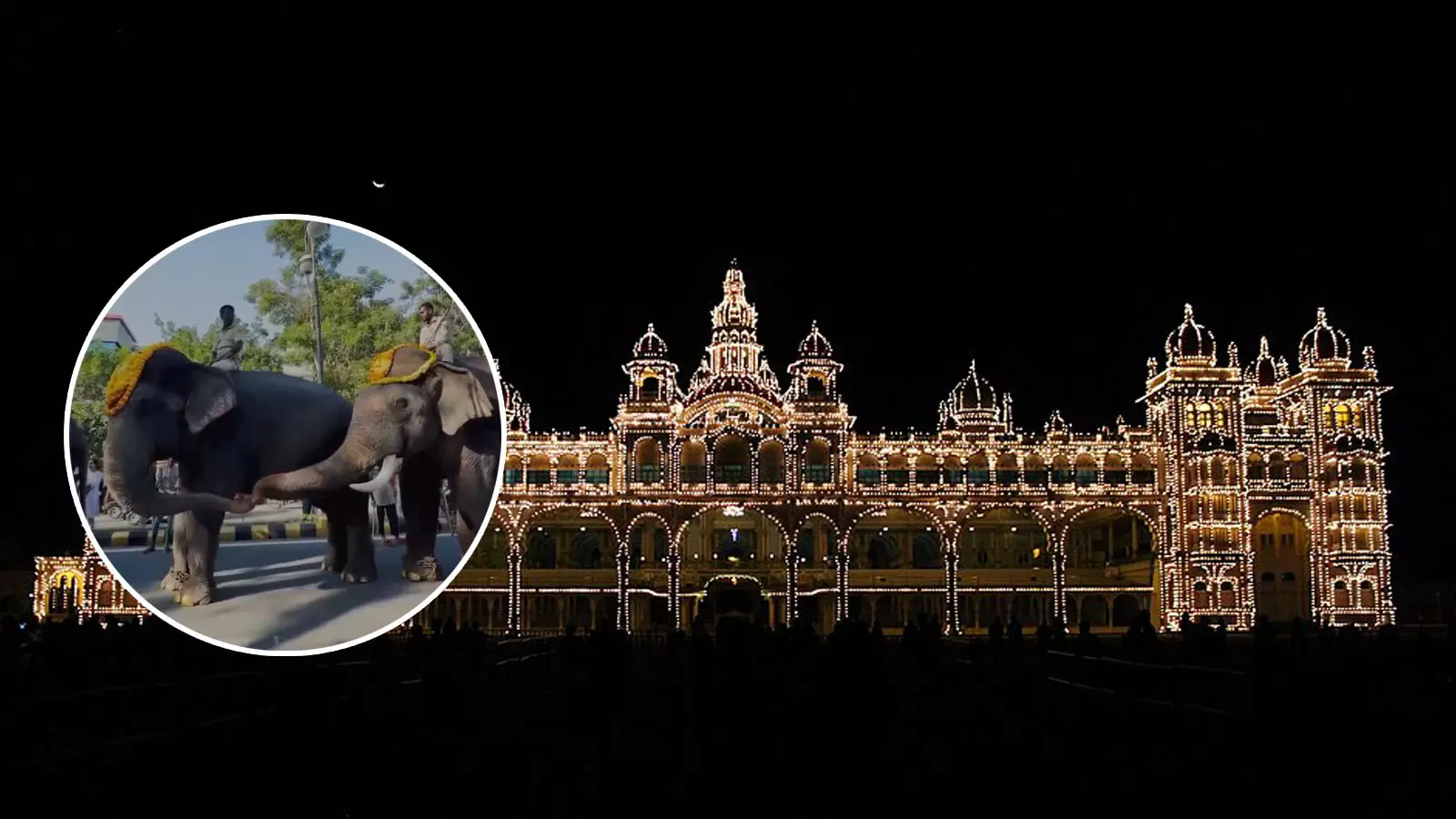
The decorated elephants, traditional music and thousands of spectators create the grandeur of Dasara. But this year the love story of Lakshmi and Mahendra have swept the attaction.
Mahendra was supposed to be the story of this year’s Mysuru Dasara. A calm, battle-tested Kumki, he was once a strong contender to carry the Golden Howdah after Abhimanyu’s retirement. Then, during an October 8 rehearsal, he stopped midway, and Prashantha took the honour. But in a quieter corner of the Mysuru Palace courtyard, away from the pageantry, Mahendra, along with Lakshmi, still steals the limelight.
Mahendra and Lakshmi, a pair of Kumkis from the Balle camp in HD Kote, simply stand close, trunks touching, and visitors can’t seem to look away. The two have become an unexpected attraction, not for the roles they will play in the procession, but for the quiet way they seek each other out. In Mysuru, an unusual love story is unfolding. In a twist, love may have cost Mahendra the Golden Howdah. Officials believe Lakshmi’s attachment was among the factors behind his setback.
Kumki companions
Both Mahendra and Lakshmi are trained Kumki elephants from the Balle elephant camp in HD Kote (Mysore district). Kumkis are specially trained elephants forest officials use for various duties, including helping in human-elephant conflict areas and assisting in operations involving wild elephants.
Also read: Mysuru Dasara 2026 will not be scaled down despite drought: Karnataka CM
Mahendra is a well-known Kumki elephant used in animal-human conflict areas in Karnataka, including parts of Hassan, Kodagu and Chikkamagaluru. He also joined the Mysuru Dasara elephant team.
Lakshmi, a female Kumki, has also been trained for duties at elephant camps and in the forest department. But in Mysuru, the two have attracted attention for something very different — their close companionship.
A bond from the elephant camp
Mahendra and Lakshmi spent time in the same elephant camp. They were now together in Mysuru as part of the Dasara preparations. The palace is a very different place from their forest camp. There are crowds, vehicles, loud music, rehearsals, officials, mahouts and other elephants. The elephants have to adjust to the noise and strict routine of Dasara.
This year, Mahendra and Lakshmi have added something more personal to that story — a quiet bond between two Kumki elephants.
Yet, amid all this activity, Mahendra and Lakshmi seem to keep looking for each other. Their behaviour has caught the attention of people who handle and observe the elephants closely. For the mahouts, who spend long hours with the elephants, the bond is more than something visitors notice for a few minutes. They see how the elephants behave during training, when they are separated and when they come together again.
Lakshmi, in particular, seems very attached to Mahendra.
Story of possessive Lakshmi
One of the most noticeable aspects of Lakshmi's behaviour is her reaction when another female elephant comes close to Mahendra. Forest officials say Lakshmi does not easily accept other female elephants coming too close to him.
Deputy Conservator of Forests Dr Prabhugouda has also spoken about this behaviour. “Lakshmi cannot tolerate any female elephant approaching Mahendra. Her reaction is intense. She insists on being the only female elephant around him. It is a rare and beautiful expression of emotion in the animal world,” he says.
Also read: A city without flyovers: Why Mysuru is finally building one
Dr Prabhugouda acknowledges Lakshmi's behaviour and also explains Mahendra's behaviour during practice. “During the third phase of weight rehearsals, elephant Mahendra showed signs of discomfort while carrying a 500 kg training load (50 per cent capacity). After completing a round within the palace premises, the elephant refused to carry the weight any further. Prioritising animal safety, especially after a similar episode during earlier rainfall, forest department officials immediately offloaded the howdah and brought him back safely.”
Officials clarified that comprehensive health screenings revealed no external injuries or underlying internal medical issues. Rather, the reluctance stems from a lack of physical stamina and fatigue, as the elephants work continuously throughout the year on frontline mitigation operations, such as capturing wild elephants and tigers.
Then there is a psychological factor, which includes the 'love angle'. To those watching, Lakshmi's behaviour can look like possessiveness. If another female elephant approaches Mahendra, Lakshmi becomes tense and alert. She may move towards them or try to drive the other elephant away. It almost looks as if she is telling the other elephant to stay away. And Lakshmi's behaviour towards Mahendra has certainly attracted attention.
Lakshmi’s attachment
During Dasara training, every elephant has to follow a strict routine. There are rehearsals, walks, weight checks and other activities. The elephants are expected to remain calm despite the noise and crowds around them.
But Lakshmi appears to keep a close watch on Mahendra. When another elephant approaches him, she notices quickly.
When Mahendra is taken away for training or another duty, Lakshmi becomes restless. A mahout who observes the pair says Lakshmi is deeply attached to Mahendra. “Lakshmi is very attached to Mahendra. Whenever Mahendra is taken away for training or other duties, she keeps looking for him and becomes restless. She always wants to know where he is,” the mahout says.
Also read: Elephant’s wellbeing above humans’ right for religious use: Bombay HC
For people who work with elephants, such behaviour isn't something you can simply dismiss as a passing moment. They observe the elephants every day. They know their habits, moods and reactions.
Bond of their own
Mahendra and Lakshmi touch trunks and stand close, and for elephants, that is no small gesture. The trunk is how they communicate, smell, touch and connect with one another.
“They have become very comfortable with each other. During the Dasara training sessions, Lakshmi keeps watching Mahendra, and when they meet after being apart, they touch their trunks and stand close to each other. It is quite a special bond,” the mahout says.
There is no dramatic display, but for visitors watching them, the sight is enough to create a story of its own.
Mahendra — the calm one
Mahendra is known for his strength and calm nature. He has been used as a Kumki in areas where human-elephant conflict is a serious problem. Such work requires elephants to be trained, disciplined and able to respond to the commands of their handlers.
Mahendra initially appeared to be one of the strong contenders for the prestigious responsibility of Golden Howdah.
His experience in forest operations also made him one of the elephants considered for the Golden Howdah role after Abhimanyu's retirement. Mahendra initially seemed like a strong contender for the prestigious role. During the early stages of Dasara training, he showed promise. But the Golden Howdah race took an unexpected turn, probably with Lakshmi's love angle.
More than a Dasara attraction
Photos and videos of the two elephants have drawn attention from visitors and on social media. The Golden Howdah may remain the biggest attraction of the Jamboo Savari. The decorated elephants, traditional music and thousands of spectators create the grandeur of Dasara. But sometimes a smaller story stays in people's minds. For many visitors, that story this year could be the sight of Mahendra and Lakshmi standing together.