How 2026 literature Nobel winner Anne Carson wears the cloak of erudition with the lightest of clasps
Canadian author Anne Carson was awarded the Nobel Prize in Literature for 2026 on October 8. In awarding the Nobel Prize to this legendary observer, commentator, creator of our times, the Swedish Academy in Stockholm, which chooses the recipient of this award, might have performed its most radical, feminist act ever.

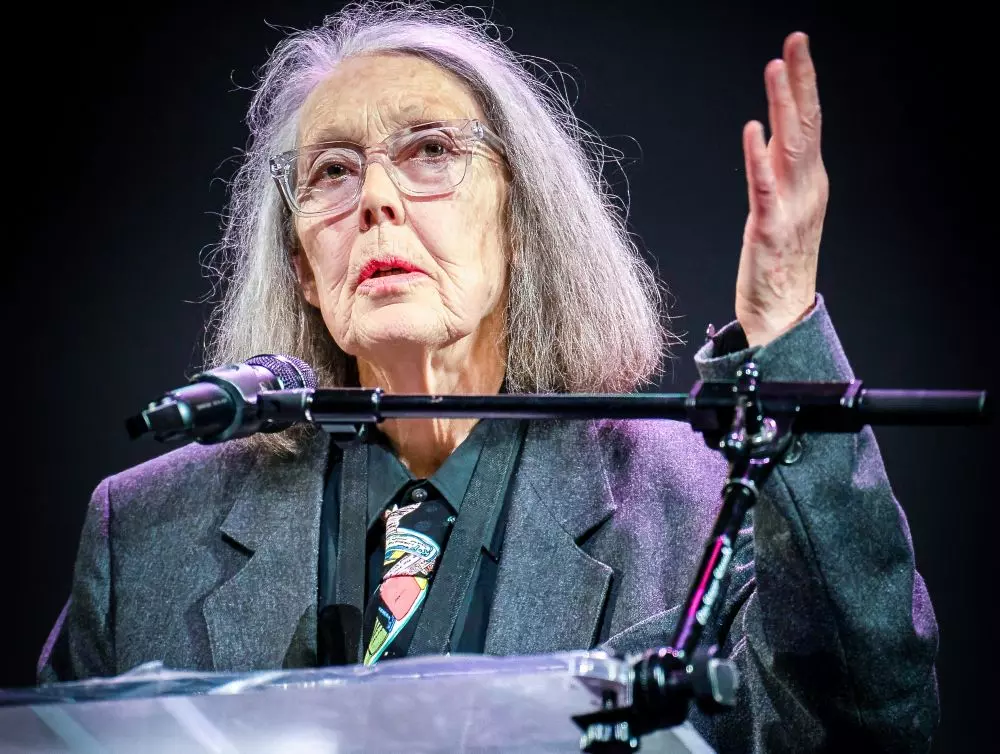
Anne Carson has been celebrated for decades and is no stranger to prestigious literary prizes. Photo: Wikipedia
In summer this year, I met a beloved feminist friend after what felt like years. We came to the rendezvous with books as gifts for each other and one of the books I was gifted that day was Anne Carson’s new title, Wrong Norma. It has been on my bedside ever since, relished and rationed, as I allowed myself only one piece at every reading, wanting the bliss to last as long as possible.
Then, on October 8, as I was travelling on work, the news broke that Carson had finally been awarded the Nobel Prize in Literature and I ached to get back home to Delhi to hold Wrong Norma in my hands again. Many have written in their accolades since that day that the honour has been late in coming to Carson, a frontrunner for the Prize for many years now, but when I heard the news, what I said aloud to myself in the cab was not “about time”, but “what marvellous timing”. Because if ever the world needed a celebration of a feminist poet, essayist, classicist and writer who makes erudition feel like one’s morning cup of coffee, it is now.
Effortlessly moving between forms
Carson has, of course, been celebrated for decades and she is no stranger to prestigious literary prizes. In 2001, she was the first woman to win the TS Eliot Prize for her collection, The Beauty of the Husband and she has also been the recipient of two of the most distinguished fellowships for scholarly and literary work, the Guggenheim and the MacArthur. One of the uncrowned queens of contemporary literature in English for some time, effortlessly moving between forms such as poetry, translation, prose, essay and fiction as if they were sheets to be changed after a night’s sleep, Carson has long been associated with what many younger writers have come to embrace as the genre of ‘autofiction’ (a portmanteau of autobiography and fiction). No wonder then, that since the announcement of the Nobel prize earlier this month, every publication worth its salt has carried breathless overviews of her entire oeuvre.
Also read: Why for publishers, editing non-fiction is a challenge, more so in charged socio-political settings
When I was invited to write this piece, however, I decided instead to explore the brilliance of four of Carson’s writings which I consider my favourites. I began to read Carson 15 years after she became a published writer. I came to her late, therefore — but having first picked up her translation of the verses of Sappho of Lesbos, celebrated ancient Greek poet, inventor of the plectron among other musical inventions and lover of women, whose verses, Carson tells us in the introduction to the translation, have been referred to and quoted in the writings of some of the greatest Greek philosophers and poets of later years — I came to Carson’s work with a hammer’s blow to my literary consciousness. In fact, the introduction to the book itself should be read for inspiration by all translators before they begin a new translation.
Almost a decade before Carson translated Sappho’s verses, she wrote an astonishing 38-page piece titled ‘The Glass Essay’. Perhaps more than any other work of hers, it is this one that has made her a lighthouse for those who want to explore ‘autofiction’ as a genre. ‘The Glass Essay’ itself is part of a book called Glass, Irony, and God, which was published in 1994, but it stands out even as part of that collection. The essay, and no living writer can do an essay in verse better than Carson, braids together a variety of strands: her mother who is so unlike Carson and yet so in sync with her and the older woman’s loneliness and fear even as she visits without fail her husband who is in a hospice with senile dementia; the end of Carson’s relationship with a man she refers to as Law, an end that she grieves with a pain laid so naked that one wants to reach out and pat a shirt over it; and an ode to her beloved writer, the odd genius, Emily Bronte. I read ‘The Glass Essay’ again last year after my mother died and Carson’s words held my grief at having lost both parents as long as the pages were open in my lap.
The idea of stillness
Her 2024 publication, Wrong Norma, is my new Carson favourite, with a plethora of riches as references to all her muses — musician John Cage, writers Emily Bronte and Samuel Beckett, artist Robert Rauschenberg, Greek philosopher Socrates, the writers of the Rig Veda and many more. Every page is a reminder that Anne Carson can wield the scalpel and the lyre with equal dexterity. My favourite piece in the book is her autobiography of the sky across seven days, titled ‘Lecture on the History of Skywriting’. The fourth day is particularly lovely as Sky enters into conversation with the greatest non-arriver the world has ever encountered, Rusty Godot.
Also read: Why this former CEO & author feels people shouldn’t allow AI to make them ‘feel ordinary’
It is her 2021 essay, ‘Stillness’, in an issue of the University of Chicago Press journal, Critical Inquiry, however, which, even after multiple readings, continues to hold me in mute awe of colossal artistry and erudition worn ever so lightly. Think of it as a rolling, expanding, deep-diving piece of music within a room with the best acoustics, an entrancing literature review where she explores the idea of stillness via the works of Greek poets Homer and Sappho, John Cage, Robert Rauschenberg, writers Emily Dickinson, John Keats and Virginia Woolf and ultimately ending with Italian philosopher Giorgio Agamben’s take on stillness as ‘a state of exception we call asylum, detention, or refugee status’. Classicist she may be, but she also firmly believes in learning from the classics for her own times. Her last movement in the essay, therefore, is to connect Agamben’s stillness as detention with the paintings by Jenny Holzer, which contain lines from documents recording the systematic prisoner abuse in Afghanistan by US special forces.
Indeed, in awarding the Nobel Prize to this legendary observer, commentator, creator of our times, the Swedish Academy in Stockholm, which chooses the recipient of this award, might have performed its most radical, feminist act ever.