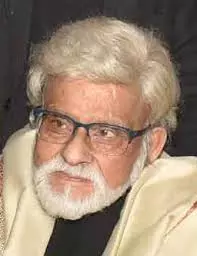
In this excerpt from the centenary edition of A Brush with Life, Satish Gujral recalls how he met and came to have kinship with Frida Kahlo that culminated in her final days, her cremation, and a precious memory

I first saw Frida Kahlo’s paintings in 1953, in her first-ever solo exhibition. She came to the inauguration against her doctor’s advice. She arrived in an ambulance and was seated on a thronelike bed decorated with posters of her paintings. The gallery Arte Contemporaneo was crowded with celebrities of the Mexican art world and leftist politicians.
Her paintings were autobiographical, bewitching and stunningly powerful. They heralded what came to be known as narrative art. The exhibition was to elevate Kahlo to cult status almost immediately. I was told that her work graphically depicted the physical and emotional suffering she had undergone.
Frida Kahlo had been stricken by polio at the age of seven. She had been in and out of hospitals all her life, suffering from multiple ailments. She had been written about in medical journals round the world. She was of Jewish descent, the daughter of a Hungarian photographer and painter. From her student days, her life had revolved around the famous artist Diego Rivera. She was said to have announced her intention of having a child by Rivera, who was twice her age. She managed against all odds to marry Diego, then divorced him only to remarry him after a few years of separation.
Meeting Frida at her residence
Despite her obsession with Rivera it was surprising that her work did not bear the remotest influence of his style. A chance encounter with a young Argentine writer named Raquel Tibol, who came to stay in the Casa de Huéspedes, made it possible for me to meet Frida Kahlo many times. Raquel was working on a series of articles on Mexican artists.
As her interview with Frida progressed, Raquel kept other guests in the Casa fully supplied with details about the artist’s life and work. Most of the information was about Frida’s illness. Recently she had been compelled to have her right leg amputated. It was a case of ‘osteomyelitis’. The mention of this word brought back stark memories of my childhood agonies. I began to take greater interest in the Argentine lady’s stories. She sensed the depth of my curiosity and began to visit me in my room. She also told Frida Kahlo about me.
Also read: The Robe and the Sword review: How Asia's non-violent Buddhist monks became extremists
Early in 1954 Frida asked the Argentinian to introduce me to her. I was very excited. I read her medical history, which she described vividly to people who came to interview her, and later became valuable source material for her biographers. Her paintings expressed her physical and emotional pain. Having been through the same ordeal I developed an affinity for her.
Before taking me to see her Raquel gave me another insight into Frida’s life, something she had not mentioned in her detailed descriptions at the dinner table. Though a full-blooded Communist, long year of intense suffering had made Frida turn towards spiritualism. She had recently read a volume of Jiddu Krishnamurti’s lectures delivered during one of his visits to Mexico. Raquel thought one of the reasons Frida had shown an interest in meeting me was perhaps that since I was also a Hindu I must be familiar with the sacred texts which discussed the path to nirvana.
This made me very anxious, as my knowledge of the Upanishads and the Gita was less than minimal. My commitment to Marxism had made me indifferent to scripture. However, I looked forward to seeing Frida. Being received by her was regarded as a rare privilege. Raquel took me to Frida’s residence in Coyoacán. Diego had gifted it to her after Trotsky’s assassination in the same house.
A macabre memory
Frida was lying in bed on her stomach. She had recently undergone spinal surgery. She continued with her painting as she had throughout her illness. She rested her chin on a pillow and had a specially designed easel placed before her. She asked me to sit beside her pillow. In her illness she was a pathetic sight, yet her face had a strange radiance. Like most Mexicans I met, she began by expressing profound admiration for India, its culture and spiritual traditions. She went on to discuss the Upanishads. Raquel came to my rescue by changing the topic of conversation to the illness which had afflicted both of us. Frida asked me to tell her how it had begun and what kinds of medical treatment I had received. We developed an immediate rapport that lasted till her death, which occurred six months later.
Also read: The Dig review: Why Keeladi findings matter to India’s present as much as its past
Frida was a very generous woman. She showered me with gifts each time I called on her: it was a basket of art material one day, a package of books on another. She also sent me fruits and other delicacies every other day. During these months I seldom saw Diego Rivera, who lived separately. He moved in with her when it became obvious that her end was near. He noticed Frida’s affection for me. When she died, he included me among the few given the honour of keeping vigil by her coffin as she lay in state at the Palace of Fine Arts. I was also privileged to be one of the pallbearers on the journey to the crematorium. Others included the former President, Lazaro Cárdenas.
I have strong memories of Frida for yet another reason. Her bent towards Hinduism induced her to make a final request that her body should be cremated rather than buried. At the crematorium of the Panteón Civil de Dolores, Diego and some family members laid Frida’s body onto a chute. As the chute slid into the oven, the intense heat forced the corpse into a sitting position; her hair rose to form an aureole around her head. The macabre scene haunted me for many years. Far from being a nightmarish reminder of a tragic death, it has become one of my most precious memories.
(Excerpted from Brush With Life: An Autobiography by Satish Gujral, with permission from HarperCollins India)