How Subramanian Swamy came to meet and receive guidance from Mahaperiyava
‘Mahaperiyava and Subramanian Swamy’, a chapter of the new book God in Kanchi: Life Story of Chandrasekharendra Saraswati (1894–1994), writes of the ‘unlikely’ bond forged between the political leader and the seer. An excerpt.

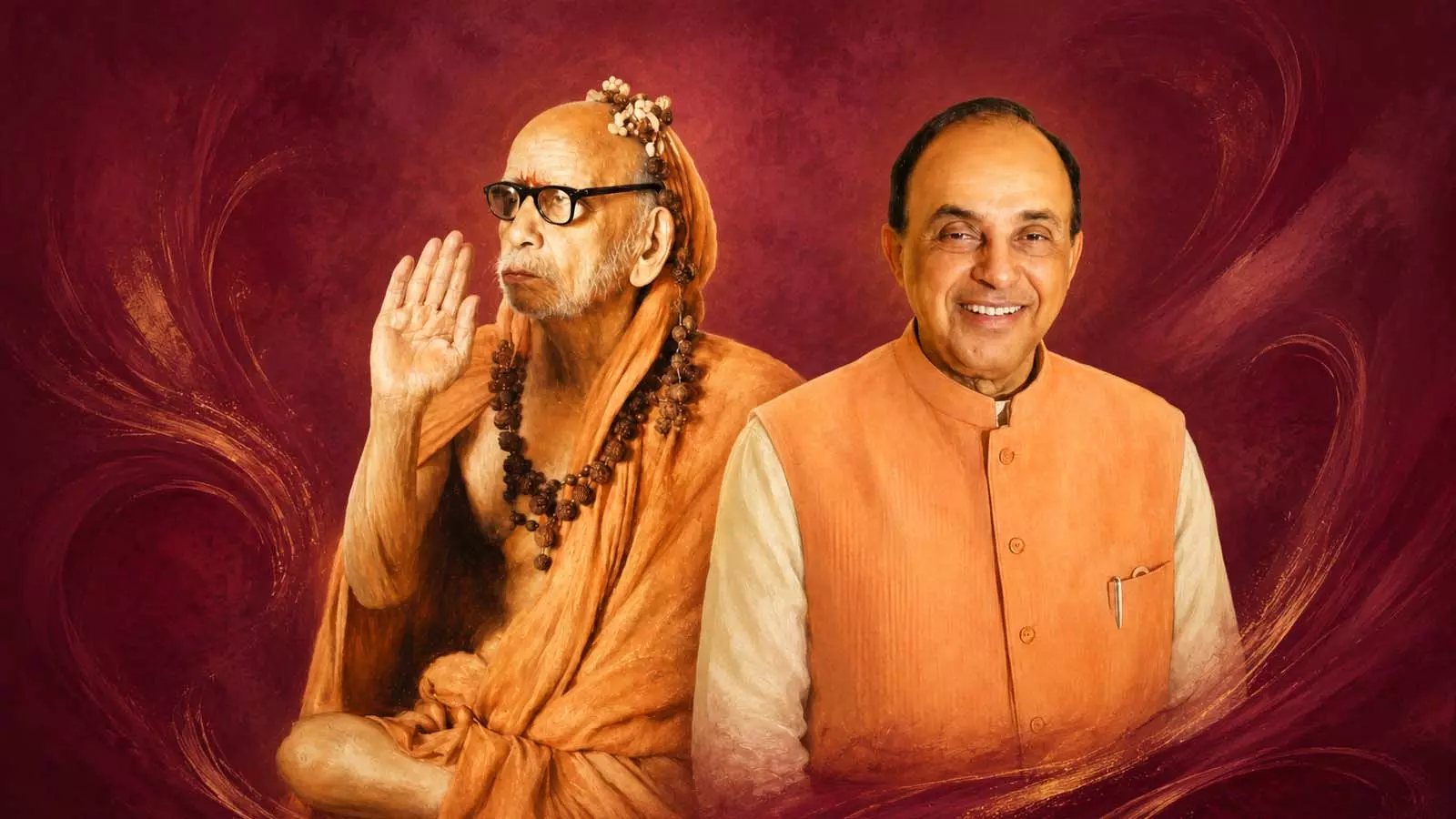
The Mahaperiyava and Subramanian Swamy.
By his own admission, veteran Indian political leader Subramanian Swamy considered himself a most unlikely person to ever earn the blessings of the god in Kanchi.
Born and raised in Delhi and educated later at Harvard, Swamy had no ties with Tamil Nadu, much less with the Mahaperiyava. Indeed, he had not heard of him until 1968 when he saw a small framed picture of the saint at the hostel room of an Indian student in Harvard. The photo, however, struck him as one not of an ordinary sadhu but a learned seer.
It was years later when Swamy saw a Periyava image again. This time was it was a mental illusion. The year was 1976 when Swamy was flying to New Delhi from the US. The Emergency rule imposed by Prime Minister Indira Gandhi was in full force. Swamy was a wanted man, and there was an alert issued for his capture. But Swamy, at the urging of close friends, decided to take the risk of flying to India. His mission was to again escape to the US without getting caught.
As his aircraft neared Delhi, Swamy wondered how he could pull through the daring act. His first plan was that as he was without any luggage, he would simply walk out of the airport as if he was a visitor, not a traveller. But that did not fructify as all the passengers were escorted to the immigration area.
That’s when a bright idea gripped Swamy. He was anyway dressed in a white kurta pyjama like any Youth Congress activist. Exploiting his looks and dress, he entered the immigration counter and flashed his parliament card from a distance. Luckily for him, the immigration officer, unable to recognise him, got up and saluted him. Swamy had entered Delhi!
Swamy’s dramatic appearance in the Lok Sabha, the furore it created, and the equally mysterious way he managed to escape from India even though the authorities were hunting for him turned him overnight into a legend. It was also the occasion when Swamy decided that this would not have been possible but for the blessings of the holy person he had not yet met—Chandrasekharendra Saraswati.
That opportunity finally came by when, in 1977, Swamy was on a tour of Tamil Nadu as part of the election campaign when the Emergency was over. As he and his associates were driving through Kanchipuram, he saw a crowd and many parked vehicles at one place. He was told that the Mahaperiyava was camping there, slightly away from the Math.
Swamy decided to call on the saint. He walked into the camp where the Periyava was present, talking to a small group of devotees. As Swamy and the Mahaperiyava saw each other, an extraordinary thing happened. For reasons that were unclear, the sage suddenly got up, turned his back to Swamy, went into a room and shut the door.
A baffled Swamy did not know what to make of the happening. He surmised that the Mahaperiyava did not want to meet him. So, Swamy quickly retreated from the camp. Just as he neared his car, an aide of the Mahaperiyava came running and told Swamy that the sage wanted to meet him. Swamy turned back and presented himself before the learned one.
“Who gave you the authority to leave (the camp)?” asked the Periyava. Swamy, his command over Tamil then not very good, said he assumed the saint did not want to meet him and so had bolted himself inside a room. The Mahaperiyava explained that he went to the room to look for a news clipping. He handed over his findings to Swamy, asking him, for good measure, if he knew how to read Tamil. Yes, Swamy said he could.
The clipping was from a Tamil magazine, Dinamani Kadir. It was in the Q and A page of the journal. A reader wanted to know if Swamy was indeed a Tamil, to which the editor replied in the affirmative. “Is this not you?” asked the Periyava. When Swamy agreed it was about him, Periyava remarked, “Now you may leave.”
Swamy’s second encounter with the Periyava happened after the election campaign concluded in 1977. This time too, the sage was camping at the same place. But unlike the first time, the saint asked everyone else to leave when he saw Swamy arrive. Much to the amazement of others, the sage ended up chatting with the young politician for one and a half hours.
The Periyava brought up both national and international events with Swamy, giving a good idea of how well informed he was despite being a Hindu religious leader. He askedSwamy pointedly if he had become a minister in the Janata Party government of Prime Minister Morarji Desai. The latter answered in a disappointed way that he had missed the bus despite his active role against the Emergency largely due to ego clashes within the Janata Party.
It was then that the Mahaperiyava gave him some invaluable advice: “Don’t run after posts (power). The posts will come looking for you.” Swamy never forgot the counsel.
The sage then surprised Swamy by citing the example of the Dravidian icon, E.V. Ramaswamy Naicker or EVR, as he was popularly known, as one who knew how to achieve his aim in politics. Surprised, Swamy pointed out that EVR was an atheist and passionately anti-Hindu.
Periyava said that EVR had changed “everyone’s mind” with his powerful political rhetoric demonising Hindu gods and goddesses. At the same time, EVR faithfully looked after a family Hindu temple in Erode due to requests from his late father. EVR, the Periyava said, found nothing contradictory in his conduct; he was anti-Hindu religion politically but he would oversee the family shrine as part of his filial duty.
The Periyava asked Swamy which countries he admired the most. When Swamy named the US, the saint rejected his choice. According to the Mahaperiyava, the two countries India needed to forge close and friendly ties with, for its own good, were Israel and China. Swamy was stunned. Relations between India and China remained strained despite Indira Gandhi’s overtures to Beijing during the Emergency period. As for Israel, it was a pariah state in the eyes of most Indians, political parties included.
Nevertheless, at the urging of the Mahaperiyava, Swamy approached Prime Minister Desai with a suggestion that it would be good to improve ties with China. Desai was aghast. He was passionately anti-China. Still, on Swamy’s insistence, the prime minister allowed him to travel to Beijing as his emissary with the message that India’s new government would remain non-aligned in the event of a conflict between the Soviet Union and China.
The Chinese were happy to get the message. The Chinese Communists had always viewed India as a member of the Soviet orbit. In response, China’s supreme leader Deng Xiaoping announced from Nepal that Beijing was ready to forge relations with India’s new government and that discussions could be held on the contentious “disputed territory”. This was a major development since the Chinese until then used to call the entire zone in the winding frontier as their territory, and not as disputed.
Morarji Desai was immensely pleased with what Swamy had managed to achieve. It was then decided that India should seek access to Mount Kailash in Tibet. The snow-capped peak in the Himalayan range is considered very sacred by Hindus. The government was divided on the subject, with those like Madhu Limaye, a socialist, firm that “communal matters” should not figure in bilateral relations. However, by the time the next meeting with the Chinese took place, the Janata Party government collapsed and Indira Gandhi returned to power with a thumping majority.
When Deng invited Swamy to visit China, the Mahaperiyava encouraged him to talk about Mount Kailash.
Initially, the new Congress government was not sure how Beijing would approach the issue. When Deng heard the request, he told Swamy that Beijing was willing to open the sacred mountain to Hindu pilgrimage “provided you go first.”
Then Indian external affairs minister P.V. Narasimha Rao was pleasantly surprised when a Chinese official delegation visiting India insisted that Swamy should lead the first batch of pilgrims to Mount Kailash. But China made it clear that the trek would not be opened to Muslims and Christians, only Hindus.
“What magic have you done on the Chinese?” asked a bewildered Narasimha Rao. It was around this time that the elderly Rao and the young Swamy became friends.
Swamy led the first delegation of 20 pilgrims to Mount Kailash in September 1980. Before that, Swamy flew to Tamil Nadu and shared a personal problem with the Mahaperiyava. It was that the duration of the pilgrimage clashed with his birthday. He had promised his daughters that come what may, he would celebrate the day with them. But this would not be possible if he went to Mount Kailash. The Acharya waved him away with a blessing.
It was a tough journey on foot. Swamy, however, endured it and made it to Mount Kailash. On the return trip, when Swamy reached the Indian border at Kalapani on 13 September, a surprise awaited him. He was shown a telex message from New Delhi that he alone would be flown to New Delhi by an Indian military helicopter at the request of the prime minister. That is how Swamy landed in Delhi on the evening of 14 September and he could celebrate his birthday with his family the next day! “This was the power of the Acharya,” he would happily remark later.
Swamy was summoned to Kanchipuram in 1990 by the Mahaperiyava. He later learnt that both he and Rajiv Gandhi, who then led the opposition as the head of the Congress party, were to speak at an event. Swamy was initially mystified since he did not have great relations with the Nehru– Gandhi family. But this was a request of the Acharya whom he respected immensely. In the event, the two politicians addressed the gathering.
Unknown to Swamy, the meeting broke the ice between the two men, Gandhi and Swamy. Perhaps this was the doing of the Mahaperiyava, who saw that the coalition government of Prime Minister V.P. Singh was tottering. That government soon fell and Chandra Shekhar, who was close to Swamy, became the prime minister at the head of a minority government with the backing of the Congress. Swamy became a cabinet minister.
Later, when Narasimha Rao himself became the prime minister after the 1991 assassination of Rajiv Gandhi, Rao wanted Swamy, whom he considered a friend, to join his government. But Rao had a condition: he wanted Swamy to embrace the Congress.When Swamy mentioned this to the Mahaperiyava, the latter told him not to join the Congress. Vendave vendam, the sage said in Tamil with a touch of finality, meaning: “Absolutely no.”
Once, Swamy was on his way from Bangalore to Vellore in Tamil Nadu when his car suffered a flat tyre close to midnight. It was a godforsaken place, and Swamy did not know what to do. As he stood on the roadside, worrying how and where to spend the night, a van from the Kanchipuram Math drove to the spot with a spare car wheel! Completely baffled, Swamy asked the men in the car how they knew he was in trouble. One of them replied, “The Mahaperiyava told us to go to this spot. He said one of the tyres in your car had got punctured. He wanted us to carry this spare tyre.”
“This was the magic of divinity,” Swamy would say years later. “We will never be able to see another spiritual giant like him ever.”
According to Swamy, he became a blind follower of the Mahaperiyava in a very short time. This was the main reason, he said, why he was not afraid of anyone in Indian politics. “If I had not met him, I would have been like anyone else.”
Swamy recalls that before attaining samadhi in 1994, one of the last things the Periyava told him was that India was free but not independent. India, the sage underlined, would make progress only when it deftly combined material and spiritual advancement, not otherwise.
[Extracted from the book, God in Kanchi: Life Story of Chandrasekharendra Saraswati (1894–1994), written by M.R. Narayan Swamy. The 312-page book (including inserts), is priced at Rs 595 and has been published by Konark Publishers Pvt Ltd, New Delhi, in June 2026.]