



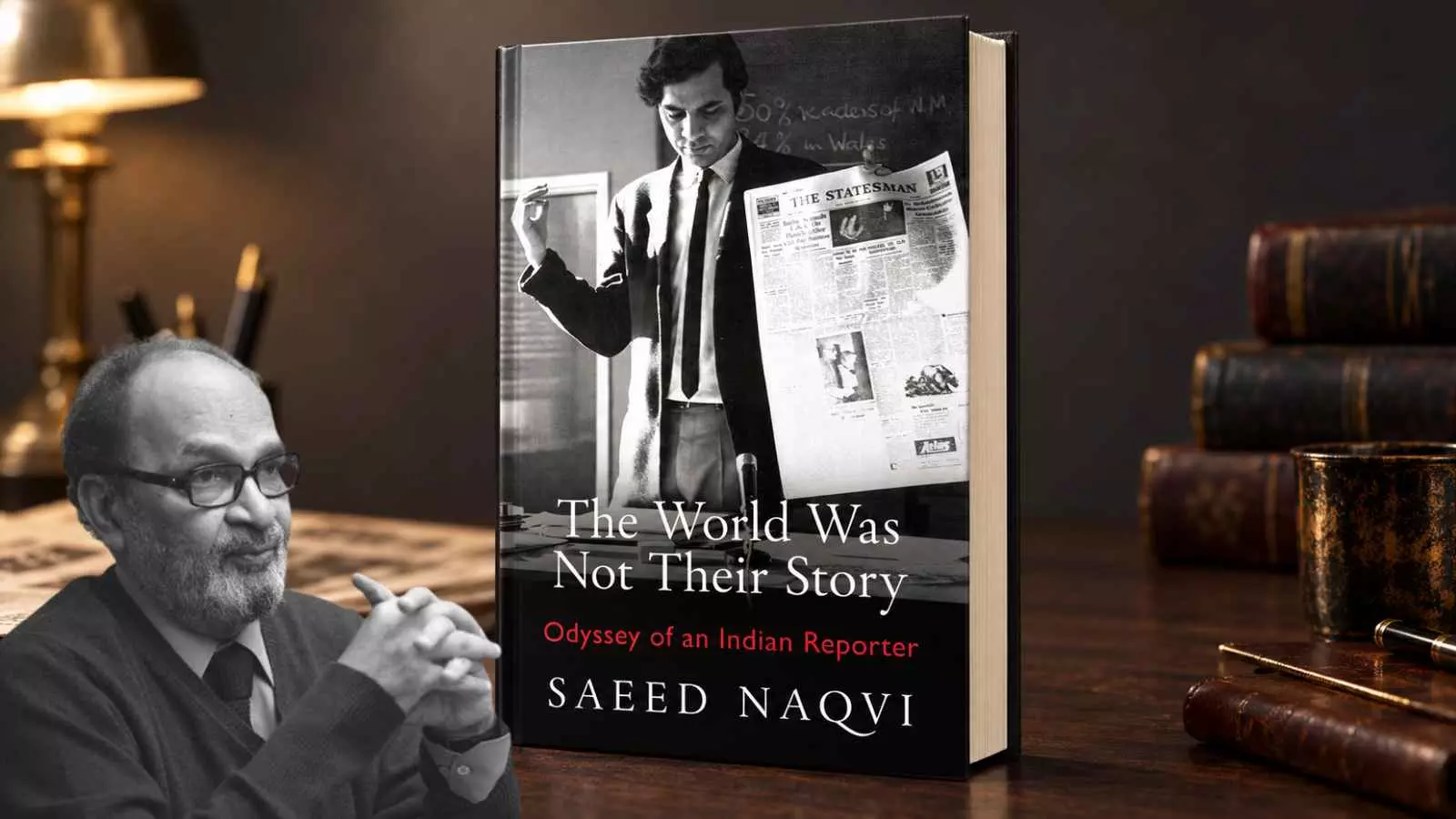
The World Was Not Their Story review: A reporter’s journey beyond ‘navel-gazing’ beat
In his memoir, veteran journalist Saeed Naqvi chronicles his brush with iconic world leaders, landing regime-changing scoops, and presenting the world from India’s eyes

“Indians love to contemplate their navel,” a former editor of mine often said.
He meant that Indians were self-absorbed, while also regarding themselves as culturally superior to the rest of the world. After all, we have a 5,000-year-old civilisation to boast of. This, combined with the fact that newspaper owners are reluctant to spend money on news gathering and sending reporters abroad, has traditionally been Indian journalism's weakness – as that would involve unnecessary expenses and cut into proprietors' profits.
As an alternative, editors were asked to rely on western news feeds for their international coverage. The result is that much of what Indian readers know about the world is through a western lens. “An uncritical acceptance of the western point of view has become part of the psyche of the Indian elite,” says veteran journalist Saeed Naqvi.
A reporter’s memoir of an ignored beat
A lot has changed in Indian journalism since Naqvi began his journalism in the 1960s, but this core principle of being tight-fisted about money spent on news gathering has remained. Proprietors get excited only when the prime minister visits, television reporters follow his entourage, and television channel viewers are almost carpet-bombed with his meetings and appearances while abroad. The coverage is not about the country but the prime minister. But consistent coverage of foreign policy by posting correspondents abroad is sadly missing to this day.
Also read: The Social Life of Indian Trains review: Amitava Kumar’s portrait of a Republic in motion
Saeed Naqvi’s book The World Was Not Their Story: Odyssey of an Indian Reporter, is a fascinating and delightful account of his journey as a bright young reporter that began with The Statesman, then still under a British editor, to his time as the Indian Express regional head in Chennai and finally on to the World Report, an independent venture he later started to cover world events and view events through an Indian or, more accurately, a non-Western, perspective.
Illustrious career, interview with change-makers
A combination of talent, hard work and luck, allowed him to cover major international events. His television reports were mainly telecast by Doordarshan.
He is perhaps the only Indian journalist to have had a ringside view of major international events and interviewed many world leaders.
Naqvi was there on the day Nelson Mandela was freed from prison. He was privileged to also be the first journalist to interview the iconic freedom fighter after he was freed. “But this was a world scoop — alas not the first to be telecast,” writes Naqvi in his book. “There was no way of sending out my interview to Delhi. Such journalism was far, far beyond the imagination of the management of an Indian TV channel.” The travails of journalists of the developing world at that time were immense.
Also read: Why motivational books continue to see market demand
Naqvi also interviewed Cuba’s revolutionary president Fidel Castro, Jerry Adams of the Sinn Féin at a time when the British had imposed voice restrictions on him. Adams surprised Naqvi with the depth of his knowledge about India and its anti-colonial struggle against the British. Muammar Gaddafi, Mikhail Gorbachev before the break-up of the former Soviet Union, Kenneth Kaunda, the first president of Zambia, Egypt’s Hosni Mubarak, you name it and Naqvi had met and interviewed them all.
He was in Iran to cover the 1979 Revolution that deposed the Shah (Mohammad Reza Pahlavi) and ushered in the theocratic government that continues to have a firm grip on the country to this day. He covered Operation Desert Storm in Iraq, when Saddam Hussain was forced to retreat from his occupation of Kuwait. Closer home, he went to Pakistan during Zia-ul Haq’s tenure. He has lovely pictures of his assignment in Pakistan where he was accompanied by photographer Raghu Rai.
Delhi-hopping with Shirley MacLaine
But it was not just presidents and prime ministers that Naqvi spoke to; he also rubbed shoulders with Hollywood stars like Shirley MacLaine, taking her for thandai (a cooling drink) at a Bhang shop in Hauz Khas and escorting her to historical monuments in the capital. She had become a major star after her work in director Billy Wilder’s masterpiece The Apartment. While her knowledge of Satyajit Ray and his work was not surprising, she also knew a lot about the country's north-eastern region and impressed Naqvi with her knowledge of Prime Minister Jawaharlal Nehru, the journalist writes in his memoir.
Also read: Why Kanupriya Dhingra’s The Sunday Book Bazaar is a bibliophile's ode to this iconic Delhi market
At the request of colleagues, Naqvi took MacLaine for an interaction with Indian journalists at Delhi’s Press Club. The majority of those in attendance knew little of MacLaine’s films. The first question directed to her by a senior journalist at the Press Club was on her views on the Vietnam War. MacLaine expected questions about her career and the question put a damper on the presser. There is a lovely picture of MacLaine in a sari walking around with a young Naqvi at her side.
Ashram retreat with The Beatles
As a young intrepid reporter, Naqvi managed to get entry into Maharishi Mahesh Yogi’s Ashram in Rishikesh, where the Beatles spent time in 1968. The ‘Fab Four’ arrived in India seeking solace after the shocking death of their 32-year old manager, Brian Epstein, who died of an overdose of prescription drugs and alcohol in 1967.
The Beatles were a major story, and the big names of the world press parachuted into India to cover their quest for peace in Rishikesh.
Also read: #MeToo & beyond: Shuma Raha’s book, The Sea has the Answers, uses a wife’s journey to reflect on soc
But none were allowed into the ashram, where great care was taken to ensure that the press did not intrude and disturb the VVIP guests. Naqvi’s book also have some rare pictures of holi in Rishikesh.
Naqvi says while he as a young reporter, got an insider scoop, the “fuddy-duddy” Statesman gave these stories scant coverage. Luckily for Naqvi, the Junior Statesman, JS, then edited by Desmond Doig, realised the worth of those reports and splashed them across its pages to make up for the stodgy main paper. Desmond Doig was also a friend of Shirley MacLaine and had got Naqvi to escort her in Delhi.
‘Role’ in breakdown of talks pre-Emergency
As always, luck played a role in Naqvi’s career, when he was sent by the Statesman for a training programme to Cardiff and through his connections landed a job in London with the Sunday Times. During Pashtun independence movement leader, Badshan Khan, the Frontier Gandhi’s year-long visit to India as a guest of the government, Naqvi was appointed as the VIP guest’s press adviser and traveled with him across the country.
While covering the Bihar students' agitation Naqvi gained the confidence of Jayprakash Narayan who was leading the anti-government movement. Ahead of Indira Gandhi’s proclamation of the emergency in 1975, serious efforts were underway for negotiations between the movement leaders and the government. The talks were going well and expectations of a settlement were high, till a story by Naqvi splashed across the front page of The Statesman, led to a complete breakdown of negotiations.
There was speculation all around at that time over who had leaked the story to ensure that the talks failed. Many suspected Sanjay Gandhi, the then prime minister’s son, who advocated a tough line. Few realised that it was JP himself who gave the story to Naqvi!
Naqvi's story, told in an easy-flowing style, is a must-read for anyone interested in journalism, as well as for those who want a glimpse of a world that Indian readers have too often encountered through Western eyes. His career is a reminder of what Indian journalism can achieve when it looks beyond its own borders and invests in telling the world's story for itself.