How a bouquet of recent & upcoming publications is drawing attention to Bengal’s terracotta temples
Seventy-five years after late artist Mukul Dey’s significant work on West Bengal’s terracotta temples, the structures are back in focus, at least in print. The temples may be in dire need of conservation, but the publications prove that there is no dearth of interest in these old, baked clay constructions, which remain works of art.

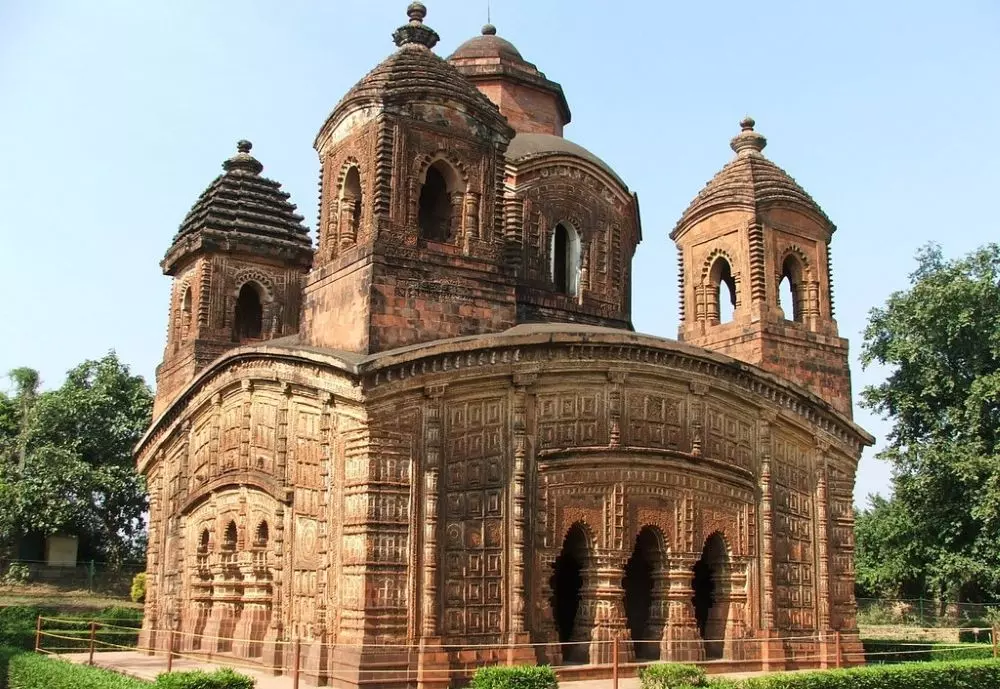
Shyam Raya Temple, Bishnupur, 1643. Photo courtesy: Amit Guha
Between 1946 and 1951, late artist Mukul Dey (1895–1989), undertook a photo documentation of terracotta temples in 25 rural locations in Bardhaman and Birbhum in West Bengal, travelling in a bullock cart equipped with a dark room. The project yielded 5000 photographs. The images captured the exquisite ornamental friezes and other architectural features of these temples, which narrated stories from the Indian epics Ramayana and Mahabharata and recounted other tales from Indian mythology — the Hindu deity Krishna’s colourful exploits, for example. Also depicted were the socio-political realities of those times in Bengal, including the presence of the Colonial masters, presented through the medium of baked clay or terracotta.
In 1959, Lalit Kala Akademi published Dey’s book, Birbhum Terracottas, which featured 65 of these photographs.
18th Century Patpur temple, Bishnupur. Photo courtesy: Amit Guha
In November 1951, in an article published in Illustrated Weekly, Dey wrote: “Thousands of Siva, Vaishnava and Kali temples are scattered all over Birbhum. They are built of brick, sand and lime plaster.... Most of these temples lie in ruins. But in many of them still remain beautiful specimens of baked clay terracottas depicting figure compositions in decorative panels.”
Dey was not the first to draw attention to the rich terracotta temple heritage of West Bengal.
Before him, Joseph David Beglar (1845–1907) an Armenian-Indian engineer, archaeologist and photographer, who was an assistant to Alexander Cunningham of the Archaeological Survey of India, and Gurusaday Dutt (1882-1941), a civil servant, folklorist, and writer, had both drawn public attention to these temples.
Now, 75 years after Dey’s work, Bengal’s famous terracotta temples are back in focus this year, with a bouquet of recently published and soon-to-be-published books highlighting these heritage structures. The temples may be in dire need of conservation, but publications prove that there is no dearth of interest in Bengal’s terracotta temples.
Social media impact
London-based engineer-turned art historian Amit Guha, whose informative and well-researched guidebook, Tapestries in Brick: A Guide to the Architecture of Bengal, was published in June this year, says in an interview over the phone: “Based on numbers from surveys, we think about 1000-1500 terracotta temples were built between 1600 and 1900. Of these about 400-500 survive”.
He adds that not all districts in West Bengal have been meticulously surveyed. “Which means that there are more temples to discover, especially, I think, in Bankura and Birbhum,” says Guha, who studied engineering at IIT Kharagpur and art history at the SOAS University of London.
The current interest is certainly at least in part fuelled by social media, particularly Facebook, which has specialised groups on them both in English and Bengali. Guha comments: “There is a Bangladesh Monuments group on Facebook with some enthusiastic field workers who regularly post pictures of temples and mosques that I have not seen in any of the surveys”.
18th century Shiva temple in Bardhaman. Photo courtesy: Amit Guha
The art historian spent more than two decades scouring hundreds of Bengal villages and exploring the “Buddhist, Persian, Hindu and European origins of their architecture”.
Another significant publication is Brick Temples of Bengal: From the Archives of David McCutchion, Edited by George Michell, Preface by Satyajit Ray. Niyogi Books’s October publication, the book is a reprint of the original ‘80’s publication based on David McCutchion’s (1930-1972) surveys undertaken in the 1960s. Over 15 years, McCutchion had documented terracotta temples scattered all over the Bengal countryside. He was accompanied by Tarapada Santra, Hitesranjan Sanyal and Pranab Roy, who had contributed independently to the research on terracotta temples.
McCutchion’s major work, published posthumously in 1972, was Late Mediaeval Temples of Bengal: Origins And Classification. This was the first detailed study of these temples and McCutchion had left behind a vast archive of about 15,000 photographs and other material. Michell continued where McCutchion had left off.
In 1975, Robert Skelton, then curator of London’s Victoria & Albert Museum, had chosen Michell to continue McCutchion’s work with the grant the latter had won before his death. Initially, Michell knew next to nothing about these temples. He made selective drawings of the sculpture and architecture of the 1,620 temples McCutchion had documented. What was missing from the archive was the map needed to locate the temples. The mapping was already done by Shambhunath Mitra, a Central Public Works Department engineer, and “this gave geographical precision to David’s work”, Michell had once commented.
The collaboration resulted in the ‘80s compendium, Brick Temples of Bengal: From the Archives of David McCutchion, which Niyogi Books has now reprinted.
Included in the book are an index of the temples, maps commissioned for the book, and short contributions by Tarapada Santra and Zulekha Haque, a Bangladeshi researcher of ancient and medieval art of Bengal and wife of renowned researcher Enamul Haque.
George Michell writes: “Built between the sixteenth and nineteenth centuries, the temples of Bengal form one of the most distinctive groups of sacred monuments in India…The chronological span of the temples is also significant, coinciding with the emergence of a new Bengali culture.”
Yet, these terracotta temples are not as well-known as the ones in the rest of India.
George Michell explained in an email that several factors are responsible for this situation. “They are ‘late’ — that is, from the 16th century onwards — and do not have the prestige of being ‘early’ — dating back to the 5th-6th centuries. They are small and extremely numerous; no single, famous ‘great’ monuments (like the Brihadishvara in Tanjore, or the Surya temple at Konarak); though the cluster at Bishnupur has attracted attention.
Many temples are in remote rural locations, in the care (or neglect) of local families.
“The temples are not much visited, even by educated people in Kolkata!
Another factor is that the temples are divided (unevenly) between the two Bengals”.
Where the UNESCO inscriptions are concerned, Bishnupur would be “appropriate” for inclusion in the list of heritage sites, Michell wrote.
Living in books
Brick Temples of Bengal is not Niyogi Books’s only recent publication on Bengal’s terracotta temples. In August, the publisher released Terracotta Temples of Bengal with photographs by Sanjay Das and text by Subhra Mazumdar. Das is a graphic designer-turned-photographer, Delhi-born and based, who discovered the terracotta temples of Bengal when he first visited Kolkata in 2011 to hold an art exhibition. He was 42 then and he has since driven down from Delhi to 11 remote villages of West Bengal, occasionally to chance upon these temples.
Instead of following the beaten track, Das has focused on “documenting and discovering” sites that are usually overlooked by tourists such as Itonda, Khardah and Kanchrapara, although Bankura and Bishnupur are also there. His aim is to pique the curiosity of viewers.
Rasmancha, 19th century, Medinipur. Photo courtesy: Amit Guha
Another important work on Bengal temples which is poised for publication is Hitesranjan Sanyal’s doctoral dissertation entitled Temple-Building Activities in Bengal: A Social Study, 1450-1900, submitted to the University of Calcutta in 1973. It is now being published by Jadavpur University for the first time.
Sanyal had done extensive, meticulous and painstaking fieldwork in south-western Bengal often accompanied by Tarapada Santra, Dipak Ranjan Das, Daniel Thorner, Partha Chatterjee and his collaborator David McCutchion. His detailed photographs of these temples reflect his knowledge of their architecture and finer points.
Sanyal had joined the Centre for Studies in Social Sciences in 1973 as a fellow in history and he remained there till his death in 1988. As an academic, he had varied interests. According to the introduction to the dissertation by Debjani Chakrabarty, “For his doctoral work, Sanyal explored the expression of indigeneity through architecture rather than a narrow artistic or stylistic history”.
There is another book to add to the list of recent or upcoming publications on the terracotta temples.
Apurba Kumar Chattopadhyay used to teach zoology at Burdwan Raj College and, in between, became a postdoctoral research fellow at the Uniformed Services University School of Medicine, USA. He has travelled all over India and studied temples depicting Ramayana and Mahabharata. Cambridge Scholars Publishing brought out in January his Ramayana Depicted in Indian Temples, half of which is about Bengal’s terracotta temples. Chattopadhyay introduces readers to the plaques showing the seven ‘kandas’ of Ramayana in different temples and cites and analyses the corresponding textual references. He has been working on this for a prolonged period of time after his retirement, and has since published in Bengali three other books on similar themes.
Also read: IN PHOTOS┃The Cauvery gorge that might vanish: A trip to Mekedatu
These books did not happen suddenly. There are unnamed people who take a passionate interest in Bengal temples. Pradip Kar, who is with the Archaeological Survey of India, started his publishing house Terracotta in 2010, which has published a steady stream of books on anthropology, archaeology, and folklore and several titles on and by David McCutchion.
Interestingly, people in various professions have published books on terracotta temples. Shyamal Kumar Ghosh, a retired fingerprint expert and photographer, and Tathagata Sen, who is employed with a filmmaking company, are perfect examples of people who turned their interest into documentation of the Bengal terracotta temples.
Perhaps more such books can get these temples the care and conservation they deserve.