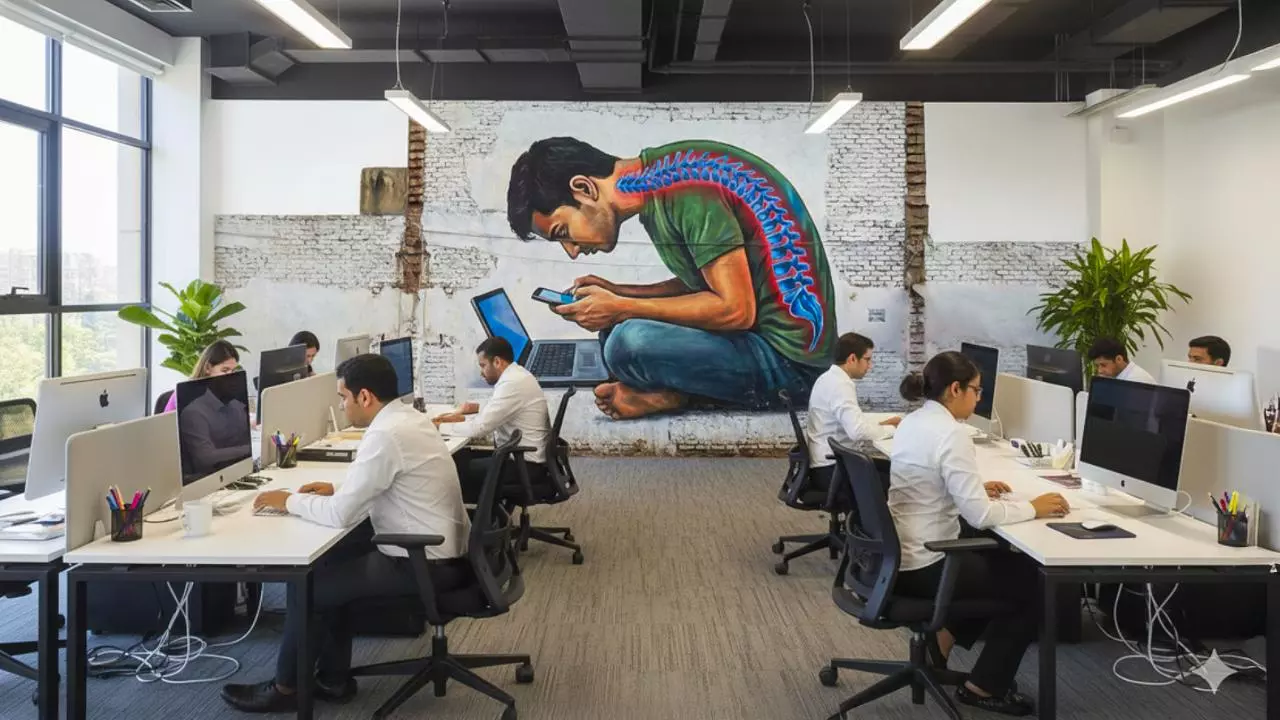
Doctors warn that India could soon see an entire generation under 40 coping with cervical and lumbar disc disorders if habits do not change
Second Opinion: Digital work culture, WFH, long working hours is hurting your spine health
There's a surge in spinal disorders among young Indians; doctors warn ignoring early symptoms could lead to lifelong damage and surgery. What experts advise

Long hours of screen time, back-to-back meetings from beds and dining tables, and poor posture are triggering a silent health crisis among young Indians.
Doctors warn that chronic neck and back pain is no longer an older person’s problem, but a growing concern for people between 25 and 45 years.
Experts say what many dismiss as “work stress” is often the spine sending out an SOS, and ignoring it could lead to long-term damage, including disc degeneration and even surgery.
Rising spine issues
A 2024 report by the Indian Spinal Injury Centre estimates that nearly 80 per cent of Indians experience back pain at least once in their lifetime, with over 10 million new spine-related cases reported every year.
Orthopaedic specialists say the shift to digital workplaces and work-from-home culture has accelerated spinal health issues, particularly among young professionals who sit continuously for eight to ten hours in poor postures.
Also read: Silent crisis of men’s mental health and the need to break stigma | Second Opinion
Dr Imtiaz Ghani, spine surgeon, explained, “People start working sitting for about 8 to 10 hours constantly. They slouch, they stoop, and they are not maintaining a proper posture. Gradually, this builds up and leads to neck pain, upper back and lower back pain.”
Posture and lifestyle
Dr Ghani stresses that ergonomics is not just about a chair or desk, but the posture adopted while working. “When you keep bending forward for a long period, it causes enormous strain on your neck and lower back,” he says, warning that some patients eventually develop radiating pain to the arms and legs, and in severe cases, require surgery.
He also highlights lifestyle factors such as lack of exercise, disturbed sleep, and poor diet as compounding forces. “You have to keep yourself active. For every 45 minutes to one hour of sitting, get up and walk for five minutes,” he advises.
Children at risk
A 2023 AIIMS study found that even children between 15 and 18 years are developing forward posture, muscle tightness, reduced flexibility and back pain.
Dr P Keerthivasan, orthopaedic spine surgeon, says the contrast between school and home environments is stark. “In schools, ergonomics were planned even in the 60s and 70s. At home, we failed to do that,” he noted.
Also read: Second Opinion: Diabetes ‘reversal’ claims rise online as doctors warn remission is not cure
He warned against children lying down and using laptops or mobiles for long periods. “That stresses the disc joints. These are growing bones. If they develop pain at 15 or 16, they have to live with that spine for the rest of their life,” he says, calling the trend deeply worrying.
Degeneration explained
What happens inside our body?
Dr Balaji Bashyam, consultant in advanced spine surgery, said his clinic has seen a 40 to 60 per cent increase in work-related cervical and lumbar issues. “The cause is deceptively simple — prolonged sitting, poor posture and badly designed home workstations,” he explained.
He added that prolonged slouching puts constant pressure on spinal discs, causing them to dry out, lose height and collapse. “This leads to nerve compression, sharp radiating pain, numbness, weakness and sometimes foot drop,” Dr Bashyam says.
As degeneration progresses, the body forms bony spurs to stabilise the spine, which can further compress nerves, making even short periods of sitting or walking extremely painful.
Preventable problem
What do experts advise?
Doctors emphasise that 80 to 90 per cent of spine problems linked to desk jobs and work-from-home culture are preventable with simple, evidence-based habits.
Dr Keerthivasan explained that the spine is designed for movement. “With every breath, there is movement in the spine. We must change posture frequently to give ligaments breathing time,” he says.
He cautions against prolonged mobile phone use with the neck bent forward. “The ligaments can tolerate stretch for only 20 to 30 minutes. Continuous pressure will damage them,” he explains, recommending screens at eye level for long meetings or movie watching.
Early signs matter
Doctors warned that India could soon see an entire generation under 40 coping with cervical and lumbar disc disorders if habits do not change.
Also read: Why breast cancer detection tools fall short for young Indian women
Early symptoms such as stiff neck, persistent lower back pain, or shooting pain down the arms or legs should not be ignored. Experts urge people to listen to their bodies, improve their work setups, stay active, and consult spine specialists before minor pain turns into a lifelong condition.
The content above has been transcribed from video using a fine-tuned AI model. To ensure accuracy, quality, and editorial integrity, we employ a Human-In-The-Loop (HITL) process. While AI assists in creating the initial draft, our experienced editorial team carefully reviews, edits, and refines the content before publication. At The Federal, we combine the efficiency of AI with the expertise of human editors to deliver reliable and insightful journalism.