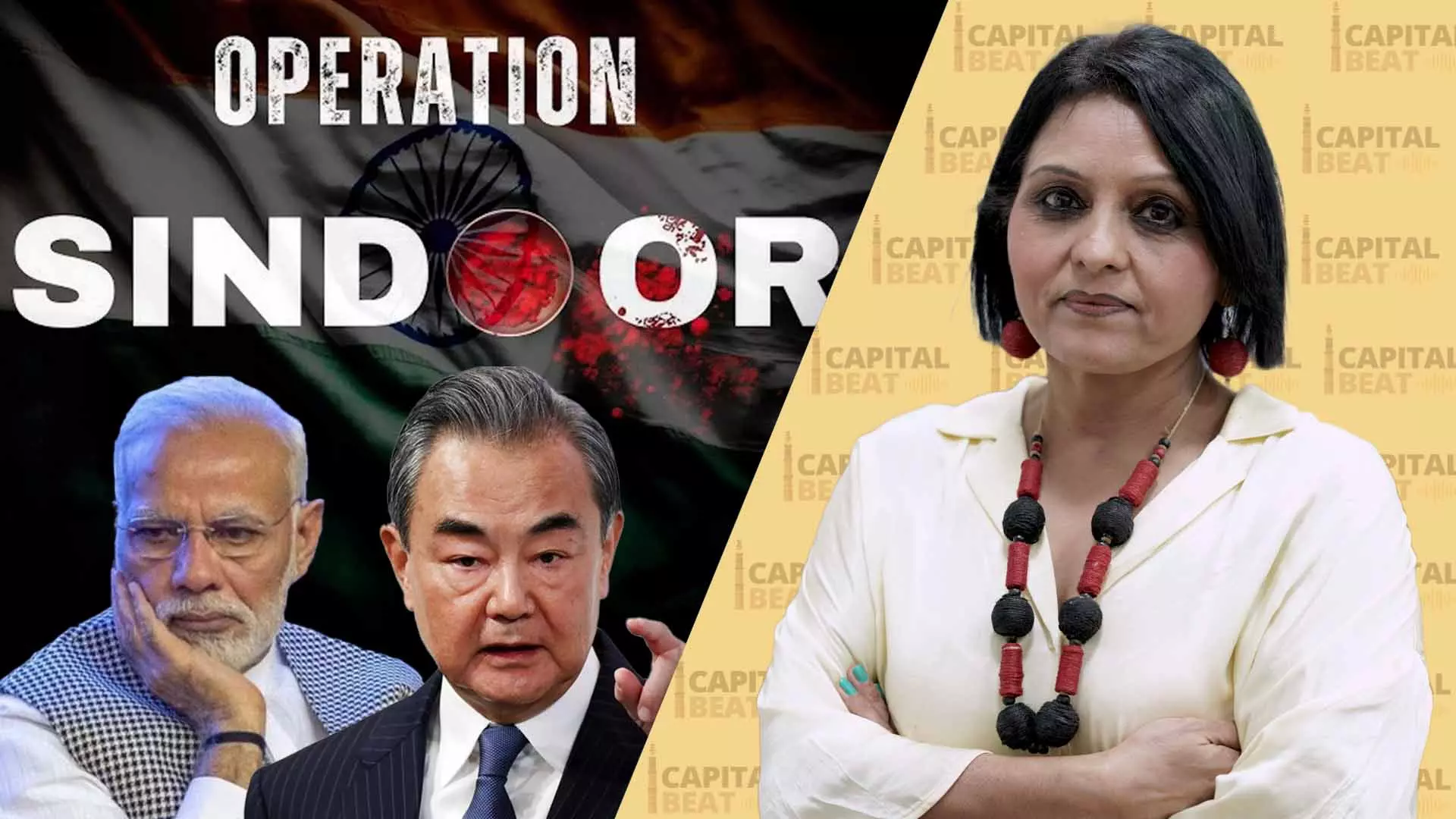
China claims mediating India-Pakistan standoff, raises questions in New Delhi
On Capital Beat, panellists examine Beijing’s assertion of a diplomatic role after the May conflict and the absence of an official response from India

Experts came together on yet another Capital Beat edition to discuss China’s claim that it mediated the India-Pakistan military standoff in May. The panel featured Sanjay Kapoor, international affairs expert and veteran journalist, and Pushpraj Deshpande, author and policy commentator. The central issue examined was the statement by Chinese Foreign Minister Wang Yi that Beijing played a mediatory role following the escalation that occurred after the Pahalgam terror attack in Jammu and Kashmir on April 22, in which 26 civilians were killed.
Wang Yi made the remarks while addressing a symposium on the international situation and China’s foreign relations. He stated that Beijing had taken what he described as an “objective and just stance” to promote peace and stability in multiple conflict zones. Among the situations listed were northern Myanmar, the Iranian nuclear issue, Palestine-Israel tensions, Cambodia-Thailand, and the India-Pakistan standoff in May.
Also read: Who is Ricky Gill, Indian-origin Trump adviser awarded for ‘Indo-Pak ceasefire’?
The claim marked the first time China publicly asserted a role in de-escalation during what India has referred to as Operation Sindoor. The statement drew attention because earlier assertions of mediation had come from US President Donald Trump, who repeatedly claimed credit for facilitating peace between the two nuclear-armed South Asian neighbours. In both instances, India has not issued a detailed official response.
Wang Yi’s statement and the diplomatic context
Wang Yi’s remarks were framed within a broader description of global instability. He said local wars and cross-border conflicts had intensified more frequently than at any time since the Second World War (1939-45). He added that China’s diplomatic approach focused on addressing both immediate crises and their underlying causes, positioning Beijing as an active participant in global conflict management.
Kapoor stated that the emergence of multiple claims pointed to external involvement in ending the conflict. He said, “The war would not have ended so abruptly if there was no mediation.” This encapsulated the concern that competing international narratives were filling a space left by India’s decision not to publicly clarify events.
During the discussion, the absence of a public reaction from the Ministry of External Affairs was noted. More than a day after the remarks were reported, no official statement had been issued either accepting or rejecting the claim. This silence mirrored India’s response to repeated assertions by Trump that he had mediated an end to hostilities between India and Pakistan.
Also read: 2025, when Modi's India found Trump 1.0 and Trump 2.0 to be cheese and chalk
Kapoor stated that the emergence of multiple claims pointed to external involvement in ending the conflict. He said, “The war would not have ended so abruptly if there was no mediation.” This remark encapsulated the concern that competing international narratives were filling a space left by India’s decision not to publicly clarify events.
The programme also recalled earlier public statements by senior Indian officials. Lieutenant General Rahul Singh, Deputy Chief of Army Staff, had said that during Operation Sindoor, India was confronting challenges that involved China’s alignment with Pakistan. These remarks were cited to underline why Beijing’s claim had triggered political and strategic scrutiny.
Opposition seeks govt response
The discussion referenced a statement issued by Congress leader Jairam Ramesh, who questioned the government’s silence. He pointed out that Trump had repeatedly claimed mediation, and that the Chinese foreign minister had now made a similar assertion. Ramesh argued that the government needed to clarify what role, if any, external actors played in the cessation of hostilities.
Deshpande noted that Wang Yi’s position as a senior member of China’s political leadership distinguished his claim from commentary by lower-level officials. He emphasised that the assertion had been made by a foreign minister with direct authority over China’s diplomatic messaging, increasing its significance in the regional context.
Also read: Trump’s new claim: ‘Threatened India, Pak with 350 pc tariffs to settle dispute’
He highlighted existing official claims that a large proportion of Pakistan’s military hardware used during the operation was of Chinese origin, and that Beijing had provided intelligence support to Pakistan. He stated that this made China’s claim of mediation particularly sensitive. “On one hand, China is militarily supporting Pakistan, and on the other, it is claiming a role in halting hostilities,” he said.
The panel noted that India’s stated policy has long rejected third-party mediation in matters involving Pakistan, especially on issues linked to Kashmir. This position has been reiterated by successive governments. The continued silence in response to claims from both Washington and Beijing was identified as an unresolved issue in public discourse.
India’s silence amid competing international claims
Kapoor observed that India had maintained its earlier position that no external mediation was accepted. He said that official communication had continued to emphasise bilateral military channels, particularly talks between the directors general of military operations, as the mechanism through which calm was restored.
Also read: Operation Sindoor | First strike was conducted at 1 am on May 7: CDS
The talks also referred to changes in regional and global dynamics. They noted that Pakistan’s engagement with the US, China’s strategic interests in South Asia, and shifting power equations had created a complex diplomatic environment in which multiple actors were asserting influence.
Deshpande said that the lack of an official, on-record clarification risked allowing external narratives to dominate. He pointed out that repeated claims of mediation — left unanswered — had implications for how India’s decision-making autonomy was perceived internationally.
As of the broadcast, no formal response had been issued by the Indian government to Wang Yi’s statement. The episode closed without resolution on whether India would address the competing claims publicly, leaving the question of mediation during the May operation officially unanswered.
The content above has been transcribed from video using a fine-tuned AI model. To ensure accuracy, quality, and editorial integrity, we employ a Human-In-The-Loop (HITL) process. While AI assists in creating the initial draft, our experienced editorial team carefully reviews, edits, and refines the content before publication. At The Federal, we combine the efficiency of AI with the expertise of human editors to deliver reliable and insightful journalism.