








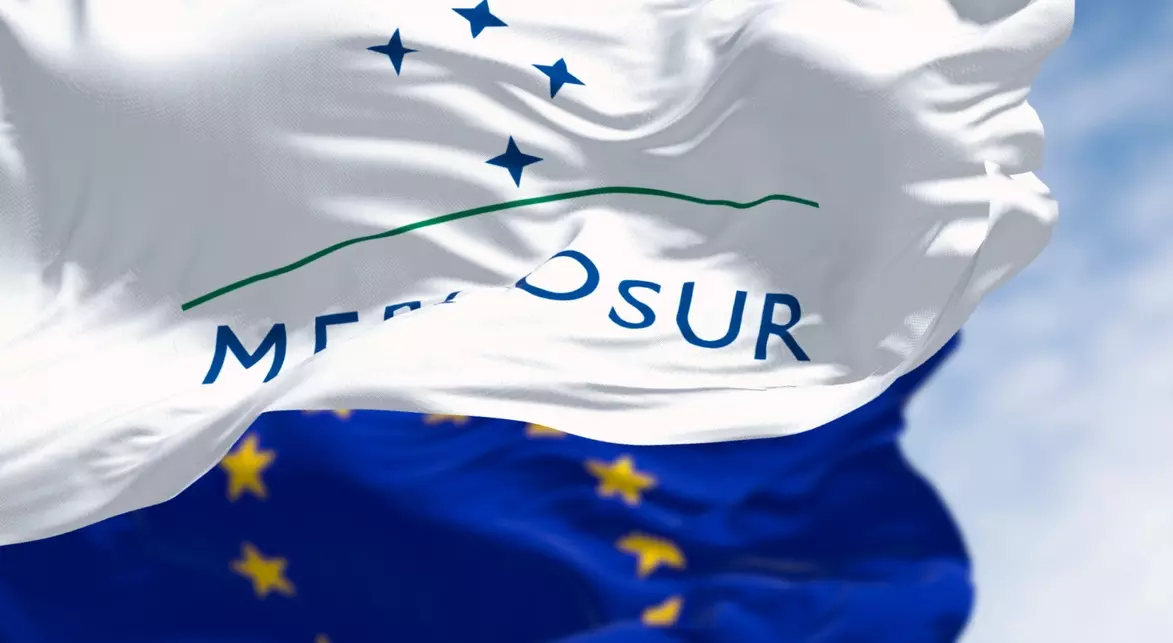
EU-Mercosur trade deal latest sign of global pushback against Trump tariffs
The EU and Mercosur have signed a landmark trade pact amid renewed Trump tariffs on Europe, signalling a wider global shift towards trade newer alliances

A bloc of South American countries has formally sealed a long-pending free trade agreement with the European Union (EU), a move widely seen as a strategic response to renewed tariff pressures unleashed by US President Donald Trump on European economies.
The agreement between the EU and Mercosur — comprising Argentina, Brazil, Paraguay and Uruguay — was signed on Saturday (January 17) in Asuncion, Paraguay, capping more than 25 years of negotiations and creating one of the world’s largest free trade zones.
The pact comes at a moment when Trump has re-escalated tariff actions against European countries, reinforcing fears of a new phase of global trade fragmentation.
Also Read: Tariff war not one-sided; US senators complain about ‘unfair Indian tariffs’ on pulses
According to news agency AP, the deal strengthens commercial ties between Europe and South America while signalling resistance to rising protectionism and unilateral trade measures emanating from Washington. The signing ceremony coincided with Trump’s announcement of fresh 10 per cent tariffs on eight European nations, imposed amid disputes over US claims on Greenland.
Together, the EU-Mercosur pact will gradually eliminate over 90 per cent of tariffs on goods ranging from South American agricultural exports to European industrial products, covering a combined market of more than 700 million consumers.
A geopolitical win for Brussels amid tariff tensions
European Commission President Ursula von der Leyen framed the agreement as a clear rebuttal to protectionist policies without naming the US president directly.
“We choose fair trade over tariffs. We choose a productive long-term partnership over isolation,” von der Leyen said at the ceremony, according to AP, underscoring the EU’s intent to deepen alliances as trade frictions with Washington intensify.
The deal expands the EU’s footprint in a resource-rich region increasingly contested by the United States and China, at a time when Trump’s second term has been marked by aggressive trade measures and a push for geopolitical dominance in the Western Hemisphere.
Brazilian President Luiz Inácio Lula da Silva, though absent from the signing ceremony, hailed the agreement as a victory for multilateralism. “At a time when unilateralism isolates markets and protectionism inhibits global growth, two regions that share democratic values choose a different path,” Lula posted on X, AP reported.
The White House's response was not immediately available.
Ratification hurdles remain in Europe
While ratification in South America is expected to be smooth, the agreement still requires approval from the European Parliament. Resistance remains strong among farming lobbies in several EU countries, particularly France, where President Emmanuel Macron has expressed concerns about political backlash from farmers fearing competition from cheaper South American agricultural imports.
Also Read: US envoy Sergio Gor calls India most essential partner, predicts Trump's visit by 2027
According to AP, the final push for the deal came only after Brussels secured additional concessions, including environmental safeguards, strict quotas on sensitive farm imports such as beef and sugar, staggered tariff reductions, and promises of substantial subsidies to European farmers. These measures helped win over key sceptics such as Italy earlier this month.
EU Trade Commissioner Maroš Šefcovic said he would begin intensive lobbying of European lawmakers to secure ratification in the first half of this year. Without naming Trump, Šefcovic said the accord sent a message that Mercosur and Europe “believe in international law, predictability, certainty and the removing of trade barriers,” even as others pursue power politics and tariffs.
Mercosur’s revival and Milei’s turn
The agreement also marks a revival for Mercosur, a bloc that had struggled in recent years amid internal political divisions, economic crises and protectionist policies.
Perhaps the most striking shift came from Argentine President Javier Milei, a self-described libertarian and admirer of Trump, who had previously dismissed Mercosur as a “prison” and threatened to withdraw from it. At the signing ceremony, Milei struck a markedly different tone.
“Argentina understands firsthand that closure and protectionism… are the greatest causes of economic stagnation,” he said before signing the agreement, AP noted.
Bolivia, Mercosur’s newest member, is not included in the current deal but may join in the future, while Venezuela remains suspended from the bloc.
Trade alliances deepen amid tariff uncertainty
The EU-Mercosur agreement reflects a broader global trend of countries seeking to diversify trade partnerships and insulate themselves from tariff shocks linked to US trade policy. Nations are forming new bilateral and regional agreements at a rapid pace to bypass the US.
In July 2025, the EU and the US signed a limited trade stabilisation agreement, setting a maximum 15 per cent tariff ceiling on most EU exports to the US and introducing zero-for-zero tariffs on select goods, according to official EU and US statements. While the deal eased immediate tensions, it stopped short of reversing Trump’s broader tariff framework.
Also Read: India-US trade deal first tranche ‘very near’, says Commerce Secretary
The global realignment has led to a surge in South-South trade (trade between developing countries), which now accounts for 57 per cent of developing-country exports and is a key driver of global trade growth.
India, facing a 50 per cent tariff on some US goods, is aggressively pursuing trade agreements with the UK, the EU, and other Indo-Pacific partners. In July 2025, India and the UK signed a Comprehensive Economic and Trade Agreement (CETA) aimed at doubling bilateral trade to $120 billion by 2030, according to official releases from both governments. The pact covers goods, services, investment and mobility, reflecting New Delhi’s push to hedge against global trade volatility.
Canada and Indonesia followed suit by signing their first-ever Comprehensive Economic Partnership Agreement (CEPA) in September 2025, seeking to eliminate or reduce most trade barriers, according to Canadian government statements. Canada, whose car imports from Mexico now surpass those from the US, is negotiating new ties with the EU's Mercosur and the ASEAN bloc.
Chinese exports to the US dropped significantly (plunged 33 per cent in one month of 2025), while shipments to Southeast Asia, the EU, and Africa grew substantially, highlighting a major rerouting of global commerce.
A group of 14 nations, including New Zealand, Singapore, Switzerland, and the UAE, have formed a new partnership to boost investment and trade among themselves.
Meanwhile, the European Free Trade Association (EFTA), comprising Switzerland, Norway, Iceland and Liechtenstein, has expanded its trade network, including an FTA with India that entered into force on October 1, 2025. The agreement deepens economic integration outside traditional US-led trade architectures.
A recalibrating global trade order
Taken together, these deals underscore how major economies are recalibrating trade relationships in response to uncertainty driven by US tariff policies. While none of the agreements explicitly target Washington, their timing and scope suggest a collective effort to preserve predictability in global commerce.
As AP noted, the EU-Mercosur pact sends a broader signal: even as tariff politics resurfaces, large regional blocs are opting to deepen trade ties rather than retreat behind economic borders.