








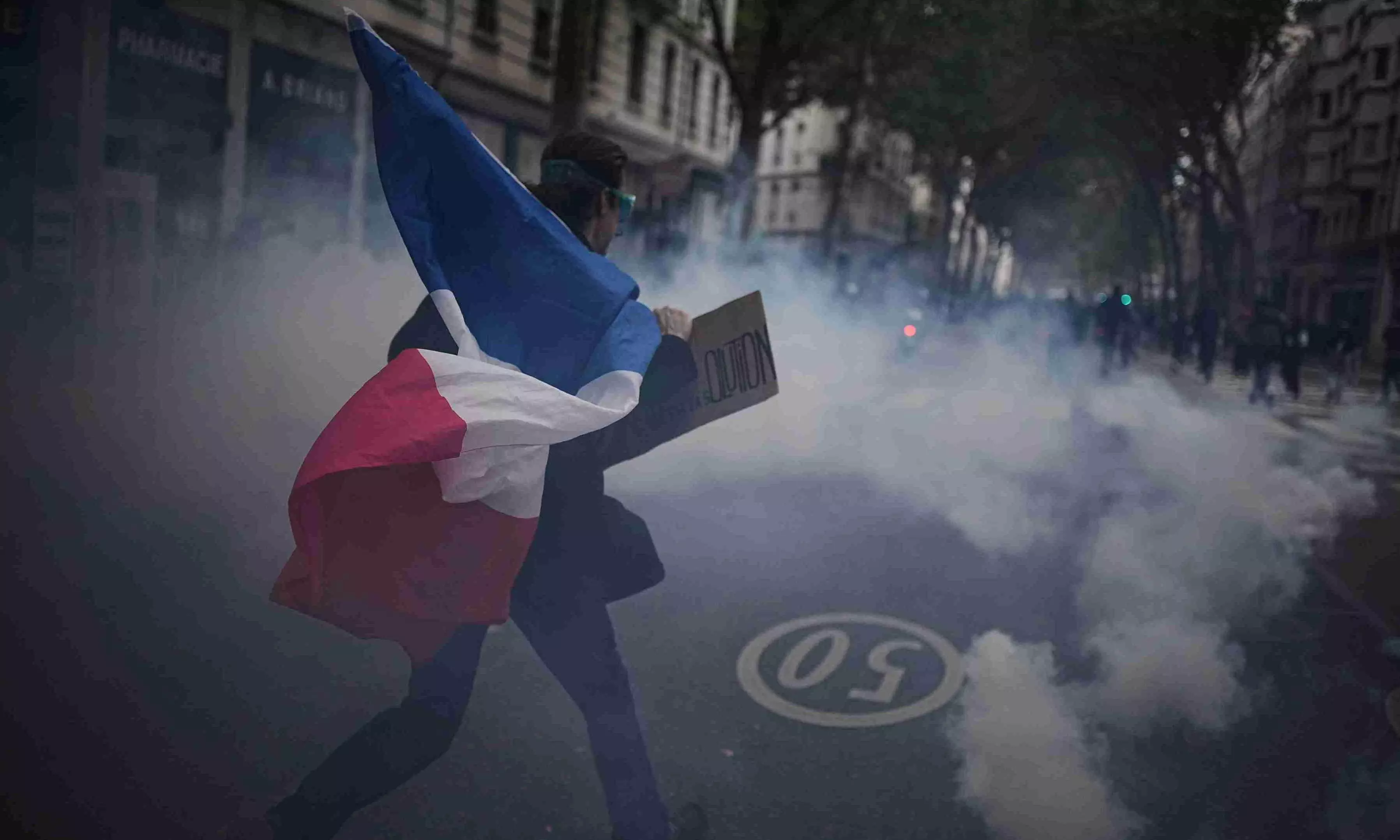
400,000 protest in France in fresh wave of demonstrations and clashes across Europe
From France’s school funding protests to Italy’s security crackdown and unrest in Albania, Europeans rally again over costs, housing and education

Europe witnessed another round of mass street protests on Saturday (October 24), with hundreds of thousands demonstrating across France and thousands more marching in Italy, Spain, Portugal and Albania over issues ranging from education and living costs to pensions, housing and corruption.
While many rallies remained peaceful, clashes with police in several cities underlined growing public frustration and the challenges facing governments across the continent.
France movement widens
The largest mobilisation took place in France, where more than 400,000 people joined demonstrations demanding better-funded schools and relief from rising living costs. What began last month as a protest over teacher shortages at a high school southeast of Paris has evolved into a broader movement encompassing students, teachers, workers and trade unions.
Also read: What’s driving Europe’s protests and what is US link? | Interview
Authorities estimated nationwide turnout at 410,000, including 110,000 people in Paris. The capital’s march began peacefully but descended into violence near its endpoint at Porte de Vincennes, where some protesters threw projectiles and police responded with tear gas and water cannons. Similar confrontations were reported in Lyon, Strasbourg, Clermont-Ferrand, Marseille, Nice and Nantes.
French prosecutors said 64 people were arrested in connection with the demonstrations and 40 were placed in police custody, including six minors. Most arrests were linked to suspected weapons offences or participation in groups allegedly preparing violence or property damage.
Members of right-wing student groups march through the streets of Rome on Saturday, October 24, during a demonstration called "Unlock Everything," organized in opposition to recent left-wing student protests and one of several demonstrations held by groups across the political spectrum. AP/PTI
Major challenge for Macron
The protests have become a major political challenge for President Emmanuel Macron in the final months of his presidency. The crisis comes just one week after widespread rioting and looting that damaged thousands of businesses and prompted an unprecedented security response.
Interior Minister Laurent Nuñez deployed up to 70,000 police officers nationwide, supported by helicopters, armoured vehicles and water cannons, while museums, art venues and shops in Paris took precautionary measures.
Despite fears of renewed unrest, many demonstrators insisted their grievances remained focused on social and economic concerns. Students are demanding more university places, an overhaul of the Parcoursup admissions system, greater investment in schools and universities, and increased financial support. Protesters also cited mounting pressure from inflation and rising energy costs.
Students, workers unite behind economic demands
A defining feature of the French movement has been the alliance between student groups and organised labour. Trade unions led Saturday’s Paris march, followed by students carrying banners and handmade placards.
Also read: Why Europe’s youth are taking to the streets: A crisis beyond politics
Participants argued that deteriorating education services and rising living expenses are increasingly linked. Education Ministry figures show public middle and high schools lost millions of teaching hours because absent teachers were not replaced. At the same time, inflation and energy prices have placed growing strain on households.
Many demonstrators said last week’s violence should not overshadow the movement’s demands. Teachers and parents marched alongside students, arguing that education concerns had not been adequately addressed by the government. Student representatives met Macron on Friday and said he had promised reforms to university admissions, but organisers vowed to continue mobilising until concrete measures are announced.
The unrest has also sharpened political tensions. Macron’s opponents, particularly the far-right National Rally, have sought to channel public dissatisfaction into electoral support. At the same time, unions have criticised restrictions imposed on demonstrations in some cities, arguing that bans undermine constitutionally protected rights to protest.
Protesters gather during an anti-government rally, in Tirana, Albania, on Saturday, October 24. AP/PTI
Italy tightens security
While France drew the greatest international attention, demonstrations also swept through several other European countries.
In Italy, thousands of mostly young protesters marched through Milan, Rome and Turin under heavy security. Authorities deployed thousands of police officers and hundreds of soldiers in an effort to prevent a repeat of the violence and looting that accompanied earlier demonstrations.
Milan saw the most extensive preparations. Luxury boutiques boarded up windows, soldiers patrolled key locations and authorities used drone surveillance, rapid-response units and monitoring of online activity. Although the march remained largely peaceful, protesters denounced Prime Minister Giorgia Meloni's government and highlighted concerns over economic hardship and energy costs. Demonstrators symbolically burned a giant electricity bill and dumped manure outside Italy's energy regulator.
In Rome, tensions were more visible. A small group briefly attempted to enter the Colosseum before being turned away, while an anti-war protest later clashed with police near Piazza della Repubblica. Officers used batons, tear gas and eventually a water cannon to disperse parts of the crowd.
Italian authorities have attributed much of last week's unrest to very young protesters. Meloni's government responded by announcing tougher penalties for minors involved in violence and sending additional soldiers to Milan.
Housing, pensions, corruption fuel wider unrest
The protest wave extended well beyond France and Italy, reflecting a broader set of social and economic anxieties across Europe.
In Albania’s capital Tirana, clashes erupted as protesters set government buildings on fire and threw projectiles at police. Riot officers responded with water cannons and maintained a strong presence across the city. Student groups demanding lower tuition fees and greater investment in education have increasingly aligned themselves with a wider anti-government campaign seeking the resignation of Prime Minister Edi Rama.
Also read: ‘State silence is violence’: Filmmaker Vijay Singh on French student protests
Meanwhile, demonstrations in Spain and Portugal remained largely peaceful. Thousands marched through Madrid to defend public pensions amid concerns about possible future reforms. Protesters argued that pension systems should not be opened to privatisation or weakened through market-based changes.
European countries grapple with common pressures
In Lisbon, residents rallied against rising housing costs and government measures that they say favour landlords over tenants. Protesters criticised proposals to ease restrictions on rent increases and simplify eviction procedures, arguing that such policies would worsen an already severe affordability crisis.
Taken together, Saturday’s demonstrations revealed a continent grappling with common pressures: Rising living costs, strained public services, housing shortages and fears about economic inequality. Though each country’s grievances differ, the scale of mobilisation suggests growing public impatience with governments struggling to respond to mounting social and financial pressures.
(With agency inputs)