








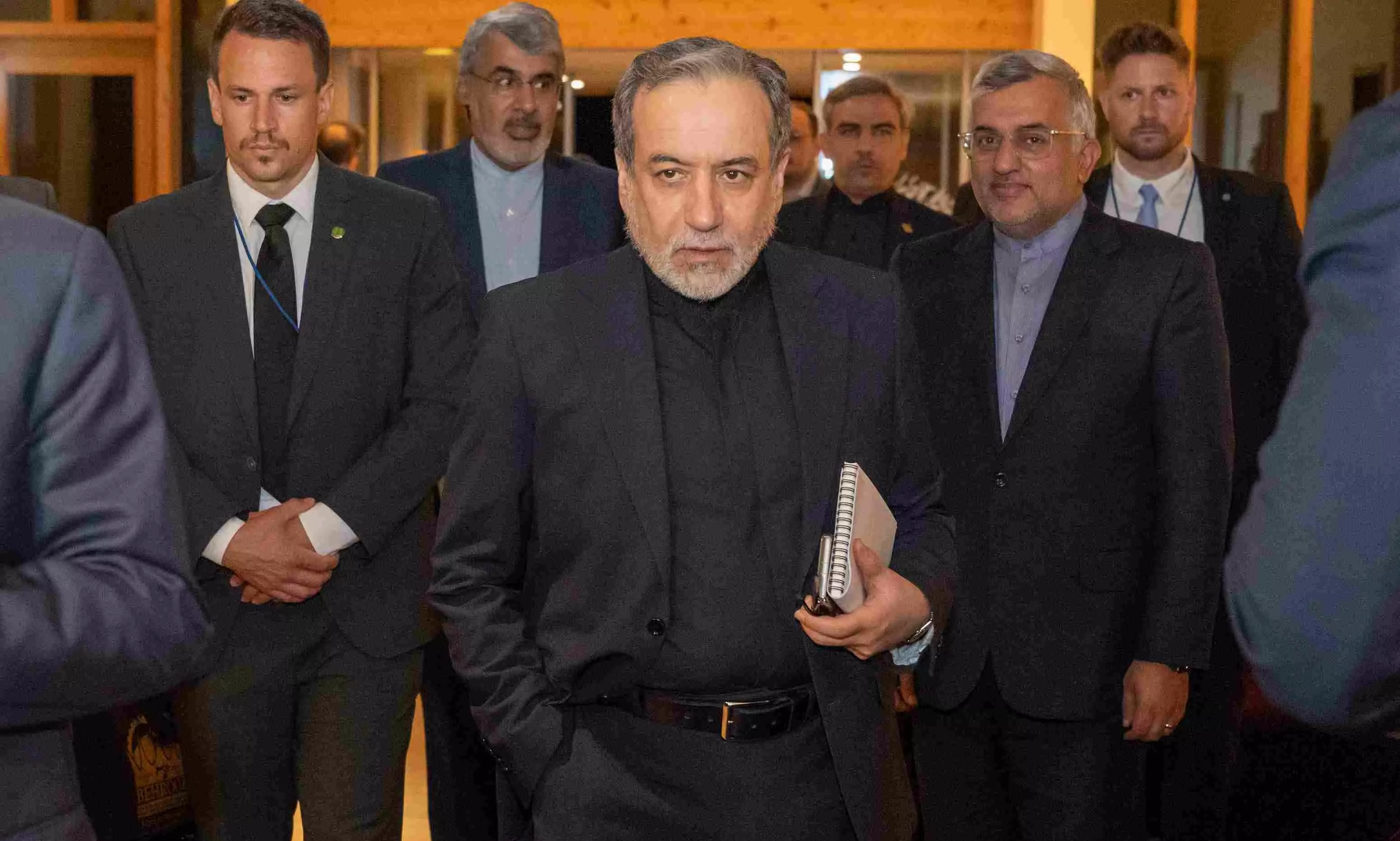
Iranian Foreign Minister Seyyed Abbas Araghchi, center, arrives at the Buergenstock resort in Obbuergen, near Lucerne, Switzerland, early Sunday, June 21, 2026. Photo: AP/PTI
US-Iran summit begins in Switzerland as Lebanon truce crumbles
Vice-President Vance downplays Tehran’s claims of a maritime blockade as a fragile Lebanon ceasefire threatens to collapse on Day One

High-level negotiators from the United States and Iran have converged in Switzerland for a critical diplomatic summit aimed at stabilising West Asia, even as a fragile ceasefire in Lebanon threatens to unravel.
Peace talks between the United States and Iran are set to begin in Switzerland on Sunday (June 21), despite lingering tensions over Tehran's claim that it has closed the strategic Strait of Hormuz. US Vice President JD Vance has arrived in the country, joining a high-level Iranian delegation that landed a day earlier.
The diplomatic summit aims to negotiate a peace memorandum to restore stability in the conflict-torn West Asia region.
Meanwhile, Switzerland's Foreign Ministry welcomed the Iranian delegation's arrival in Bürgenstock ahead of the talks, noting on X that the visit is part of implementing the memorandum of understanding (MoU) previously signed between the US and Iran.
Fresh uncertainty
Amid renewed tensions over a vital maritime chokepoint, negotiations between the United States and Iran face fresh uncertainty.
The two sides recently agreed to a 60-day ceasefire to allow talks to proceed, but on Saturday Iran’s Islamic Revolutionary Guard Corps announced the closure of the Strait of Hormuz. The US military, however, countered that commercial vessels continued to transit the waterway, underscoring the conflicting claims over one of the world’s most strategic shipping lanes.
Also read: Trump says no Hormuz tolls during ceasefire as US-Iran talks resume in Switzerland
Efforts to move ahead on a Pakistan-brokered interim agreement were clouded in uncertainty this weekend, as the dispute over the Strait of Hormuz escalated. The accord, signed on Wednesday by US President Donald Trump and Iranian President Masoud Pezeshkian, was intended to halt nearly four months of conflict.
Hormuz dispute raises stakes
On Saturday, however, accusing Israel of “crimes” in Lebanon, Iran’s Islamic Revolutionary Guard Corps said the United States had failed to honour ceasefire commitments, warning vessels to stay clear of the strait.
The waterway is a critical artery for global oil and gas shipments. US Central Command pushed back, reporting that 55 merchant ships carrying more than 17 million barrels of oil and other cargo passed through Hormuz that day, and vowed American forces would safeguard the continued flow of commercial traffic.
The Iranian delegation, led by chief negotiator Mohammad Baqer Qalibaf and featuring foreign minister Abbas Araqchi alongside senior security, oil, and central bank officials, are expected to hold a "couple days of talks" with the US team headed by Vice President JD Vance, special envoy Steve Witkoff, and presidential adviser Jared Kushner. They are expected to tackle a broad agenda, including Tehran's nuclear programme and regional security.
Meanwhile, before leaving Washington Vice-President Vance told reporters that they were going to "hopefully" make progress on the nuclear issue and on the Lebanon ceasefire issue. He downplayed Tehran's recent assertions regarding maritime blockades.
Also read: Collapsed US-Iran talks expose a broken global order
Vance noted he has seen "no evidence" that the strategic Strait of Hormuz has actually been closed.
A skeptical start
Despite the diplomatic push, both sides are entering the room with deep-seated skepticism. Iranian Foreign Ministry spokesperson Esmaeil Baghaei stated that Tehran intends to ensure it sticks to its commitments, citing a history of the US failing to honour its obligations.
Meanwhile, the very foundation of the summit—a halt to the fighting in Lebanon, which was a prerequisite for these talks—is already faltering.
Ceasefire crumbles on day 1
Just hours after the truce took effect on Saturday, Lebanon’s Civil Defence reported that Israeli strikes killed 20 people.
Israel claimed the strikes were in retaliation to Hezbollah firing more than 50 projectiles overnight. In turn, Hezbollah declared it would not allow Israel "freedom of movement" within Lebanese borders.
Compounding the diplomatic friction, Israel, which is not a party to the US-Iran agreement, has refused to pull back. According to Israeli broadcaster Channel 12, Prime Minister Benjamin Netanyahu and defence minister Israel Katz have instructed the military to hold their fire but maintain their positions in captured Lebanese territory.
Domestic blowback for Netanyahu
The ongoing military friction comes amid sharp domestic backlash for the Israeli government. An exclusive Hebrew University poll shared with Reuters revealed deep public dissatisfaction with the military campaign's outcomes:
a) 92 per cent of Israelis believe Iran benefited more from the joint Israeli-US military campaign than Israel did.
b) Nearly 90 per cent feel the war's core objectives were not achieved.
c) Over 70 per cent expressed skepticism toward Prime Minister Netanyahu's claims of major military gains.
Also read: Trump may claim victory but MoU shows Iran had the last laugh
As Israeli warplanes and drones continue to strike suspected Hezbollah strongholds in southern Lebanon and the Bekaa Valley, the Israeli military maintains it is committed to the ceasefire—but will continue to neutralise any active threats.
Whether the fragile truce can survive long enough for diplomats in Switzerland to salvage a broader peace memorandum remains to be seen.