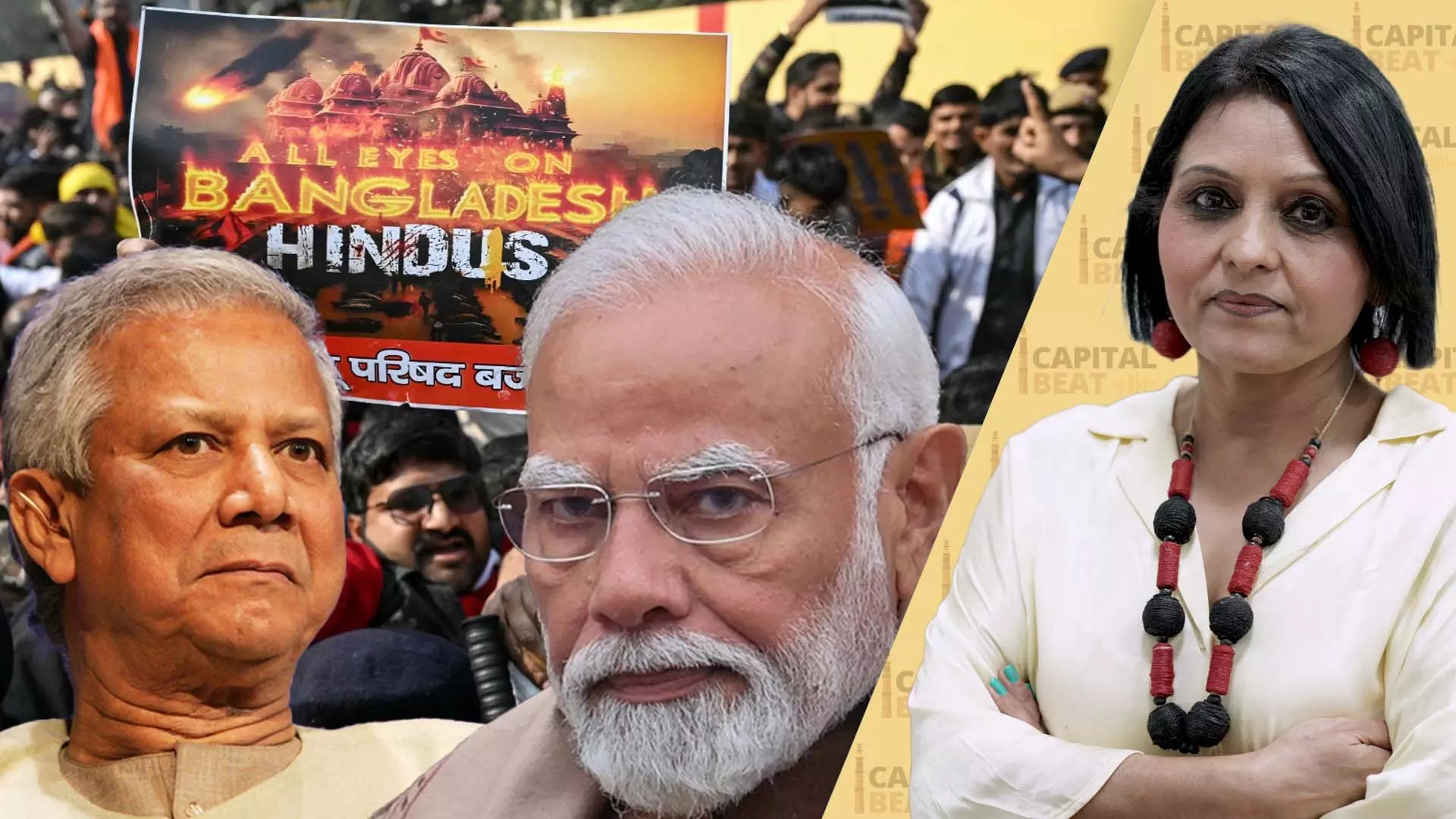
Should India send Sheikh Hasina back to Bangladesh? What experts say
Capital Beat panel discusses killing of Hindu man, Dhaka unrest, demands for Hasina's deportation and impact on India-Bangladesh relations

A Capital Beat discussion hosted by Neelu Vyas brought together senior journalist Subir Bhaumik and student leader and activist Sheikh Enan to examine the sharp deterioration in India-Bangladesh relations following violent protests in Bangladesh, the killing of a Hindu minority member, and growing diplomatic tensions between Dhaka and New Delhi.
The central issue revolved around the killing of 27-year-old Deepu Chandradas, a member of Bangladesh’s Hindu minority, who was beaten to death by a mob in Mymensingh after allegations of blasphemy. The incident occurred shortly before violent protests erupted in Dhaka over the killing of student leader Sharif Osman Hadi, intensifying unrest across the country.
If India sends her back now, it is sending her back to the gallows
The discussion linked these incidents to widening political instability in Bangladesh, protests by Hindu nationalist groups in India, and escalating accusations between the two governments, raising questions about whether bilateral ties are entering a prolonged crisis.
Violence and minority insecurity in Bangladesh
The panel outlined that Deepu Chandradas was targeted amid heightened communal tensions, with his killing triggering reactions both within Bangladesh and across the border in India. Hindu nationalist organisations such as the Vishwa Hindu Parishad and Bajrang Dal staged protests in India following the incident.
Also Read: Let Hasina stay in India, but she can't run politics from here 8 mins read
The unrest was further compounded by protests over the killing of Sharif Osman Hadi, described in the discussion as a prominent student leader in Dhaka. Allegations circulated among Hadi’s supporters that the main suspect had links to the Awami League, the party of former prime minister Sheikh Hasina, who has fled to India.
This violence is partly by design and partly because once you start riding the tiger, you don’t have control over it
These developments were presented as contributing to a surge in anti-India sentiment in Bangladesh, particularly within sections of the protesting groups, and as deepening mistrust between the two neighbours.
Political turmoil and the interim administration
The panel discussion focused extensively on the role of Bangladesh’s interim administration led by Muhammad Yunus. The discussion described a breakdown of law and order, with repeated references to attacks on minorities and political opponents.
The violence was framed as having electoral implications, particularly for minority communities such as Hindus and Buddhists, who were described as traditionally aligned with the Awami League. The discussion stated that fear generated by targeted killings could deter voter participation.
One of the central assertions during the programme was that the prevailing instability benefits Islamist political forces. Subir Bhaumik stated, “This violence is partly by design and partly because once you start riding the tiger, you don’t have control over it,” linking the unrest to broader political manoeuvring ahead of elections.
Anti-India sentiment and diplomatic consequences
The discussion highlighted a pattern of anti-India rhetoric and actions, including attacks on Indian diplomatic properties in Bangladesh. Indian missions and deputy high commissions in Chittagong and Khulna were cited as having been targeted during protests.
Sheikh Enan described these attacks as unprecedented and damaging to Bangladesh’s international standing. The discussion rejected allegations that India was involved in the killing of Sharif Osman Hadi, questioning the claims that suspects fled to India after the attack.
The panel also referred to historical narratives used to fuel anti-India sentiment, including references to Bangladesh’s 1971 Liberation War and repeated claims that India seeks to dominate Bangladesh, which were described as propaganda revived during periods of political instability.
Sheikh Hasina asylum and extradition debate
A significant portion of the discussion focused on former Prime Minister Sheikh Hasina’s presence in India and demands from Bangladesh for her return. The programme stated that India received Sheikh Hasina following an official request from the Bangladesh military and that her safety was a key consideration.
The discussion emphasised that India is not obligated under existing extradition arrangements to repatriate an individual if the judicial process in the requesting country is deemed unfair or motivated by vendetta. The legitimacy of proceedings initiated against Sheikh Hasina in Bangladesh was questioned during the programme.
Subir Bhaumik stated, “If India sends her back now, it is sending her back to the gallows,” underscoring the gravity of the extradition issue and its implications for bilateral relations.
Impact on people-to-people ties
Despite the diplomatic crisis, the panel distinguished between governmental tensions and public sentiment. The discussion noted that large numbers of Bangladeshi citizens continue to rely on India for medical treatment, education, and trade.
The discussion emphasised that India is not obligated under existing extradition arrangements to repatriate an individual if the judicial process in the requesting country is deemed unfair or motivated by vendetta
The programme pointed out that closures or disruptions at Indian visa offices directly affect ordinary Bangladeshis, while wealthier political actors retain the ability to travel elsewhere. This dynamic was presented as exacerbating public hardship rather than addressing security concerns.
The discussion concluded without a definitive resolution, reflecting uncertainty over whether the historic relationship between India and Bangladesh can be stabilised amid ongoing violence, political upheaval, and diplomatic strain.
The content above has been transcribed from video using a fine-tuned AI model. To ensure accuracy, quality, and editorial integrity, we employ a Human-In-The-Loop (HITL) process. While AI assists in creating the initial draft, our experienced editorial team carefully reviews, edits, and refines the content before publication. At The Federal, we combine the efficiency of AI with the expertise of human editors to deliver reliable and insightful journalism.