








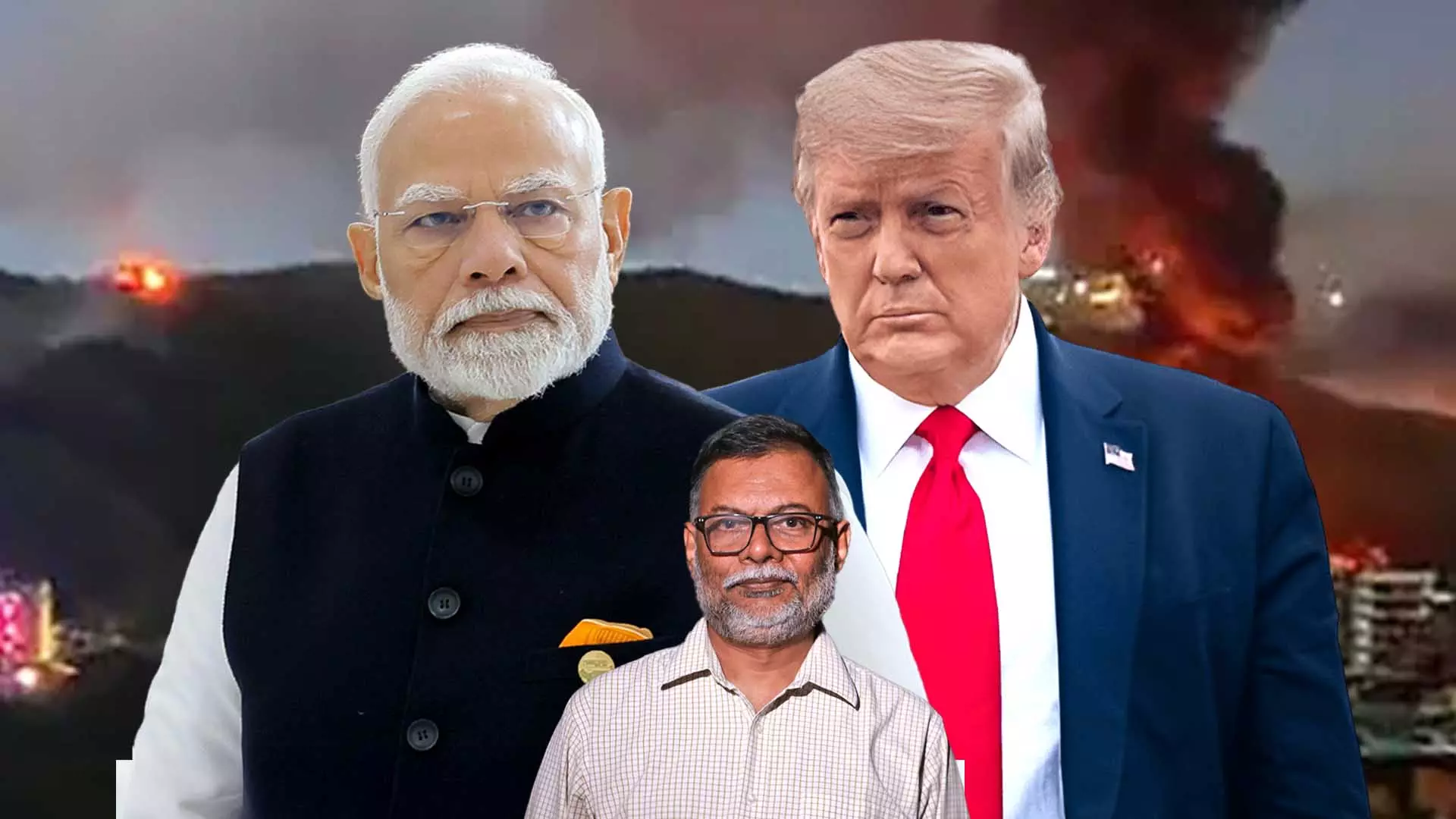
Maduro's capture: Why India prefers not to criticise Trump’s actions
As Trump’s actions shake global norms, India stays restrained. Is this strategic autonomy or a risky silence in a force-driven world?

The recent capture of Venezuelan President Nicolás Maduro by the United States has reopened global questions about sovereignty, power, and the erosion of international norms. As India maintains a restrained response, attention has turned to what this moment reveals about New Delhi’s foreign policy choices. In this episode of Worldly-Wise, KS Dakshina Murthy, Consulting Editor, The Federal, talks about how India is navigating a world increasingly shaped by force and transactional power politics.
How does India’s cautious response reflect its foreign policy today?
India’s foreign policy has long been driven by balance. In a situation like this, where Donald Trump’s actions in Venezuela and threats over Greenland are difficult to defend, India has still avoided open criticism.
Much of the world, including Russia and China, has condemned US actions. India’s silence reflects its attempt to balance competing interests. India has stakes in Venezuela through ONGC and has been a consumer of Venezuelan oil. At the same time, it has significant economic and strategic ties with the United States.
This balancing act is shaped by vulnerability. When India increased oil imports from Russia, it faced punitive tariffs from the US. China, despite importing more Russian oil, did not face similar action. This highlights India’s weaker position compared to major powers.
India’s foreign policy balance does not come from strength but from constraint. The Modi government has struggled to articulate firm positions when major powers clash. India is comfortable criticising Pakistan but avoids direct confrontation with larger global powers.
This is not new. India has followed this approach for decades. Unless there are fundamental internal changes, this cautious balancing is likely to continue. Foreign policy reflects domestic strength, and India’s internal limitations shape its external posture.
Also read: US to sell Venezuela’s oil ‘indefinitely’, says energy secretary: Report
Is Trump creating a new world order or disrupting the old one?
What is unfolding is not a new world order. It is a stress test of the existing one.
The US has intervened in Latin America for nearly a century. What is new is the directness. For the first time, the US openly entered a country and captured a sitting president.
This action crosses a serious line by challenging national sovereignty. Countries guard their sovereignty fiercely, and Trump’s move signals that those boundaries are now being openly tested.
The concern is that this sets a precedent for other major powers. Comparisons are already being drawn with Russia’s invasion of Ukraine. The fear is that such actions legitimise similar behaviour elsewhere.
Trump’s statements on Greenland further underline this shift. Greenland is an autonomous territory linked to Denmark, a NATO ally. By threatening a takeover, Trump is also unsettling US allies.
This is not the emergence of a new order, but the erosion of restraint within the old one.
Also read: US tells Venezuela to cut ties with China, Russia, Iran to sell oil
What does the Maduro capture mean for China and Taiwan?
For China, the Venezuela episode sets a precedent. If Beijing decides to take aggressive action against Taiwan, it can cite Venezuela as justification.
Beyond precedent, there are strategic concerns. Washington was increasingly uneasy about China’s growing ties with Venezuela, including cooperation on oil and possibly rare earth materials.
From the US perspective, this represented a political and strategic challenge in its own hemisphere. Trump’s response reflects that anxiety.
For China, this is an unfavourable development, but Beijing has limited options in Latin America, a region where US intervention has long gone largely uncontested. At the same time, the implications extend beyond Venezuela and feed into China’s broader strategic calculations.
Also read: 'Ready to lead Venezuela after Maduro's ouster,' says Machado
How central are energy and resources to Trump’s foreign policy?
Donald Trump approaches global politics as a businessman. His worldview is fundamentally transactional.
This is visible in his dealings with India. Trump has been unhappy with India over trade, particularly agriculture. He wants US agricultural products to enter the Indian market, which India has resisted. That resistance has contributed to tensions.
The contrast with China is revealing. Trump threatened China with severe tariffs but ultimately excluded it from punitive measures. This is because the US depends heavily on China for rare earth materials. China’s control over these resources gives it leverage.
The same logic applies to Russia and Ukraine. Trump wants the war to end because it is costly for the US. He views prolonged conflict as bad business.
Even Greenland is framed commercially. Trump talks about buying Greenland, not political integration. The language reflects his transactional mindset.
Trump’s foreign policy prioritises deals, resources, and costs over diplomacy. This approach is reshaping global power dynamics and placing strain on established international norms.
(The content above has been transcribed from video using a fine-tuned AI model. To ensure accuracy, quality, and editorial integrity, we employ a Human-In-The-Loop (HITL) process. While AI assists in creating the initial draft, our experienced editorial team carefully reviews, edits, and refines the content before publication. At The Federal, we combine the efficiency of AI with the expertise of human editors to deliver reliable and insightful journalism.)


