








Iran’s ‘jellyfish’ drone formation: F-15E pilot’s account could signal new era of warfare
The so-called “jellyfish” formation works through a combination of larger command drones and smaller supporting drones

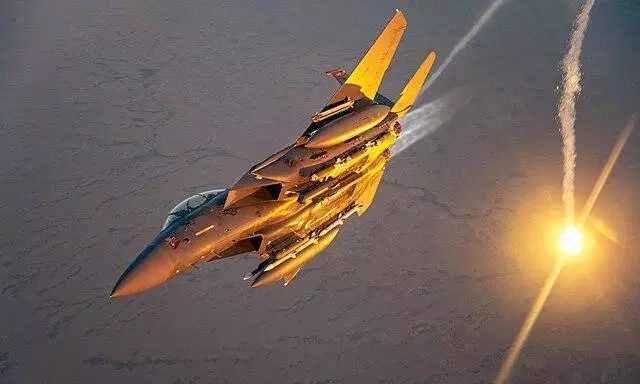
A US F-15E Strike Eagle pilot, who was shot down during the Iran-US war in April, has described witnessing what he called a “jellyfish-like” drone formation moments before ejecting from the aircraft.
After being rescued by US special forces and undergoing intelligence debriefings, the pilot reportedly told officials that he encountered what looked like a “minefield of drones” in the sky — an unusual aerial formation that suggested a possible advancement in Iran’s drone warfare capabilities, according to CNN.
When F-15E was downed
The F-15E Strike Eagle, a fighter jet valued at around $31.1 million (approximately Rs 289 crore), was downed during a combat mission involving Iran. The aircraft carries two crew members - a pilot and a weapons systems officer. While one crew member was rescued, the other remains missing, triggering an ongoing search operation.
Also read: Lost jet, destroyed planes, daring rescue: How US airman was pulled out of Iran
The incident marked the first loss of a US fighter jet in combat in more than two decades. The Donald Trump administration has not publicly confirmed what caused the aircraft to go down.
Synchronised pattern drones
Recalling the encounter, the pilot described seeing larger “mothership” drones appearing to move together as a single unit. Beneath them, smaller drones were reportedly positioned in a synchronised pattern, creating an appearance similar to a jellyfish moving through water.
"Multiple drones interconnected and moving as one with smaller drones below the bigger drones like legs... Real alien s**t (Sic)," a source familiar with the pilot's testimony told the news outlet.
Also read: US readies to deploy its most lethal long-range missiles as Iran holds its ground: Report
Sources familiar with the pilot’s account said US defence analysts believe the description could point to Iran using advanced “one-to-many meshed networking” technology, allowing multiple drones to communicate directly with each other and operate as a coordinated swarm.
Drone swarms
Unlike traditional drone systems that depend on a central command station, mesh networks allow individual drones to exchange real-time information, adjust positions and potentially conduct surveillance, electronic warfare or targeting operations as a unified group.
Earlier assessments suggested the F-15E may have been brought down by Iran’s Majid infrared air defence system or shoulder-fired missiles. However, if the pilot’s account is accurate and a drone swarm was involved, it would indicate a capability currently associated with only a few countries, including China and Russia.
Also read: Iran, US agree on 60-day roadmap to reach final peace deal
The so-called “jellyfish” formation works through a combination of larger command drones and smaller supporting drones. The larger “mothership” acts as a coordinating platform, while the smaller units remain connected below it, creating a wide-area airborne network.
Drone warfare
Drone mesh technology itself is not new and is already used in areas such as remote communications. However, applying it to military operations creates a major challenge for traditional radar and air defence systems. A swarm operating at low altitudes and spread across a large area can be difficult to detect and intercept.
The formation also offers strategic advantages, allowing forces to conduct surveillance, overwhelm defence systems and operate without risking human pilots.
Also read: Lessons from Ukraine to Op Sindoor: How the new CDS must rebuild India’s war machine
However, officials have urged caution while analysing the pilot’s testimony. The pilot had suffered a severe concussion during ejection, and investigators are still verifying the details of the encounter.
If confirmed, the sighting could represent a significant shift in drone warfare, where coordinated autonomous swarms become a new challenge for modern air forces. Beyond its military impact, the unusual appearance of such formations could also create a psychological advantage by unsettling pilots facing an unfamiliar threat in the sky.