








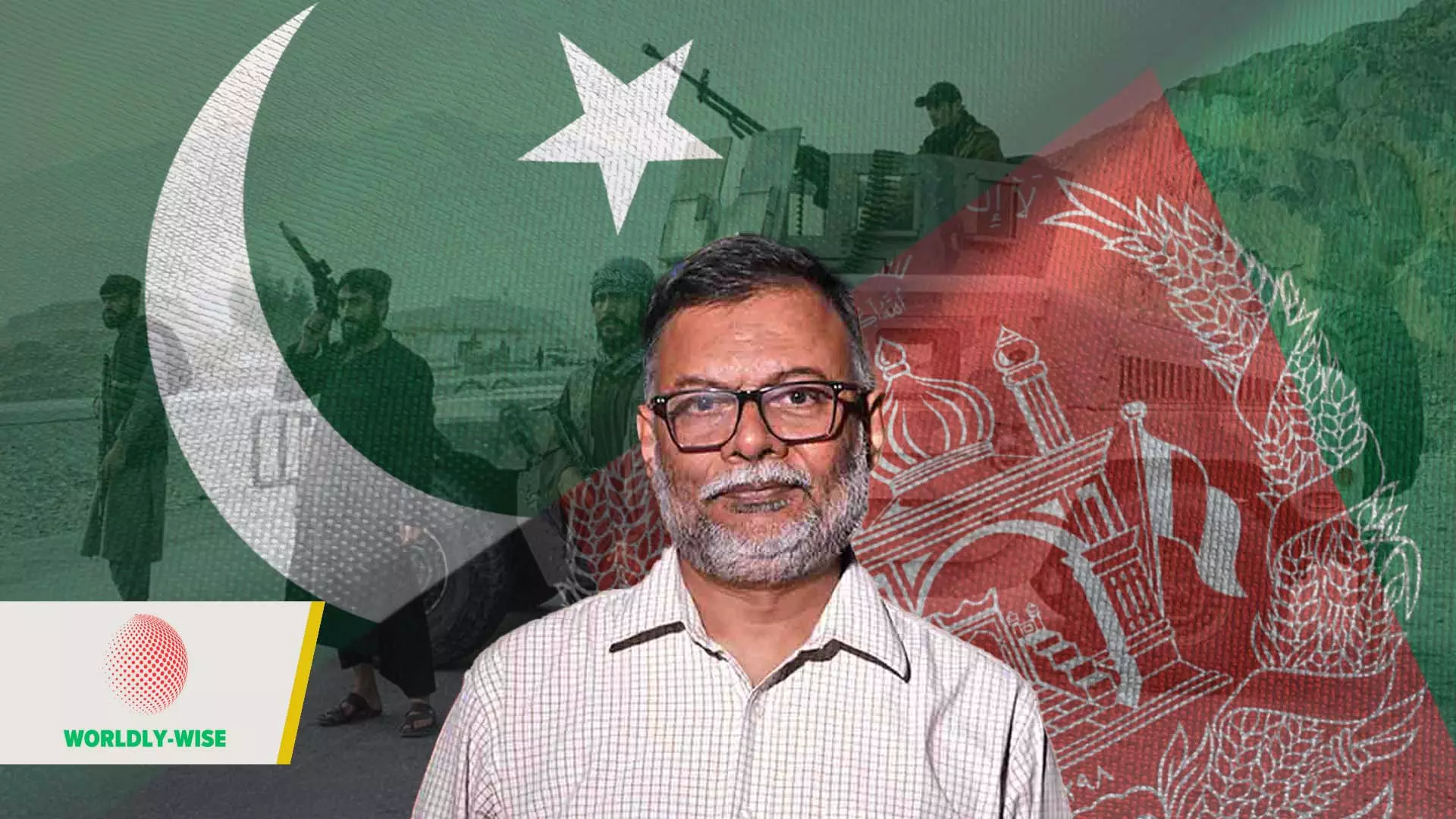
Pakistan Afghanistan war
Why are Pakistan and Afghanistan edging closer to open confrontation?
Worldly Wise examines airstrikes, border clashes and wider war fears: What triggered the Pakistan-Afghanistan crisis, and where does India stand?

The current Pakistan–Afghanistan crisis marks a dangerous escalation in a relationship long shaped by militancy, mistrust and strategic miscalculations. What began as cross-border strikes on alleged militant camps has now spiralled into open hostilities, raising fears of a prolonged and volatile regional flashpoint.
In the latest episode of Worldly Wise, The Federal spoke to KS Dakshina Murthy, senior journalist and Consulting Editor, to unpack the roots of the crisis, the Taliban’s military capacity, Pakistan’s internal pressures, and what the conflict means for India and regional trade routes.
Islamabad says militant sanctuaries inside Afghanistan prompted the strikes, while Kabul calls it a violation of sovereignty. Is this escalation driven by security compulsions or political signalling?
What we are seeing today between Afghanistan and Pakistan is the culmination of a long history of militancy, cross-border terrorism, and encouraging one group versus another.
If you look at the Taliban ruling Afghanistan now, in some ways it is a creation of Pakistan. It was nurtured and mentored by Pakistan. So, this is almost a fratricidal conflict — like a parent and a child.
After the Taliban returned to power in 2021, pushing out the US-led forces, issues that had been simmering became clearer. Between 1996 and 2001, Pakistan and the Taliban worked very closely. But during the 20 years from 2001 to 2021, after the World Trade Center attacks, relationships shifted in ways that were not fully visible until the Taliban came back to power.
A group called Tehrik-e-Taliban Pakistan emerged within Pakistan. It is distinct from the Afghan Taliban but ideologically similar — almost like a clone. It began attacking the Pakistani government from within and often sought refuge across the border in Afghanistan.
The Afghan Taliban has been unable to act strongly against it because of ideological similarities. It would be like fighting their own brothers. So this is a tangled situation that will be very difficult to untangle unless there is some unexpected development.
How capable is the Taliban regime of responding militarily, and does this risk a wider confrontation?
This current round of conflict actually began in 2024 after attacks by Tehrik-e-Taliban within Pakistan. Pakistan retaliated by targeting camps along the border, and since then, the conflict has expanded.
If you compare militaries, Pakistan has an organised professional army of around 6,60,000 personnel with fighter aircraft and full-fledged capabilities. The Taliban, on the other hand, is more of an irregular force, skilled in asymmetric and guerrilla warfare.
In a conventional war, Afghanistan would be far weaker. When the US withdrew, it left behind nearly $7 billion worth of equipment. But much of it is high-end and the Taliban lacks the expertise to use it effectively.
So in a conventional battle, Pakistan would prevail. But this is not a normal war between two professional armies. The Taliban can fight in unexpected ways. For example, if Pakistan intensifies attacks on Afghan Taliban positions, Tehrik-e-Taliban inside Pakistan could escalate its own attacks. That possibility complicates everything.
What exactly went wrong in the Pakistan–Afghanistan relationship?
Pakistan initially mentored the Taliban. After the Soviet withdrawal, the Taliban took power in 1996. Following the 9/11 attacks, the US invaded Afghanistan and ruled there for 20 years. When the US withdrew in 2021, the Taliban returned to power.
Meanwhile, Tehrik-e-Taliban Pakistan had established camps along the 2,600-km border, which is highly porous and difficult to monitor. Militants would attack inside Pakistan and then seek refuge across the border.
Pakistan accused Afghanistan of not curbing these camps. Afghanistan responded that Pakistan was killing civilians when it targeted border areas. Retaliatory strikes followed, including attacks on Pakistani army posts.
Qatar stepped in during 2024 to mediate and temporarily ease tensions, but the core issue was never resolved. Now, Pakistan says it wants to end this once and for all, declaring an open war.
Given Pakistan’s internal security and economic stress, where does this conflict lead?
In one sense, this war is purposeless. It does not advance the cause of either country. It is not about invasion or capturing territory.
But Pakistan is, in some ways, paying the price for having supported militancy in the past under US pressure during the anti-Soviet campaign. This conflict will likely continue intermittently. Neither side can fully defeat the other in strategic terms. It will fester, with periodic fighting.
Countries like Qatar and China could play a role. China is close to both Pakistan and Afghanistan and has major interests in the region. Yet, China has not made concrete moves to resolve this dispute, apart from broader regional meetings.
From India’s perspective, does this create strategic space or heighten security risks?
In a strategic sense, one of the biggest beneficiaries could be India.
During the first Taliban phase from 1996 to 2001, India had very poor relations with the Taliban, while Pakistan had excellent ties. Today, that has changed dramatically. India sees an opportunity to improve ties with Afghanistan and consolidate its presence there. Strategically and politically, that is beneficial.
Any distress to Pakistan from another quarter is often seen by Indian defence experts as advantageous, especially since it diverts Pakistan’s attention from Kashmir and India toward Afghanistan.
But what about trade routes and practical constraints for India?
Here lies the complication. Afghanistan’s easiest trade access is through Pakistan. In the past, Pakistan allowed Afghan goods into India but blocked Indian goods from entering Afghanistan.
That is why India invested in the Chabahar port in Iran, signing agreements to enable exports to Afghanistan while bypassing Pakistan.
However, US pressure on India regarding sanctions on Iran has slowed progress on Chabahar. A private Indian company had signed a long-term agreement, but that development has largely come to a halt. So, while India has the intention to deepen ties, practical access remains difficult.
If Pakistan squeezes Afghanistan’s trade routes, what options does Kabul have?
Afghanistan will look towards Central Asia — countries like Turkmenistan and others with access routes.
It may also move closer to China, which has been aiding Afghanistan. But China is close to both Pakistan and Afghanistan, so how Beijing balances this will be interesting.
Afghanistan will need to rework its trade strategy. I am sure it will explore ways to strengthen economic ties with India as well. India, too, will look for ways to increase engagement.
The content above has been transcribed from video using a fine-tuned AI model. To ensure accuracy, quality, and editorial integrity, we employ a Human-In-The-Loop (HITL) process. While AI assists in creating the initial draft, our experienced editorial team carefully reviews, edits, and refines the content before publication. At The Federal, we combine the efficiency of AI with the expertise of human editors to deliver reliable and insightful journalism.


