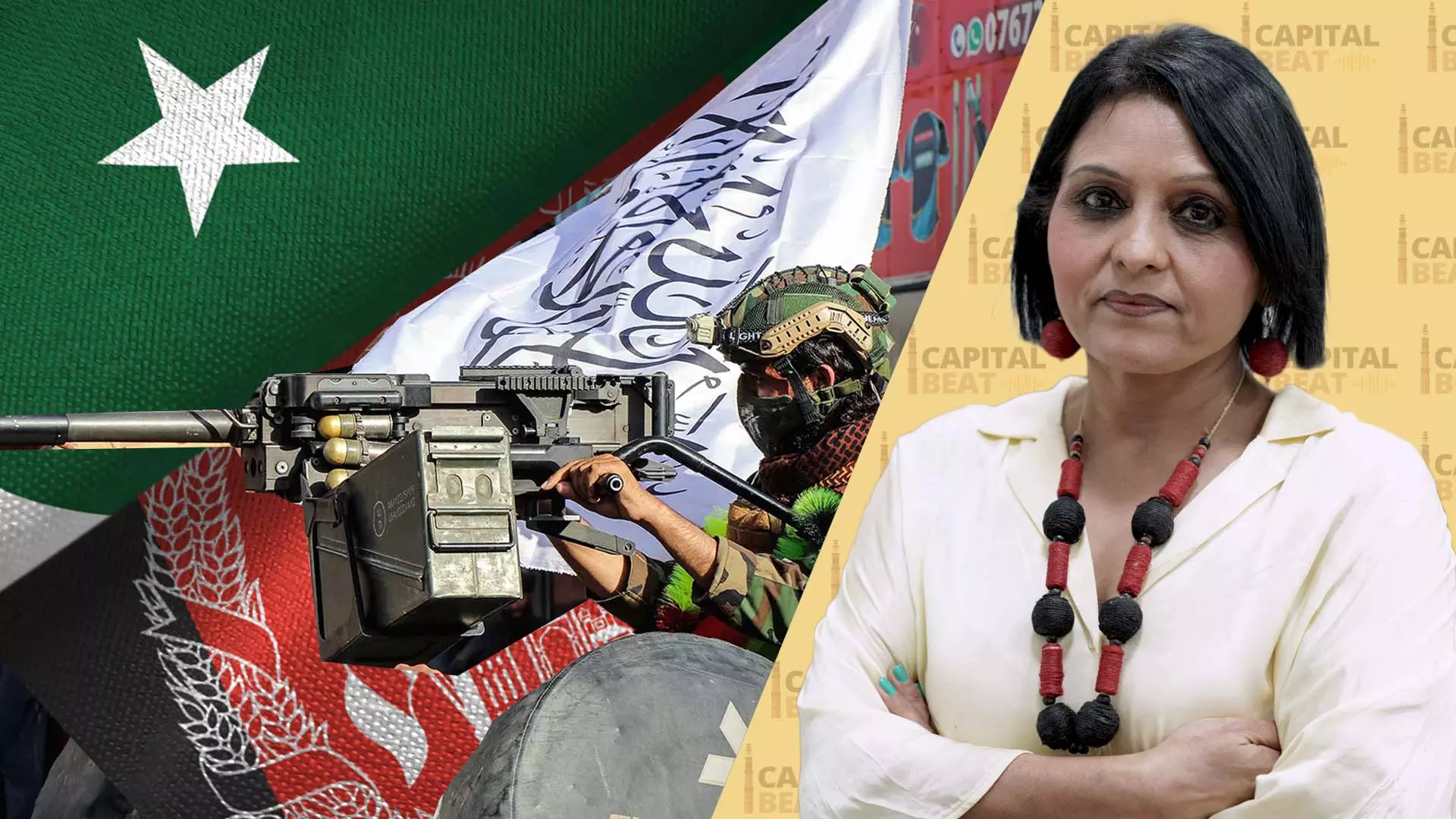
What triggered the Pakistan-Afghanistan conflict and its geopolitical impact?
In this episode of Capital Beat, experts analyse border clashes, Taliban–TTP tensions, China’s mediation, and the regional implications for India and South Asia

In this episode of Capital Beat, Consulting Editor KS Dakshina Murthy, defence expert Manoj Joshi, and senior journalist Anjana Sankar dissected the escalating hostilities between Pakistan and Afghanistan, which Pakistan’s Defence Minister Khwaja Asif described as an “open war.” The discussion examined cross-border strikes, the role of Tehrik-e-Taliban Pakistan (TTP), and the potential geopolitical implications for South Asia and beyond. The episode also explored the triggers of the conflict, the prospects for ceasefire efforts, and the likelihood of international mediation.
Explosions were reported in Kabul as fighting intensified along the Durand Line. Afghanistan’s Taliban government spokesperson Zabihullah Mujahid stated that “Afghanistan was carrying out large-scale offensive operations against the Pakistani military along the Durand Line". Casualty figures from both sides remained contested, with competing claims about military losses and territorial control.
The panel detailed how both governments released conflicting numbers of fatalities and battlefield gains. The lack of independent confirmation underscored the fog of war surrounding the conflict. The situation was described as a collapse of already-strained bilateral relations that had been deteriorating for months.
'From friction to open confrontation'
Anjana Sankar highlighted that “both sides are quoting different figures and it is impossible at this moment for us to confirm it independently". She cited Pakistani claims that at least 50 Taliban fighters were killed and counterclaims from the Taliban that at least 30 Pakistani military personnel had died, alongside assertions of control over military installations.
Also Read: Why are Pakistan and Afghanistan edging closer to open confrontation?
She pointed to a previous flare-up in October, recalling air strikes in Kabul and the fragile ceasefire that followed.
“These two sides are experiencing a complete breakdown in relations, which has now escalated into open confrontation,” she said, describing the trajectory from friction to conflict.
The discussion noted India’s upgraded diplomatic presence in Kabul and high-level engagements between New Delhi and the Taliban administration. Sankar observed that India now has “a full-fledged Indian embassy” and “strategic interest there", adding, “we have our skin in the game".
Beginning of breakdown
Manoj Joshi outlined Pakistan’s longstanding accusation that the Taliban government supports Tehrik-e-Taliban Pakistan. He stated, “Pakistan accuses the Taliban government of supporting the Taliban Pakistan which is a Pashtoons group seeking Pashtostan.”
He emphasised that “neither the Afghans nor the Pashtoons in Pakistan recognise the Durand Line as the border", identifying the disputed frontier as a structural fault line in bilateral relations. According to him, friction intensified after the Taliban returned to power and did not restrain TTP activities.
“When the new Taliban government had come to power Pakistan had hoped that the Taliban government would help to establish a truce,” Joshi noted. Instead, “the Taliban started systematically favouring the TTP", which he described as the beginning of the breakdown.
Military asymmetry
Joshi assessed the military asymmetry between the two sides. “Pakistan has been using air power mainly,” he said, adding that it appeared impressive but had limits. “There is a limit to what it can do.” He cautioned against the notion of decisive superiority.
Also Read: Why Pakistan-Afghanistan tension has escalated into ‘open war’
“The Taliban have the capacity to launch a campaign across Pakistan. They may use truck bombs. They may use car bombs. They may use human bombs,” he stated, outlining the prospect of asymmetrical retaliation.
He also clarified, “The TTP may occasionally use tactics, but it's not a terror organisation. It's an insurgent organisation,” describing it as a movement seeking independence from Pakistan.
International mediation and US stance
Dakshina Murthy evaluated the likelihood of international mediation. “This is one conflict that the US so far hasn't shown much interest in,” he stated, noting the absence of formal ties between Washington and the Taliban government. “I don't see the US intervening in this in any way.” He suggested China as a more probable mediator.
Also Read: Pakistan says 70 militants killed in cross-border strikes on hideouts in Afghanistan
“If at all there is going to be some kind of a mediation, the chances are it will be China that will play a big role,” he said, citing Beijing’s close relationship with Pakistan and growing engagement with the Taliban.
He added that China had already offered to mediate and was in discussions with both sides. He stressed that while ceasefires could halt fighting, they would not resolve deeper causes. “The ceasefire is not the end of the road,” he remarked.
Impact on India and regional security
Sankar addressed implications for India and the wider region. She stated that instability in Afghanistan could turn the country into “a theatre for India-Pakistan conflict". She warned of spillover risks involving non-state actors such as the Balochistan Liberation Army and Islamic State Khorasan Province.
She highlighted Pakistan’s security concerns regarding TTP, noting, “They consider TTP as an internal security threat,” and cited “more than a 1,000 incidents of violence inside Pakistan perpetrated by TTP".
Referring to statements from Kabul, she acknowledged escalating rhetoric but added, “Both parties cannot afford to have a long sustained conflict across their borders.”
Geopolitical shifts
Joshi pointed to potential geopolitical realignments. He stated that escalation could push Afghanistan to rely more on India, Iran, and Russia.
“Earlier, Taliban was dependent on Pakistan,” he said, suggesting that further deterioration could reshape regional alignments. He warned against Pakistani overreach.
Also Read: Airstrikes hit Kabul, hours after Afghanistan attacks Pakistan
“If they overreach in this case, they will actually succeed in uniting the Taliban, getting the Taliban to openly support TTP,” he said, describing the situation as “inherently inflammable".
Dakshina Murthy concluded that resolution hinges on Pakistan’s engagement with TTP. “One way of resolving it is for the Pakistan government to speak to the Tehrik-e-Taliban Pakistan and then figure out a way of sorting their issues out,” he said, identifying it as “at the heart of this entire issue".
(The content above has been transcribed from video using a fine-tuned AI model. To ensure accuracy, quality, and editorial integrity, we employ a Human-In-The-Loop (HITL) process. While AI assists in creating the initial draft, our experienced editorial team carefully reviews, edits, and refines the content before publication. At The Federal, we combine the efficiency of AI with the expertise of human editors to deliver reliable and insightful journalism.)