








Spain-Morocco border crisis explained: What triggered the Ceuta migrant surge?
From a misread Supreme Court ruling to economic pressures and immigration policy, here's what fuelled the mass crossings into Ceuta

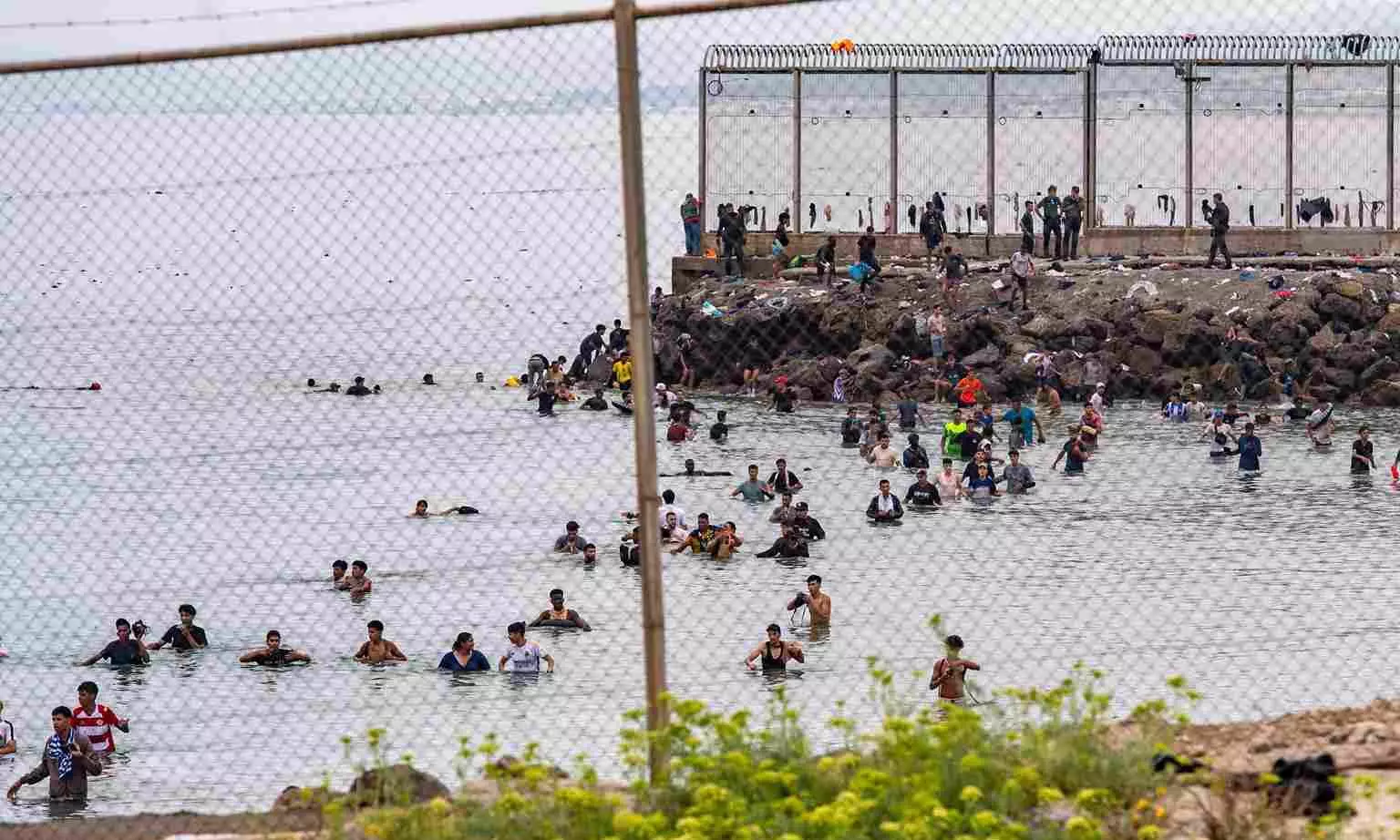
Spain has tightened security along its border with Morocco after tens of thousands of migrants crossed into the North African exclave of Ceuta in one of the country’s biggest migration surges in recent years. With the death toll rising to 67 and authorities moving quickly to return most of those who entered, questions remain over what triggered the unprecedented influx.
Spanish officials said human trafficking networks encouraged the crossings by falsely claiming that a recent Supreme Court ruling meant migrants arriving by sea could no longer be deported. The government argued that the misinformation triggered the sudden rush into Ceuta. Migration experts, however, say the ruling was far narrower than widely believed and cannot, by itself, explain the scale of the influx.
What triggered the crisis?
According to a CNN report, Spanish Prime Minister Pedro Sánchez said human trafficking networks encouraged the crossings, by misrepresenting a recent Supreme Court ruling on migrant returns.
Also read | Spain deploys military as migrants breach Ceuta border; 9 dead
As per the government’s explanation, the traffickers and migrants incorrectly assumed that the ruling meant anyone attempting to enter by sea could not be deported. However, the legal decision was extremely narrow.
On June 29, Spain's Supreme Court ruled that migrants arriving by sea cannot be summarily returned without due process, as they do not cross the physical border infrastructure referred to under Spanish law.
The ruling applies to migrants intercepted while swimming into the Spanish exclaves of Ceuta and Melilla on the North African coast, who had often been immediately sent back to Morocco without any formal legal procedure.
“It just means you cannot push them back at sea because there is no crossing of a formal border,” Gemma Pinyol-Jiménez, head of migration policies and diversity at Instrategies and an associate researcher at GRITIM–Pompeu Fabra University, told CNN. “The purpose is to make the police follow due process, but it does not mean these people have the right to remain in Ceuta.”
Pinyol-Jiménez said the required process could be very brief, allowing people to be deported within days. “And it still means that if you have entered irregularly, you can be sent back to Morocco, because there is also an agreement with Morocco,” she said.
Spain and Morocco signed a bilateral readmission agreement in 1992 that requires Morocco, under certain conditions, to take back third-country nationals who entered Spain irregularly via Moroccan territory.
Beyond the court ruling
Experts point to several other factors, including Spain’s relatively strong economy, its regularisation programme for undocumented migrants, favourable summer sea conditions and persistent youth unemployment in Morocco.
Speaking to CNN, Daniel Thym, a professor of public, European and international law at the University of Konstanz, described the judgment as “a very technical ruling.” He said it draws a distinction between migrants who scale the border fences and those who swim around them into Spanish territory, and should not be viewed as a broad human rights ruling.
“The court even laid down a possible way the government might circumvent the ruling,” he said, referring to judges’ suggestion that Spain could install physical barriers in the water that would once again allow immediate returns.
“It’s important to understand that migration movements almost never have one single cause,” Thym said. “The ruling might have been a trigger, but there were many other factors at play.”
Thym also pointed to the large number of adolescents among those who crossed. “Many of them are 16 or 17,” Thym said. “That creates problems because it’s officially unaccompanied minors. But if they apply for asylum, they get a proper procedure, which often takes months, if not years.”
Also read | UK’s new immigration rules: Indians face longer waits; possible visa bans
According to official statistics, the unemployment rate for Moroccans aged 15 to 24 remains high, at 37.2%, despite the nationwide unemployment rate falling slightly to 13% in 2025.
“There is a constant structural attraction to Europe for younger people. The Spanish economy is doing very well,” Thym said.
Spain’s immigration policy contrast
Spain is also moving in the opposite direction to many other European countries, which are shifting to the right and tightening immigration policies. Earlier this year, Sánchez’s government announced a regularisation program initially expected to give 500,000 undocumented migrants already living in Spain a path to legal status.
Thym said applications far exceeded that initial estimate. “More than 1 million undocumented migrants applied,” he said.
A similar migration surge in 2021 was widely viewed as retaliation during a diplomatic dispute over Western Sahara. Moroccan authorities were widely accused of easing border controls after Spain allowed a leader of the Western Sahara independence movement to receive medical treatment.
“These kinds of organised movements don’t happen without, at minimum, passive collaboration from Moroccan authorities,” Pinyol-Jiménez said. However, Morocco has denied any involvement.
Ceuta slowly regains calm
Spain has begun installing a 500-metre-long containment barrier along the sea border between Ceuta and Morocco after an estimated 50,000 to 60,000 migrants crossed into the Spanish territory, according to news agency AP. The death toll from the crisis has risen to 67, with victims including those who drowned and others killed in a stampede at the breakwater barrier.
Spanish authorities have started returning migrants to Morocco, with the Interior Ministry saying most of those who entered Ceuta have already gone back. Interior Minister Fernando Grande-Marlaska said Spain would act firmly against illegal crossings but stressed that Morocco remains a reliable partner and that cooperation between the two countries helped bring the situation under control within 24 hours.
Also read | 33 Gujarati immigrants deported from US land in Ahmedabad
Although the immediate chaos has subsided, Ceuta has not yet returned to normal. Residents woke up to relative calm after days of disruption, but local authorities said life in the city continues to be affected and the process of returning migrants is still underway.
Despite tightened security and efforts to send migrants back, some remain determined to stay in Ceuta. One migrant said authorities had restricted access to food to pressure people into returning to Morocco, but insisted they would remain in the territory despite the hardships.