








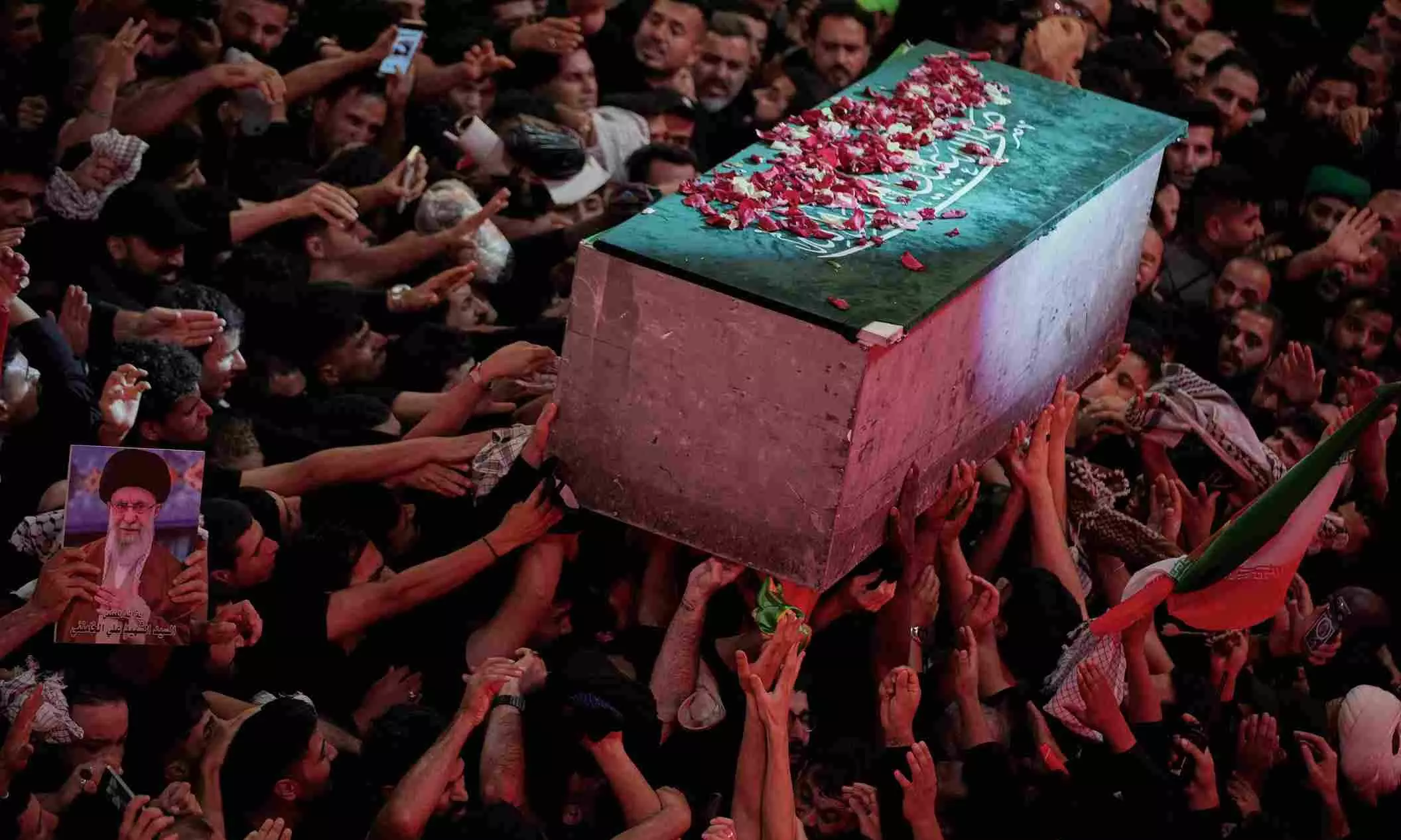
Supreme Leader Ayatollah Ali Khamenei laid to rest as US-Iran tensions escalate
Khamenei was buried in Mashhad months after being killed in US-Israeli strikes, as fresh US airstrikes and Iranian retaliation threaten the fragile ceasefire

Supreme Leader Ayatollah Ali Khamenei has been laid to rest months after being killed in the opening salvos of the Iran war.
He ruled Iran for nearly 37 years before being killed in the US and Israeli airstrikes that started the war on February 28. He was laid to rest in his hometown of Mashhad early Friday after days of public mourning.
Khamenei is only the second ruler of the nation to be buried in the city of Mashhad. In 1747, Nader Shah was buried in the city after he was assassinated following nearly 11 years in power.
Also read | Iran begins Ali Khamenei's funeral procession in Tehran as mourners call for revenge
The funeral processions began on Saturday, with authorities shutting down streets, airspace and daily life in Tehran, Iran's capital, and other cities, as throngs commemorated the man who led Iran for decades with an iron fist while confronting the West.
Ceasefire faces fresh strain
Meanwhile, the United States launched new airstrikes against Iran early Thursday, and Tehran responded by targeting US-allied Mideast countries in an exchange of fire that threatened an interim deal intended to help end the war in the Middle East.
Back-and-forth attacks, including a day earlier, have repeatedly threatened the ceasefire. But Thursday's appeared bigger all around, with sirens sounding at least three times in Bahrain, home to the US Navy's 5th Fleet headquarters, and missiles targeting Kuwait and Qatar.
Sirens sounded Thursday afternoon in Jordan as well, where the US has stationed troops and aircraft.
An Iranian official accused the US of launching an airstrike later Thursday targeting the area around Iran's sole nuclear power plant, and other explosions were reported elsewhere in the country during the afternoon.
The strikes came hours after US President Donald Trump said recent Iranian attacks on ships in the Strait of Hormuz signalled the end of a fragile ceasefire and threatened to escalate the conflict if they didn't stop. That raised concerns that the region could tip back into a war that would engulf several countries and could halt energy shipments through the strait that are crucial for the global economy.
US strikes widen offensive
In Iran, the two days of American airstrikes have killed at least 14 people and wounded another 78, Iran's Health Ministry said Thursday. Most were reportedly members of the armed forces.
Also read | Trump says ‘one shot’ could eliminate Iran’s leadership during Khamenei funeral
In Kuwait, the military said falling debris wounded one person as the nation shot down three ballistic missiles, a cruise missile and 10 drones. Bahrain said it shot down incoming fire, without elaborating, and Jordanian government spokesman Mohammad al-Momani said all incoming fire from Iran had been intercepted. Iranian state TV said the country's paramilitary Revolutionary Guard fired missiles at a US base in Jordan. There was no immediate word of damage in Qatar.
US strikes hit more targets The US military's Central Command said it hit 90 targets across Iran, releasing black-and-white footage of what appeared to be strikes on an airport runway and missile launchers.
The US said the strikes were intended to "further degrade" Iran's ability "to threaten freedom of navigation" in the strait, through which a fifth of the world's traded oil and natural gas passed before the war began with US and Israeli attacks on February 28.
(With agency inputs)