








Swiss bar fire: Bengal lights likely triggered deadly New Year’s Eve blaze
At least 47 people were killed and over 100 injured after a deadly fire at a Crans-Montana bar, as investigators probe negligence and families search for missing loved ones

Swiss authorities said a devastating fire that broke out at a bar in the ski resort of Crans-Montana on New Year’s Eve was likely sparked by sparkler-style party candles. At least 47 people have died and more than 100 were injured, many of them critically.
Preliminary findings indicate the blaze at Le Constellation bar began when “fountain candles” or “Bengal lights” fixed to champagne bottles were brought too close to the ceiling, local prosecutor Beatrice Pilloud told a news conference. She said the fire spread with extreme speed, stressing that while this explanation was probable, it had yet to be formally confirmed.
Investigators examine cause
Investigators are also probing whether insulation foam in the ceiling accelerated the fire’s spread and intensity. Pilloud said further investigations would establish whether criminal liability for negligence was involved.
Also read | Death toll reaches 40 after fire at Swiss Alpine bar during New Year’s celebration
Swiss officials warned that identifying all victims would take time because of the severity of the burns. “Many of those injured are still fighting for their lives today,” said Mathias Reynard, chief of the Valais region. He added that around 50 injured people have been, or will be, transferred to specialised burn units in hospitals elsewhere in Europe, including Germany and France.
Police chief Frédéric Gisler said 113 injured people had been identified so far. Among them were 71 Swiss nationals, 14 French citizens, 11 Italians, four Serbians, and one each from Bosnia, Belgium, Poland, Portugal and Luxembourg. Authorities underlined that the casualty figures remain provisional.
Eyewitness recalls ordeal
Axel, who was in the basement where the fire is believed to have started, said he did not know how he “miraculously” survived. Speaking to reporters, he said he overturned a table to shield himself from the flames before making his way upstairs. “We couldn’t see anything, I was half choking,” he said, adding that he smashed a window using a table and his feet to escape because a single door was too narrow for the crowd trying to get out.
A 16-year-old Italian international golfer living in Dubai was the first victim to be publicly identified. The Italian Golf Federation said it “mourns the passing of Emanuele Galeppini, a young athlete who carried with him passion and genuine values.”
Search for missing continues
Families and friends of missing youths gathered near the site of the blaze, appealing for information as foreign embassies worked to determine whether their nationals were among the victims. Italy’s Foreign Minister Antonio Tajani said 13 Italians were hospitalised and six were listed as missing. France’s embassy in Switzerland said eight French citizens were unaccounted for, while nine others had been injured.
Also read | At least 10 dead in New Year explosion at Crans-Montana bar, Switzerland
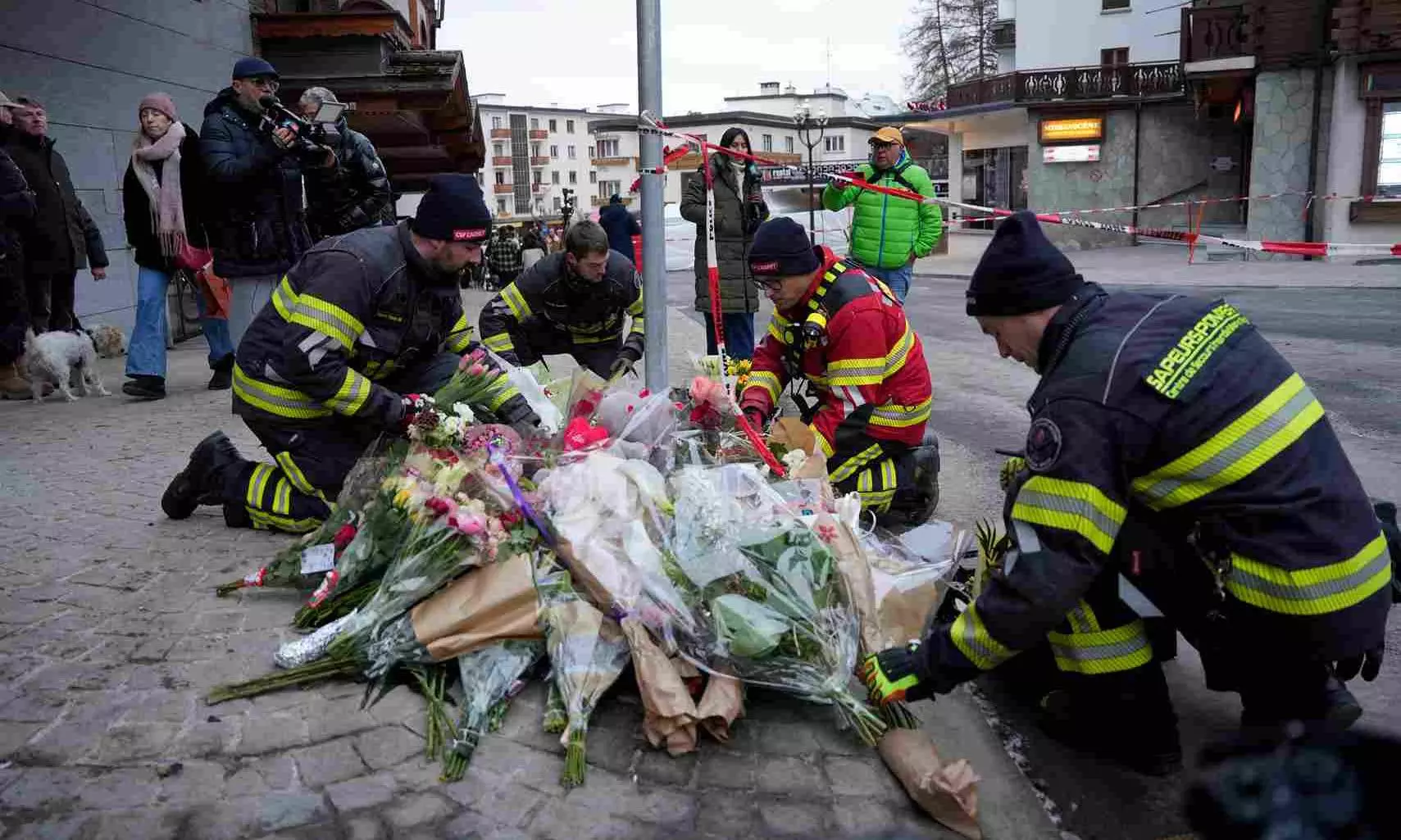
Residents and visitors laid flowers and lit candles at a makeshift memorial outside the cordoned-off bar. “It could have been us,” said Emma, an 18-year-old from Geneva who chose not to enter because of a long queue. Elisa Sousa, 17, who spent the evening with her family instead, said, “And honestly, I’ll need to thank my mother a hundred times for not letting me go. Because God knows where I’d be now.”
Tracing Bengal light origins
Fountain candles, also commonly called Bengal lights, derive their name from Bengal due to their historical association with the region.
The term comes from “Bengal fire” or “Bengal light,” a pyrotechnic composition widely used in 18th–19th century Europe for stage effects, military signalling and celebrations. The name stuck because the ingredients and techniques for producing bright, steady-burning coloured flames were believed to have originated from, or were inspired by, fireworks and pyrotechnic knowledge from Bengal, which was then a major centre for fireworks and chemical crafts under Mughal and later colonial rule.