








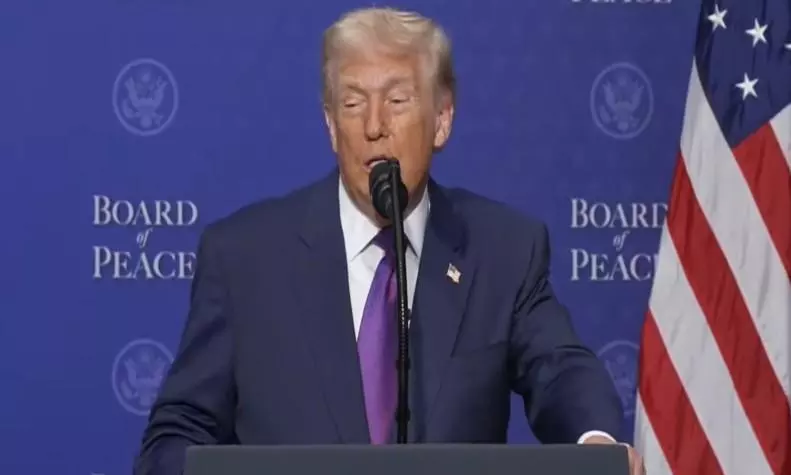
Tariffs will eventually replace Income Tax, says Trump, slams SC ruling
During his State of the Union address, Trump criticised the Supreme Court’s ruling against his tariff policy and described it as "very unfortunate"

US President Donald Trump defended his move to impose sweeping global tariffs even after they were struck down by the Supreme Court, stating that he believes the tariffs would eventually replace the modern-day system of Income Tax. Trump made the remarks during the annual State of the Union address.
"As time goes by, I believe that tariffs, paid for by foreign countries, will, like in the past, substantially replace the modern-day system of income tax, taking a great financial burden off the people that I love," said Trump.
‘Tariffs boosted US economy’
Arguing that tariffs were among the key reasons behind the US economy’s turnaround, Trump said. "I used these tariffs, took in hundreds of billions of dollars to make great deals for our country, both economically and on a national security basis. Everything was working well. Countries that were ripping us off for decades are now paying us hundreds of billions of dollars. They were ripping us so badly.”
Also Read: The world waits with apprehension as Trump decides on attacking Iran
"These countries are now happy, and so are we. We made deals. The deals are all done. And they're happy. They're not making money like they used to, but we're making a lot of money. There was no inflation, tremendous growth," he added as quoted by NDTV.
Slams SC verdict
The Republican leader slammed the Supreme Court’s verdict, which struck down the tariffs, and termed it "very unfortunate".
"Just four days ago, an unfortunate ruling from the United States Supreme Court. It just came down. It came down. Very unfortunate ruling. But the good news is that almost all countries and corporations want to keep the deal that they already made - knowing that the legal power that I, as President, have to make a new deal could be far worse for them. And therefore, they will continue to work along the same successful path that we had negotiated before the Supreme Court's unfortunate involvement," he said.
‘Tariffs to remain in force’
Reiterating his claim of stopping wars with the threat of tariffs, Trump said that without the levies, he would not have been able to resolve the conflicts. He further stated that the tariffs would remain in force under a fully approved alternative legal status, adding that no Congressional action would be required.
Also Read: Trump says he may face assassination risk for being a 'consequential President'
"Despite the disappointing ruling, these powerful countries saving - it's saving our country the kind of money we're taking in - peace-protecting many of the wars I settled was because of the threat of tariffs. I wouldn't have been able to settle them without - will remain in place under fully approved and tested alternative legal statutes. And they have been tested for a long time," said Trump.
'They're a little more complex, but they're actually probably better, leading to a solution that will be even stronger than before. Congressional action will not be necessary. It's already time-tested and approved. And as time goes by, I believe that tariffs will take a great financial burden off the people that I love," he added.
'Pak PM would have died'
Doubling down on his claim of stopping the India-Pakistan military conflict following Operation Sindoor, Trump said that the standoff could have escalated dramatically. “Pakistan and India would have been in a nuclear war,” he said. He went further, claiming that “"35 million people, said the Prime minister of Pakistan (Shehbaz Sharif), would have died if it were not for my involvement,”, reported the Hindustan Times.
The Republican leader has repeatedly maintained that his administration intervened at a critical moment between the two countries. His remarks at the annual address echoed similar assertions he has made in recent months about stepping in during heightened hostilities.
-Trump framed his involvement as decisive, suggesting the fallout could have been catastrophic without it. The comments once again placed his claim of preventing a nuclear conflict at the centre of his account of the India-Pakistan episode.
The backdrop
Barely half a year after returning to the White House, Trump upended the longstanding global trade framework, wielding America’s economic weight against countries that refused what he described as fair terms and pressing others for sweeping concessions.
On April 2, Trump rolled out what he called “reciprocal” tariffs of as much as 50 per cent on imports from nations running trade surpluses with the United States, alongside a 10 per cent “baseline” levy on goods from nearly every other country. To justify the move, he cited a 1977 statute and declared the trade deficit a national emergency.
Also Read: Uniform 15 pc tariff would benefit some Asia-Pacific economies: Moody's Analytics
The announcement set off immediate backlash at home and abroad. Within days, Trump paused the reciprocal tariffs for 90 days, saying the window would allow governments to come to the table. Some eventually agreed to revised terms. Others resisted and faced steeper duties as a result.
The legal challenge reached the US Supreme Court, which, in a 6-3 decision, dealt Trump a sharp setback on a policy central to his economic agenda. Angered by the ruling, he moved quickly. Hours after the decision, Trump signed a fresh order imposing a 15 per cent tariff on imports from around the world. Unlike the earlier measure, the new duties fall under a different law that limits them to 150 days. The administration said the tariffs would take effect “almost immediately.”