








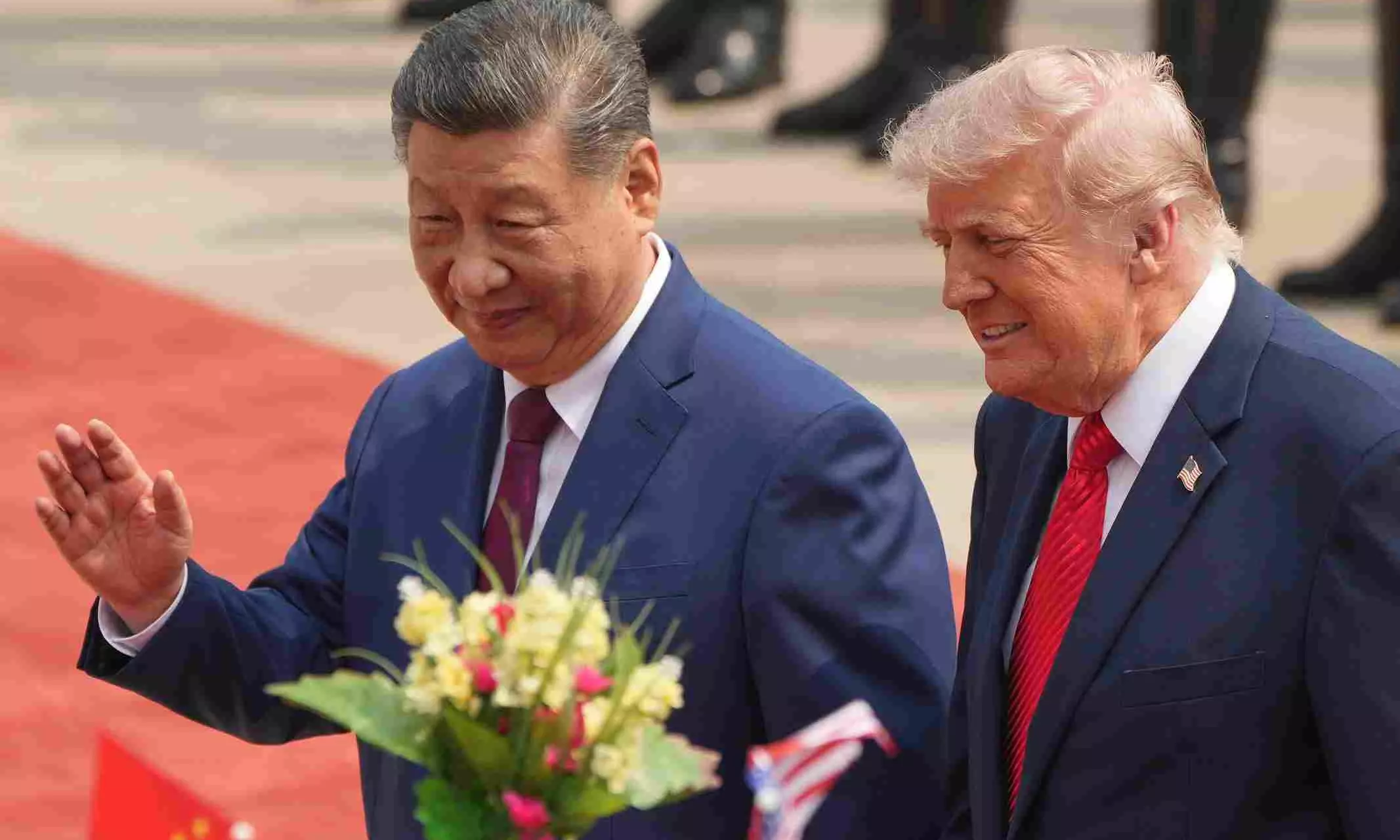
President Donald Trump participates in a welcome ceremony with China's President Xi Jinping at the Great Hall of the People, Thursday, May 14, 2026, in Beijing. Photo: AP/PTI
Taiwan, Iran, trade: Key highlights of Trump-Xi meet in China amid global turmoil
As war in Iran spikes energy prices, the two leaders project unity in Beijing while clashing over trade, Taiwan, and nuclear arms control. Here are some key points

US President Donald Trump's meeting with Chinese leader Xi Jinping on Thursday (May 14) wrapped up after two hours of talks covering Taiwan, trade, international conflicts and other differences in US-China relations.
The meeting was expected to be long on pageantry and symbolism as experts predicted no major breakthroughs are expected on these key issues.
Earlier, cannons boomed a welcome salute for Trump and a band played the Star-Spangled Banner. Xi and Trump then went on to inspect a military honour guard.
Tiananmen Square was cleared for the event, with no movement in the plaza save for officials and press, as well as military personnel who paraded in after Trump arrived. The hall featured giant, red-carpeted steps and huge expanses of marble, where soldiers hung large American and Chinese flags.
After the meeting, the two Presidents toured the UNESCO heritage site Temple of Heaven and will later attend a state banquet on Thursday, before taking tea and lunch together on Friday, according to the White House.
There was one jarring moment, however. Even as the two leaders struck a warm and optimistic tone before their high-stakes bilateral meeting at the Great Hall of the People (an imposing building on Tiananmen Square that houses China's legislature), prioritising cooperation over confrontation, Xi issued a warning on Taiwan. Not before referring to how the two countries should avoid falling into the Thucydides Trap, which refers to how tensions historically between a rising and ruling power have often resulted in a war.
Here are some key highlights from the high-stakes meet:
1. Xi's warning on Taiwan
Chinese premier Xi in his opening remarks ahead of his meeting said if the Taiwan issue was not handled well, the two countries would clash or even come into conflict, pushing China-US relations into "a very dangerous place", Chinese state media Xinhua reported.
China views democratically governed Taiwan as its territory – a claim that Taipei rejects – and opposes US arms sales to the island. United States has "reaffirmed its clear and firm support" for the island.
"If it is handled well, bilateral relations can remain generally stable. If mishandled, the two nations could collide or even come into conflict, pushing the entire China-US relationship into a highly perilous situation," was the message from Xi.
The Chinese leader added that Taiwan's so-called independence was "fundamentally incompatible" with peace in the Taiwan Strait. "And peace in the strait is the greatest common ground between China and the United States," he said.
The Trump administration has approved an USD 11 billion weapons package for Taiwan, but has yet to begin fulfilling it. Trump has also demonstrated greater ambivalence toward Taiwan — an approach that's raising questions about whether he might be open to dialling back support for the island democracy. Taiwan is the world's leading chipmaker, producing components essential to the development of artificial intelligence.
Trump has sought to bolster trade deals with Taiwan that can stimulate chip production in the US.
2. Iran and other wars
In their two hour meeting, US President Donald Trump and China’s leader Xi Jinping discussed the war in the Middle East, the Ukraine conflict, and issues on the Korean Peninsula when they met in Beijing, the Chinese government said.
The US president's Beijing swing came as Iran continues to dominate his domestic agenda and stoke fears about the prospect of a weakening US economy as the election season ahead of November's midterms — when Republicans will be looking to maintain control of Congress — begins heating up.
The US and Israel's war in Iran has led to the effective closure of the Strait of Hormuz, stranding oil and natural gas tankers and causing energy prices to spike, threatening global economic growth.
China is the largest purchaser of Iranian oil, and Secretary of State Marco Rubio said in in an interview with Fox News' Sean Hannity that Trump will make the case for Beijing to exert its influence on Iran, noting that administration officials will underscore that “economies are melting down because of this crisis” which means consumers are “buying less Chinese product.”
“So it's in their interest to resolve this,” Rubio said of Chinese officials. “We hope to convince them to play a more active role in getting Iran to walk away from what they're doing now and trying to do now in the Persian Gulf.”
3. Trade deals
Xi told a delegation of US business executives accompanying Trump that China would "open wider" to the world during US-China talks in Beijing on Thursday.
“China’s doors to the outside world will open wider and wider... American companies will enjoy even brighter prospects in China,” Xi said, Chinese state media reported.
Trump’s delegation includes the heads of Apple, Nvidia, Micron, Qualcomm, BlackRock, Boeing, Citigroup, Goldman Sachs and more.
Meanwhile, the United States has approved exports of Nvidia’s advanced H200 artificial intelligence chips to several major Chinese technology firms, including Alibaba, Tencent and ByteDance, even as US President Donald Trump held high-stakes talks with Chinese President Xi Jinping in Beijing, Reuters reported on Thursday, citing sources familiar with the matter.
China too has renewed export licences for hundreds of US beef processing plants, customs data showed, in a possible goodwill gesture as the leaders of both countries met in Beijing.
More than 400 US beef plants lost export eligibility over the past year as Beijing’s permissions, granted between March 2020 and April 2021, lapsed without the customary renewal, accounting for roughly 65% of the once-registered facilities.
The US and China reached a trade truce last year that calmed each side's threats to impose steep tariffs on the other. The White House says there have been ongoing discussions and mutual interest in extending the agreement, though it is unclear whether any such announcement could come during Trump's visit.
Trump has said he will ask Xi to give US firms greater access to the Chinese market, urging his Chinese counterpart to “'open up' China so that these brilliant people can work their magic.” He's also seeking to extend a deal that allows China to continue exporting rare earth minerals to the US, prompting China to hold off on limiting the global supply in response to Trump's threatened tariffs.
What did Xi and Trump talk about?
The US is yet to comment on the discussions, but the Chinese foreign ministry has just released a readout. According to the ministry:
- Xi and Trump agreed to frame their relationship as “constructive strategic and stable” in a new positioning that will guide ties for the next three years and beyond.
- Xi said “the essence of China-US economic and trade relations is mutual benefit and win-win cooperation”, adding that both sides should work together to “maintain the hard-won positive momentum”.
- He said China’s door to US businesses will only open wider.
- He called for better communication between the Chinese and US militaries, as well as expanded “cooperation in areas such as trade, health, agriculture, tourism, culture, and law enforcement”.
- Xi stressed that the Taiwan issue is the most important issue in China-US relations. “If handled well, bilateral relations can maintain overall stability. If handled poorly, the two countries will clash or even clash, pushing the entire China-US relationship into a very dangerous situation”.
- The two leaders also exchanged views on the situation in the Middle East, the Ukraine crisis, and the Korean Peninsula.