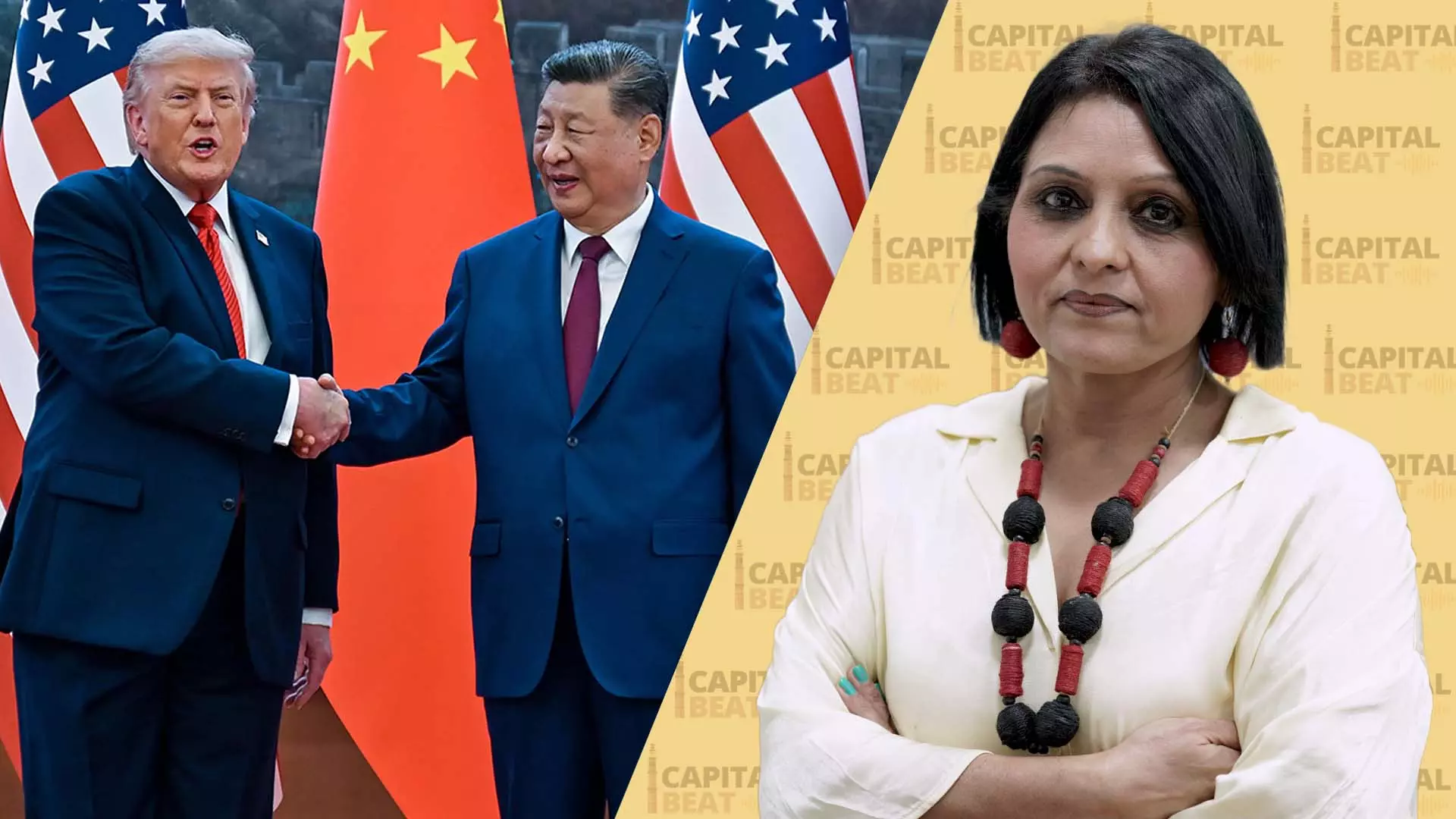
What does Trump’s China visit mean for Taiwan, Iran and India? | Capital Beat
Experts say the Trump-Xi summit revealed China’s growing strategic confidence, with discussions on Taiwan, trade, Iran and global power dynamics dominating the visit

US President Donald Trump’s two-day state visit to China ended without major breakthroughs on Iran, Taiwan or trade, but triggered intense debate over whether China emerged with the upper hand in both optics and diplomacy. A viral image showing Trump’s delegation discarding Chinese-issued burner phones, credentials and gifts before boarding Air Force One further amplified the geopolitical symbolism surrounding the visit.
The Federal spoke to Aftab Kamal Pasha, Middle East expert and diplomat, and Sanjay Kapoor, senior journalist and international affairs expert, on the broader implications of the Trump-Xi Jinping summit, the silence on Taiwan, the Iran question and what the visit means for India and the global balance of power.
The summit featured discussions on trade, artificial intelligence, Taiwan and the Iran conflict, but yielded very few concrete outcomes publicly. Trump promoted agreements involving Chinese purchases of American farm goods, beef and Boeing aircraft, though details remained unclear and no extension of the trade truce was announced
Viral optics
One of the biggest talking points after the summit was a viral image showing members of the American delegation discarding Chinese-issued items near the staircase of Air Force One before departing Beijing.
Also read | Trump’s China visit: Will it help resolve Iran conflict?
White House correspondent Emily Goodin posted on social media that American staff collected “credentials, burner phones, pins and delegation items” before boarding the aircraft and disposed of them in a bin at the bottom of the stairs. “Nothing from China allowed on the plane,” she wrote.
The image quickly sparked online speculation about espionage fears and heightened mistrust between Washington and Beijing.
Kapoor said the development was not unusual and reflected long-standing American suspicions of Chinese surveillance practices.
“I don’t find anything unusual because the US believes China will bug everything possible and they are very strong on surveillance,” Kapoor said. “In this hyper-communication world, everything gets noticed and amplified.”
He added that such measures were standard security protocol for high-level visits involving sensitive diplomatic and business delegations.
Summit outcome
While headlines focused on symbolism, Kapoor argued that the real significance of the visit would become clear only later.
“This is just a distraction. What really happened in Beijing is far more important,” he said, suggesting that crucial understandings may have been reached privately between Trump and Xi.
Kapoor noted that Xi invited Trump to a highly exclusive leadership compound in Beijing, something he described as unusual and diplomatically significant.
“I am sure some agreements have happened. Otherwise, such a major summit involving top CEOs, diplomats and political leaders would not have taken place,” he said.
According to Kapoor, two key issues dominated behind-the-scenes discussions — the Strait of Hormuz crisis and China’s global economic leverage through rare earth minerals and manufacturing.
Questions also remain over Trump’s announcement that China would purchase 200 Boeing aircraft. Markets reportedly reacted cautiously because no detailed agreement or timeline was released.
US soybean futures also reportedly fell after the summit failed to produce concrete commitments on American agricultural exports.
China’s edge
Pasha argued that China clearly held the upper hand throughout the visit, beginning with the diplomatic choreography itself. “The fact that the US president went to Beijing itself shows that the United States was keen to initiate dialogue,” he said.
He pointed out that Xi did not personally receive Trump at the airport, with only China’s vice president and junior officials present to welcome him. He also noted that major Chinese newspapers did not prominently feature Trump’s visit on their front pages.
“These were signals that China was not willing to project this as a major diplomatic concession,” he said.
According to Pasha, Beijing entered the summit with confidence after resisting Trump’s tariff escalation and retaliating with restrictions on rare earth exports and trade measures. “The Americans realised that China is a hard nut to crack,” he said.
Also read | Putin to Meet Xi Jinping in Beijing days after Trump's China visit
Pasha argued that Trump needed China’s cooperation on multiple fronts, including the Iran conflict, supply chains and American corporate interests linked to Chinese manufacturing.
Taiwan silence
One of the most closely watched aspects of the summit was Trump’s silence on Taiwan. Pasha described the omission as highly significant, especially after previous American commitments involving arms sales to Taiwan.
“The final statement did not mention Taiwan at all, which is shocking for Taiwan, Japan and South Korea,” he said.
Kapoor also said Trump’s silence could indicate discussions about a broader geopolitical realignment. “Any acknowledgement by the US allowing China’s sovereignty over Taiwan would mean the global order is being reshaped,” he observed.
He suggested that Washington and Beijing may gradually be moving towards informal spheres of influence, with China dominating Asia while the US maintains influence in Europe and Latin America.
Kapoor also referred to growing speculation about the emergence of a “G2” world dominated by the United States and China.
Trump’s restraint
Observers also noticed that Trump appeared unusually restrained during the Beijing visit, sticking closely to prepared remarks instead of his typical improvisational style.
Kapoor said visits to China involve extensive diplomatic preparation and cultural briefing. “China has a way of interpreting things that can make situations very difficult,” he said. “Trump stayed close to the script because he did not want to be misunderstood.”
He added that body language, handshakes and public gestures are carefully analysed during high-level meetings with Chinese leadership.
Pasha argued that China’s diplomatic style and insistence on respect may have influenced Trump’s behaviour. “The Chinese expect respect. They are not comfortable with the kind of language Trump often uses against world leaders,” he said.
According to Pasha, Beijing projected itself as calm, composed and strategically patient throughout the summit.
India concerns
The panel also discussed what the summit means for India, particularly amid concerns over rising oil prices and instability around the Strait of Hormuz.
Kapoor said India would closely monitor developments and seek detailed briefings from Washington. “India is going to watch this with great suspicion,” he said.
He noted that disruptions in oil supply routes could directly impact inflation and fuel prices in India. “Since yesterday, fuel prices have already increased by Rs 3, and this could worsen if there is no agreement,” he warned.
Also read | Taiwan, Iran, trade: Key highlights of Trump-Xi meet in China amid global turmoil
Pasha added that China’s comments on keeping the Strait of Hormuz open appeared directed at the United States, especially after Beijing criticised the Iran conflict as illegal and against international law.
According to him, the partial movement of ships through the Strait after Trump’s Beijing visit may indicate some limited diplomatic coordination between China and Iran.
G2 possibility
Pasha said the world may gradually be moving towards a US-China dominated global structure.
“These two countries have the capability to shape international developments — economic, political and strategic,” he said. He argued that no other country or alliance currently possesses equivalent global influence.
Kapoor, however, urged caution in drawing immediate conclusions from the summit. “There is too much spin doctoring happening at the moment,” he said. “We will understand the real outcomes only in the coming days.”
For now, Trump’s Beijing visit has left more questions than answers — on Taiwan, Iran, trade, oil routes and the future balance of global power.
The content above has been transcribed from video using a fine-tuned AI model. To ensure accuracy, quality, and editorial integrity, we employ a Human-In-The-Loop (HITL) process. While AI assists in creating the initial draft, our experienced editorial team carefully reviews, edits, and refines the content before publication. At The Federal, we combine the efficiency of AI with the expertise of human editors to deliver reliable and insightful journalism.