








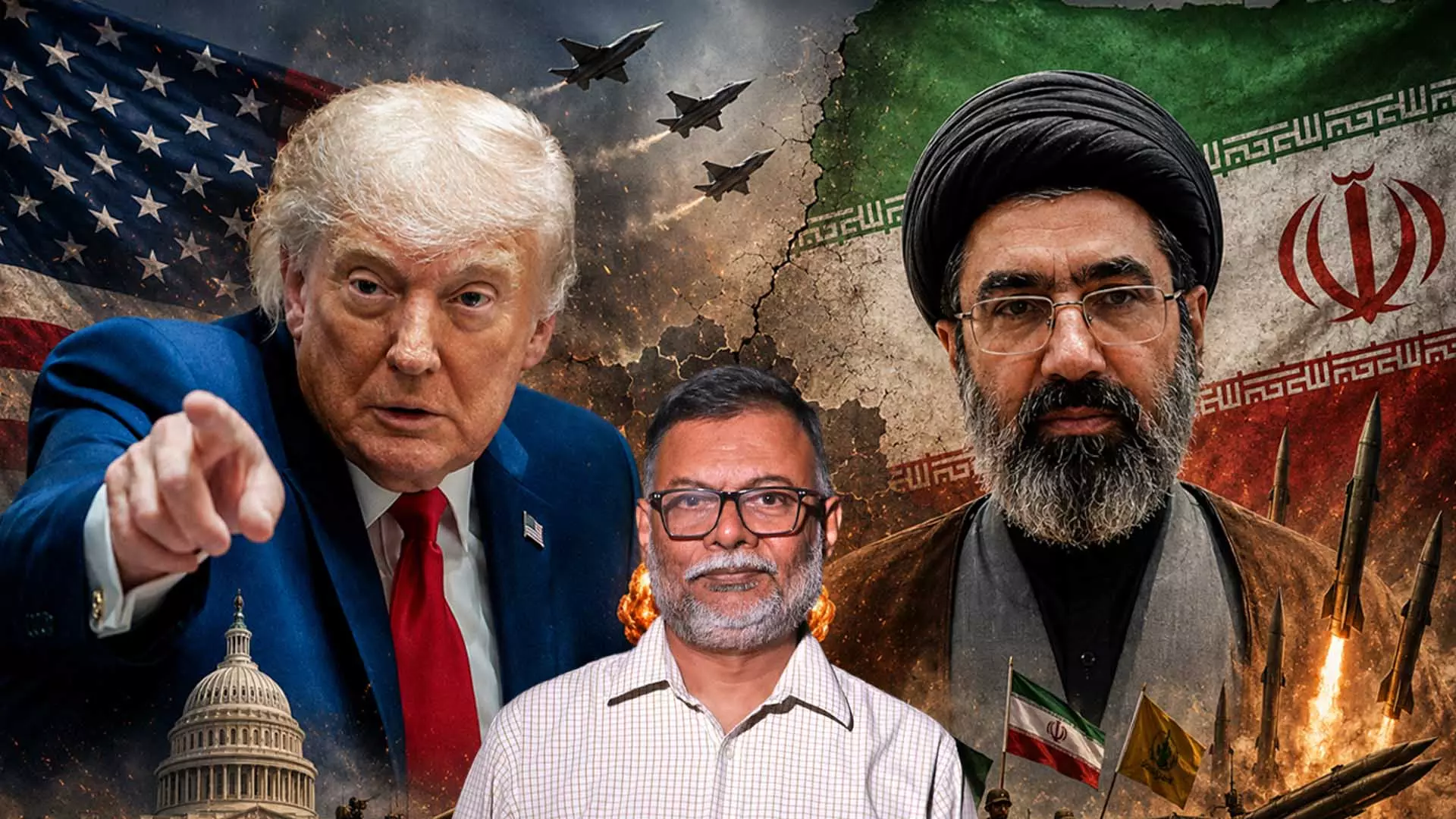
'Trump is under pressure, wants to end Iran war' | Worldly-Wise
Despite the ceasefire and diplomacy, the US-Iran-Israel conflict remains unresolved. Is a prolonged standoff becoming inevitable?

The ongoing conflict involving the United States, Iran and Israel is no longer centred solely on Iran’s nuclear programme, but increasingly on broader regional flashpoints such as the Strait of Hormuz and Israel’s military operations in Lebanon, says The Federal's Consulting Editor and international affairs expert, KS Dakshina Murthy. He argues that while all sides continue to speak about peace, their objectives remain fundamentally different, making negotiations fragile and complicated.
In the latest episode of Worldly-Wise, Murthy speaks about the prospects for a US-Iran agreement, the role of Lebanon in peace negotiations, the diplomatic efforts underway in the Gulf, and India’s cautious approach to the conflict.
Are we moving towards peace or just buying time?
As far as Iran is concerned, its priorities are very clear. It wants to enter into a peace agreement without compromising on its sovereignty. Iran does not want to be arm-twisted into a peace deal.
As far as the US and Donald Trump are concerned, Trump is very clear that Iran should not have a nuclear programme at all. More importantly, the enriched uranium should be handed over to the US or somebody else and should not remain in Iran. The idea is to prevent Iran from developing a nuclear weapon.
As far as Israel is concerned, particularly Prime Minister Benjamin Netanyahu, the objective is regime change. Netanyahu wants Iran’s Islamic dispensation replaced by a different political setup that is less hostile to Israel.
These are the three varying demands on which any agreement has to be settled.
Initially, Trump insisted that Iran give up its nuclear programme. Over time, however, his position appears to have softened. If you notice the latest extension of the ceasefire for another 60 days, the focus has shifted. The US now wants Iran to ensure that the Strait of Hormuz remains open and unrestricted.
The goalposts have changed. The US is no longer talking primarily about ending Iran’s nuclear programme. It now wants Iran to abandon any attempt to control the Strait of Hormuz. In return, the US would ease its blockade measures in the Persian Gulf. Negotiations could then continue and eventually address the nuclear issue.
This is something Israel does not want. Israel is unhappy with this direction because it does not see much benefit in such an arrangement. Yet that appears to be where things are heading.
Trump’s widely reported conversation with Netanyahu, including the harsh language he reportedly used, reflected growing frustration. Trump wants to end this war. He is under pressure within the US, his support is declining, and there are concerns that the conflict could affect Republican prospects in the upcoming mid-term elections.
Even within the Republican Party, some sections are openly siding with Democrats against Trump on this issue. That leaves Trump in a difficult position.
Meanwhile, attacks continue. Iran recently targeted Kuwait, while Iran says its actions are linked to developments around the Strait of Hormuz and the Persian Gulf. The US, in turn, accuses Iran of using drones to threaten shipping.
The immediate priority appears to be ending the siege-like situation around the Strait of Hormuz by both Iran and the US. For now, the larger demands have been pushed into the background.
Also read: US House passes resolution to halt military action against Iran
Why has Lebanon become a sticking point?
To understand Lebanon’s role, one has to understand Hezbollah.
Hezbollah is an independent political party in Lebanon with an armed militia. It enjoys substantial support among Lebanon’s Shia population.
When the war began, one of the earliest major developments was the assassination of Ayatollah Ali Khamenei. Hezbollah responded by firing rockets into Israel.
Northern Israel shares a border with southern Lebanon. Hezbollah launched rockets from southern Lebanon into Israel. These rockets are nowhere near the military capabilities of Israel, but Israel nevertheless treated the attacks seriously and responded by targeting Hezbollah positions in Lebanon.
That is how Lebanon became directly involved.
At one level, Israel was targeting Iran. Simultaneously, it was targeting Hezbollah in Lebanon.
The history between Hezbollah and Israel stretches back to the 1980s during the Lebanese civil war. Israel occupied parts of southern Lebanon for many years before withdrawing in 2000. Since then, there have been occasional clashes, including in 2006, but the current offensive is among the most significant military operations Israel has undertaken in Lebanon in recent decades.
Hezbollah is closely linked to Iran. Iran is one of its principal supporters and organisers. Hezbollah is widely regarded as one of Iran’s regional proxies.
Because of this close relationship, Iran cannot simply abandon Hezbollah while negotiating peace. Hezbollah entered the conflict in support of Iran, and the two remain deeply interconnected.
That is why Iran insists that Israel must stop attacking Hezbollah. At the same time, Hezbollah would also need to stop its attacks on Israel.
Israel has already occupied territory south of the Litani River in Lebanon, and that issue would require separate negotiations.
From Iran’s perspective, demanding an end to Israeli attacks on Hezbollah is natural. Iran is not willing to abandon a close ally.
Also read: Israel, Lebanon agree to renew fragile ceasefire, create Lebanese security zones
Is Lebanon complicating the negotiations?
Yes, it is. Israel remains committed to the idea of regime change in Iran. In addition, Netanyahu faces pressure from within his own right-wing coalition government.
His coalition partners want Israel to continue targeting Hezbollah and oppose any withdrawal from occupied areas in Lebanon. So Netanyahu is caught between pressure from Trump to end the fighting and pressure from his coalition partners to continue military operations.
Iran has made its position very clear. It even suspended talks with the US for a few days because it was unhappy with continued Israeli attacks in Lebanon.
So Lebanon has become a major sticking point in any peace process.
What should the world watch most closely now?
The most important thing to watch is the negotiations.
If you look at the three major developments—the fighting in the region, pressure from Congress on Trump, and the mediation efforts involving Pakistan, Türkiye, Egypt, Saudi Arabia and now Qatar—the mediation process is the one driving any realistic prospect of peace.
Take the US Congress. Some Republicans have voted alongside Democrats on resolutions aimed at limiting Trump’s ability to continue the war with Iran.
Even if Trump is not legally bound by those votes, they provide a clear indication of public sentiment and political pressure within the US.
In the Gulf, countries have had enough of the war. They have suffered economically and become caught in the crossfire. Recovery will take years.
The Gulf’s reputation as one of the world’s most stable regions has also suffered. Millions of expatriates, including Indians, work there. Stability benefits both the Gulf countries and the people who depend on the region.
As a result, Gulf states are pressuring both the US and Iran to avoid further escalation.
All these developments matter, but the mediation process remains the key factor. If there is any possibility of peace, it will emerge through negotiations.
How is India balancing its ties with the US and Iran?
As far as India is concerned, it has largely stepped back from direct involvement in the conflict between Iran, Israel and the US.
India has strong ties with all three. It is close to the US, has longstanding relations with Iran, and has developed a new strategic understanding with Israel.
Because of these overlapping relationships, India often adopts a cautious position. Whether in the United Nations General Assembly or other international forums, India generally calls for peace and negotiations rather than taking a strongly partisan position.
India has not attempted to play a proactive role in the conflict. In my view, it missed an opportunity because its good relations with all sides could have made it a credible mediator.
However, the Narendra Modi government does not appear particularly interested in assuming such a role.
For now, India has chosen to remain on the sidelines.
India is not a major power in the international system in the same way China is, so its direct impact on the outcome of the war may be limited.
What matters to New Delhi is ensuring that Indian interests are not harmed once the conflict eventually ends. The government does not want any action taken today to be held against India later.
This reflects a cautious foreign policy tradition that has characterised India for decades. Except in relation to Pakistan, India has generally preferred to maintain friendly relations with all sides and avoid aggressive posturing.
That cautious approach is visible in the current conflict as well.
(The content above has been transcribed from video using a fine-tuned AI model. To ensure accuracy, quality, and editorial integrity, we employ a Human-In-The-Loop (HITL) process. While AI assists in creating the initial draft, our experienced editorial team carefully reviews, edits, and refines the content before publication. At The Federal, we combine the efficiency of AI with the expertise of human editors to deliver reliable and insightful journalism.)


