








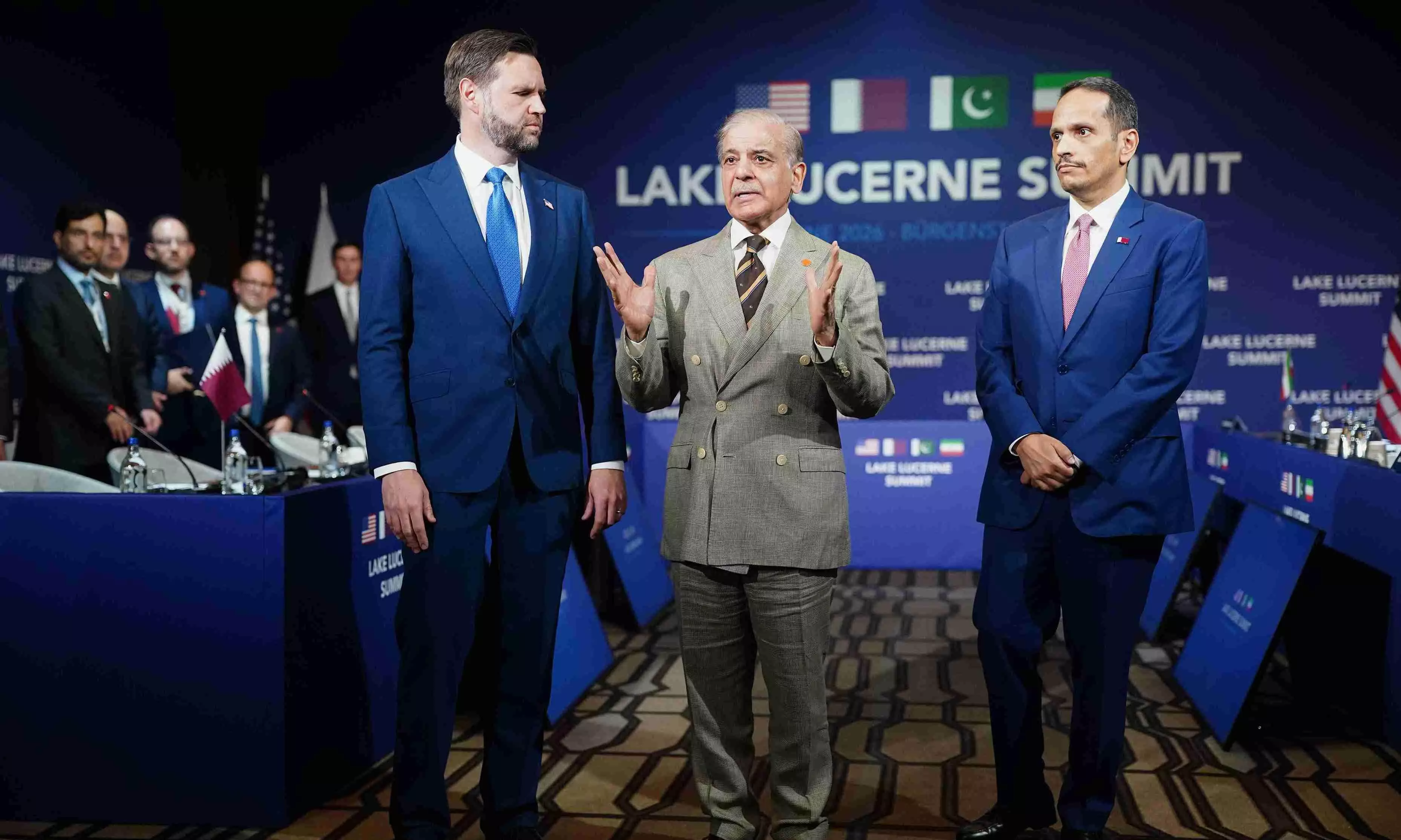
(From left) US Vice President JD Vance (left) with the prime ministers of Pakistan (centre) and Qatar at the Buergenstock Resort in Switzerland on June 21. Photo: AP/PTI
Mixed signals from Washington after first round of US-Iran peace talks in Switzerland
President Trump threatens Tehran with heavy strikes over ongoing Israel-Lebanon conflict irritants even as VP JD Vance hails 'great progress' in negotiations

The American leadership was found to be split in its reaction as high-level technical negotiations kicked off between the US, Iran and other mediating countries such as Pakistan and Qatar in the Bürgenstock mountain resort in central Switzerland after an initial peace agreement signed between Washington and Tehran on Thursday (June 18) faced irritants, such as Israel's continued strikes on Lebanon, where Iran sympathiser Hezbollah is based.
Also read: Collapsed US-Iran talks expose a broken global order
US Vice President JD Vance, who is present at the European venue for the talks, announced "great progress" in ongoing peace talks and expressed hope for a future where both nations could "work together to promote peace and prosperity". While acknowledging Iran's role as a "driver of regional instability", he said US President Donald Trump remained committed to a full regional ceasefire, though admitted such agreements are "a little bit messy".
Trump threatens Iran even as talks begin
However, the president simultaneously posted warnings on his Truth Social platform, threatening to strike Iran "very hard again, only harder" if it failed to restrain the activities of its "highly paid proxies" in Lebanon. The contradictory signals from Washington came as Israeli strikes on southern Lebanon killed at least 16 people on Saturday, threatening to derail the preliminary US-Iran peace deal. The strikes took place just hours after a ceasefire between Israel and Lebanon took effect.
Vance maintained that technical negotiations, though unlikely to resolve every disagreement, yet it “allow us to sit together as teams for the first time in history”.
“The question before us now is how much more can we accomplish together? Can we turn over a new leaf?” Vance asked in a tone of optimism.
Iran on Lebanon strikes, nuclear weapon
Iran, meanwhile, said before the talks began that it was shutting the Strait of Hormuz to protest the Israeli strikes in Lebanon, a move that could undermine the interim peace deal, which is far away from looking strong.
Besides Lebanon, Iranian nuclear plans are also something that the US seeks attention on.
Iranian President Masoud Pezeshkian said on Sunday that Tehran was prepared to provide written guarantees that it was not pursuing a nuclear weapon, while firmly stating that Iran would not surrender its right to enrich uranium, AFP reported.
Also read: 'US achieved very little from the war': Talmiz Ahmad | AI With Sanket
“What the United States demands is that Iran not build an atomic bomb. This is nothing new, and we can also state in writing that we have no intention of building a bomb,” the president’s website quoted him as saying.
“However, we will not relinquish our right to enrichment, and the other side will have no choice but to accept this right,” he added, ahead of the talks in Switzerland.
Pezeshkian also said the preliminary agreement was beneficial for Tehran and claimed it included the return of around $6 billion in Iranian funds currently frozen in Qatar.
According to Iran’s semi-official Tasnim news agency, Pezeshkian said the deal recognised rights that had previously been denied to Iran and that the benefits of the agreement would become clearer over time.
Who are attending the Switzerland talks
The US delegation, led by Vance, includes Trump’s special envoy Steve Witkoff and son-in-law Jared Kushner, while the Iranian team features Mohammad Bagher Ghalibaf, speaker of the country's parliament and Abbas Araghchi, the foreign minister. Pakistani Prime Minister Shehbaz Sharif and his Qatari counterpart Sheikh Mohammed bin Abdulrahman bin Jassim Al-Thani were also present.
Also read: Trump says no Hormuz tolls during ceasefire as US-Iran talks resume in Switzerland
The talks come days after Trump and Pezeshkian signed a preliminary memorandum of understanding (MoU) days ago, aimed at addressing the ongoing regional conflict, nuclear concerns and tensions around the strategic Strait of Hormuz.