








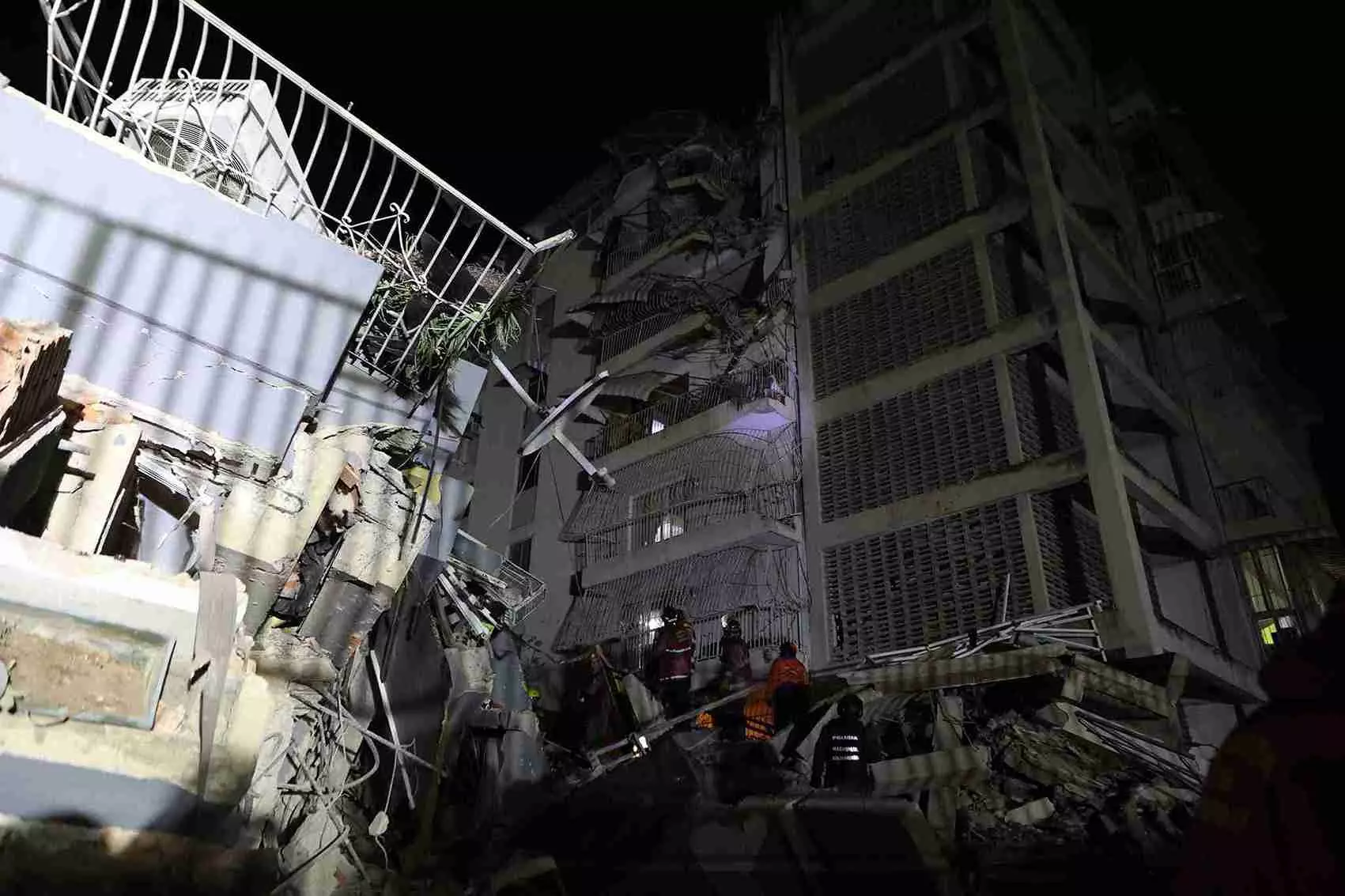
Over 160 dead, nearly 1,000 injured as twin strong earthquakes devastate Venezuela
Acting President Delcy Rodriguez declares hard-hit coastal zones a 'disaster area' as frantic rescue operations continue through the rubble for survivors

The acting president of Venezuela, Delcy Rodriguez, on Thursday (June 25) said at least 164 people died while 971 were injured after two back-to-back powerful earthquakes rocked the South American nation on Wednesday (June 24) evening, local time. She added rescue teams were visiting the hardest-hit areas to rescue people trapped under debris.
The twin quakes, of 7.2 and 7.5 magnitude, were among the strongest to strike Venezuela in more than a century and could be felt throughout the region. The country's main airport was damaged and closed, while buildings were evacuated in places as far away as Brazil's Amazon, located about 1,700 kilometres from Venezuela's capital, Caracas.
People walk into debris looking for missing
Television broadcasts showed Thursday rescue workers using power tools to penetrate piles of rubble where buildings once stood in search of lives. Panicked residents of Caracas were sent pouring into the streets. After the quakes, many people walked among the rubble searching for the missing among collapsed buildings and toppled electric poles.
Also read: India, Venezuela explore long-term energy partnership as crude trade gains momentum
Footage on state TV showed three children, covered in dust but alive, pulled from the rubble in La Guaira state, which sits north of Caracas on the coast. The acting president described it as a “disaster zone” and one of the areas hardest hit areas because of the large number of collapsed buildings.
Rodriguez said officials were trying to make the most of the daylight hours to speed up efforts to rescue people believed to remain trapped under the rubble.
“Dozens of buildings have collapsed there ... and we are currently carrying out intensive rescue operations to save lives,” Rodríguez said.
She appealed to businesses to make heavy construction equipment available for rescue operations, adding that search and rescue teams certified by the United Nations were on their way to Venezuela to assist.
Two massive temblors
The US Geological Survey (USGS) initially said the first earthquake had a magnitude of 7.1, but later revised it to 7.2. The epicentre was west of the community of Morón, located along the country's Caribbean coast, about 168 kilometres west of Caracas. The quake had a depth of 22 kilometres.
The USGS reported an even larger 7.5-magnitude earthquake just a minute later. The second quake had a depth of 10 kilometres and its epicentre was 16 kilometres southwest of Morón.
The quakes, among the strongest to strike Venezuela in more than a century, struck shortly after 6 pm. People evacuated swaying buildings in the capital Caracas, many visibly shocked as they saw entire walls that had collapsed, making furniture visible from the street. Dust columns could also be seen in two neighbourhoods of the capital, where restaurants and other businesses are typically busy.
Residents console a man outside their homes after successive earthquakes, in Caracas, Venezuela, on Thursday, June 25. AP/PTI
Rescue worker carry an injured man after an earthquake in Caracas, Venezuela, on Thursday, June 25. AP/PTI
No power, cellphone signal
People remained on the streets for hours, even after sunset. Some sat on the ground hugging their pets as dust gathered around them. Collapsed buildings, toppled electric poles and debris blocked streets. Parts of the capital lost power and cellphone signal.
“It started off gently and then gradually grew, and in the end, we all had to leave our houses, go outside and gather together,” Caracas resident Hector Ricci told news agency AP.
The lack of cellphone signal in parts of Venezuela deepened the distress of many families, particularly those among the more than 7.7 million people who have left the country during its protracted crisis.
“May strength, serenity, and solidarity prevail among us in the face of this difficult time,” Opposition leader Maria Corina Machado said from exile on X.
Quake felt in several states
The country's Interior Minister Diosdado Cabello said the quake could be felt in several states. The Altamira neighbourhood in Caracas had “alarming situations” with collapsed homes and buildings, he said, suggesting people were injured in the earthquake and asking motorists to give way to ambulances and other emergency vehicles.
“The building really shook from side to side. Unreal. The force was incredibly strong,” Caracas resident Roberto Gamas said. “We were walking and it was tossing us around. Everything in the apartment fell. Well, thank God we were able to get out.”
The quakes were so strong that buildings were evacuated in cities as far away as Brazil’s Amazon about 1,700 kilometres away. According to reports on TV Globo, buildings in Manaus, Belem and Macapá in Brazil's Amazon were evacuated.
The quakes also were felt in Colombia’s Caribbean and northeast regions, but there were no reports of damages or injuries. The Colombian Maritime Authority in a statement said the country’s Caribbean coast is at no risk of tsunami.
Security forces stand next to a collapsed building after an earthquake in Caracas, Venezuela, on Thursday, June 25. AP/PTI
Rescue workers search through the rubble after an earthquake in Caracas, Venezuela, Thursday, June 25. AP/PTI
Unusual quake for Venezuela
The US Pacific Tsunami Warning Centre issued a tsunami alert for Virgin Islands. Authorities in the Dominican Republic also issued one for the island. Another alert for Puerto Rico was quickly lifted.
Strong earthquakes are unusual in Venezuela. While the country sits near multiple fault lines, its position straddling the South American and Caribbean plates make earthquakes much less common than in other parts of Latin America.
Along the Pacific coast, in Mexico and Chile, for example, earthquakes are frequent. The two countries sit along the seismically active tectonic belt known as the Pacific Ring of Fire, which is responsible for 90 per cent of earthquakes, according to the USGS.
(With agency inputs)