








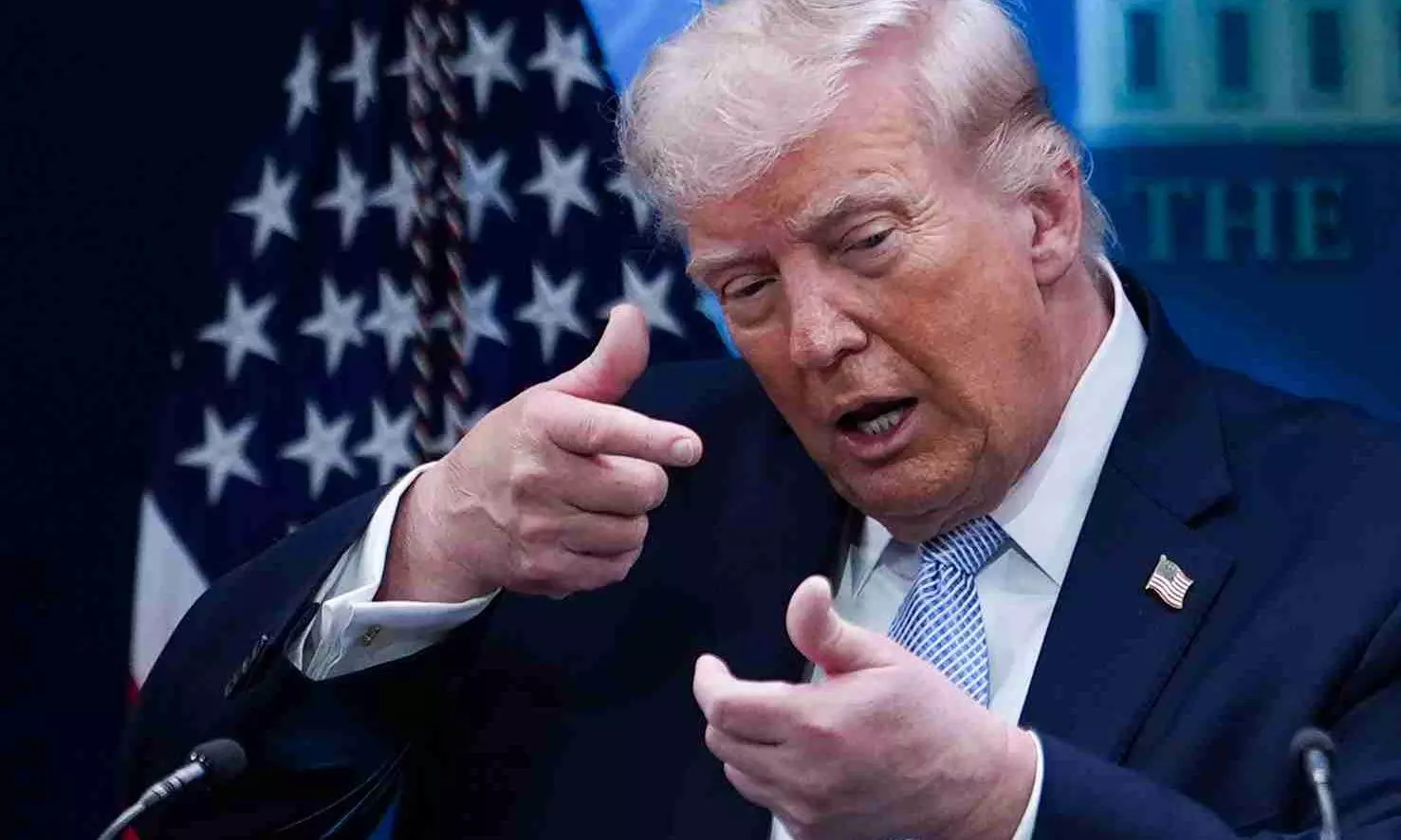
LIVE: Trump warns Iran of bombing if deal not reached, rules out truce extension
Trump says Iran “has no choice” but to negotiate and signals escalation as ceasefire deadline nears, while expressing optimism over a possible deal

Here is the top, trending news of Tuesday, April 21, 2026, including the West Asia war, Indian politics, states’ politics, geopolitics, federal issues, economics, development issues, sports, entertainment, and so on.
Read updates below.
Live Updates
- 21 April 2026 9:06 PM IST
Trump warns he will bomb Iran if no deal by tomorrow, rules out truce extension
US President Donald Trump on Tuesday said he would start bombing Iran if they do not agree to a deal with the US before the end of the two-week ceasefire on Wednesday. “Well, I don’t want to do that,” Trump told CNBC’s “Squawk Box” when asked if he would extend the ceasefire with Iran to allow time for the peace talks to reach a deal to end the war.
“They have to negotiate. And, you know, the one thing I’ll say is this: Iran can get themselves on a very good footing. If they make a deal, they can make themselves into a strong nation again, a wonderful nation again,” he added. Trump said that if the ceasefire ends on Wednesday without an agreement, he is prepared to resume attacking Iran. “I expect to be bombing because I think that’s a better attitude to go in with,” he said.
Trump said he thinks the US is “going to end up with a great deal” with Iran to end the weeks-long war. “I think they have no choice,” Trump said when asked about his expectations from the second round of peace negotiations with Iran. “We’ve taken out their navy, we’ve taken out their air force, we’ve taken out their leaders,” the president said.
“We’ve taken out their leaders, frankly, which does complicate things in one way, but these leaders are much more rational,” Trump said. “It is regime change, no matter what you want to call it, which is not something I said I was going to do, but I’ve done it indirectly.” While the first round of US-Iran talks, held on April 11 and 12, ended without an agreement, uncertainty surrounds the second round.
- 21 April 2026 2:45 PM IST
Conflicting signals cloud Iran-US talks, tensions persist
The messaging has been anything but steady. At one moment, a note of urgency from Washington, “The deal may happen very soon.” Hours later, the tone hardens, with warnings that “If a deal does not happen, bombs will start going off.” Iran, for its part, has pushed back at both the pressure and the framing, insisting, “We do not accept negotiations under the shadow of threats.”
For now, a fragile ceasefire has paused open hostilities, but the language on both sides continues to escalate. US President Donald Trump has alternated between suggesting a breakthrough is close and floating drastic steps, including the claim that “The US will begin the process of blockading the Strait of Hormuz.”
Confusion has deepened around proposed talks in Islamabad. Washington initially indicated Vice President JD Vance would travel for a second round, yet he remained in the US. Tehran quickly dismissed the idea altogether. Iran’s Parliament Speaker, Mohammad-Bagher Ghalibaf, accused Washington of trying to turn diplomacy into a “table of surrender.”
Pakistan continues to signal readiness to host, even as the outline of any talks remains unclear. With competing proposals on the table and neither side yielding on core demands, the gap between rhetoric and resolution remains wide.
- 21 April 2026 2:39 PM IST
Iran denies sending delegation to Islamabad amid talk rumors
Iranian state television on Monday sought to shut down speculation over a possible diplomatic channel with Washington, airing an on-screen statement that “no delegation from Iran has visited Islamabad... so far.”
The brief message, carried without additional context, comes as reports and rumours swirl about potential talks involving the US, with Pakistan’s capital cited as a possible meeting point. Tehran has not formally acknowledged any plan to dispatch officials.
The broadcast appears to mirror a wider debate inside Iran’s leadership, where competing factions are weighing how to respond to the US Navy’s seizure of an Iranian container ship over the weekend. That incident has added urgency to an already tense moment, though there has been no clear signal of a unified course of action.
State television, long aligned with more hardline currents within Iran’s political structure, has often served as a window into internal positioning. Its decision to issue a categorical denial, even in the absence of an official foreign ministry statement, suggests heightened sensitivity around the prospect of engagement.
In Islamabad, officials have been on standby for several days amid expectations that an Iranian delegation might arrive. Those preparations remain in place, but there has been no confirmation from Tehran, and no visible movement to indicate that talks are imminent.
- 21 April 2026 12:30 PM IST
Iranian tanker slips past US blockade, returns home safely
An Iranian supertanker has re-entered home waters after completing a crude transfer near Indonesia, slipping past a US naval cordon that Tehran has long condemned. According to Fars News, the vessel left Iran in March, reached the Riau Archipelago, and offloaded roughly 2 million barrels before turning back.
State media cast the voyage in defiant terms, calling it a breakthrough against the "US Siege" and declaring that "Another Iranian Tanker Breaches the U.S. Siege." Fars, citing Tanker Traffic, reported, "National Iranian VLCC supertanker departed Iran in late March 2026 and swam on over to the Riau Archipelago where she transferred her 2 million barrels of crude oil to another VLCC. She then returned home via the blockade line. She'll reach Kharg Island tomorrow."
The episode unfolds as scrutiny of Iranian shipping intensifies, and a fragile ceasefire nears its April 22 deadline, with tensions still unresolved.
- 21 April 2026 12:06 PM IST
Iran gives field commanders more power over Iraqi militias
Iran has granted its commanders greater autonomy over militias in Iraq, allowing some groups to carry out operations without Tehran's approval, a shift driven by the pressures of the war, three militia members and two other officials have told The Associated Press.
Many Iran-backed militias are funded through the Iraqi state budget and embedded within the security apparatus, drawing criticism from the United States and other countries that have borne the brunt of their attacks and say Baghdad has failed to take a tougher stance.
Despite mounting pressure from the US, Baghdad has struggled to contain or deter the groups. The most hard-line factions now operate under Iranian advisers using a decentralized command structure, the five officials told AP, each on condition of anonymity to speak freely about sensitive matters.
“The various forces have been granted the authority to operate according to their own field assessments without referring back to a central command,” said one militia official, who didn't have permission to speak publicly.
The war in the Middle East has exposed the fragility of Iraq's state institutions and their limited ability to restrain these groups. A parallel confrontation between Washington and the militias has deepened the crisis, with factions acting as an extension of Iran's regional campaign and escalating attacks on US assets in Iraq before a tenuous ceasefire deal was reached in April.
Even if the ceasefire agreement holds, Washington is expected to intensify efforts against the groups militarily and politically, particularly as they gain latitude to operate more independently, officials and experts said. On Friday, the US imposed sanctions on seven commanders and senior members of four hard-line Iran-backed Iraqi militia groups.
- 21 April 2026 12:02 PM IST
Vance likely to travel to Islamabad on Tuesday for peace talks with Iran
US Vice President JD Vance is likely to travel to Islamabad on Tuesday for peace talks with Iran to end the seven-week war, according to a media report.
On Monday, US President Donald Trump told The New York Post that the Vance-led delegation was already en route to Islamabad, while other media outlets reported that the vice president was very much in Washington.
Vance is expected to reach Islamabad as the two-week ceasefire, agreed to between the US and Iran on April 8, ends amid threats by Trump to bomb bridges and power plants in Iran if both sides fail to reach a deal.
With Vance expected to reach Islamabad late Tuesday, Trump has effectively extended the ceasefire by a day till Wednesday.
“Vice President Vance is expected to depart for Islamabad by Tuesday morning for talks with Iran over a potential deal to end the war,” American news outlet Axios reported, quoting three US sources.
Special envoy Steve Witkoff and Jared Kushner are expected to join Vance.
The Iranian team was urged to join the meeting by mediators from Pakistan, Egypt, and Turkiye, Axios reported, but, according to the source, didn't leave until they received approval from Iran's supreme leader.
The Iranian delegation's plan to travel to Islamabad was also reported earlier on Monday by the New York Times, citing two Iranian officials.
Iranian Parliament Speaker Mohammed-Bagher Ghalibaf is expected to lead the delegation.
Axios, quoting a source with knowledge, said the Iranians were stalling amid apparent pressure from the Revolutionary Guards on the negotiators to hold a firmer line – no talks without an end to the US blockade.
During the first round of talks on April 11, American negotiators proposed a 20-year pause on Iran's enrichment of uranium, a source familiar with the discussions was quoted as saying by CNN.
Iran responded with a proposal for a five-year suspension, which the US has rejected, according to a US official.
- 21 April 2026 7:33 AM IST
Trump offers mixed messages about path ahead
US President Donald Trump offered mixed messages on Monday about the path ahead for the U.S. war against Iran, declaring that he was in no rush to end the conflict while also expressing confidence that further negotiations with Tehran will soon take place in Pakistan.
With the 14-day ceasefire to expire Wednesday, Trump whipsawed in telephone interviews and social media posts between measured optimism that a deal could soon be reached and warning that “lots of bombs” will “start going off” if there's no agreement before the ceasefire deadline.
Trump indicated that he still expects to dispatch his negotiating team, led by Vice President JD Vance, to Pakistan's capital of Islamabad for a second round of talks, even as Iran insisted it would not take part until Trump dialled back his demands.
Trump insisted he feels no pressure to end the war until Iran agrees to his terms. “I am under no pressure whatsoever,” Trump said on his Truth Social platform, “although, it will all happen, relatively quickly!” Trump told Bloomberg News he was “highly unlikely” to renew the ceasefire.
- 21 April 2026 7:30 AM IST
Iran's chief negotiator seems to cast more doubt on round 2 of talks
“We do not accept negotiations under the shadow of threats,” Parliament speaker Mohammed Bagher Qalibaf wrote early Tuesday morning in Tehran in a social media post on X.
He accused the United States of wanting Iran to surrender and said that on the contrary, Iran has been preparing “to reveal new cards on the battlefield.”
US President Donald Trump said Vice President JD Vance, his son-in-law Jared Kushner and envoy Steve Witkoff would be going Monday to Islamabad, where Pakistani officials were preparing the venue, but Iranians made no commitment to a second round of talks with the US, and Vance's motorcade was later spotted at the White House.
Trump said he's “highly unlikely” to renew the ceasefire before it expires at 0000 GMT Wednesday (8 pm ET Tuesday.) The escalating standoff threatened to deepen the energy crisis roiling the global economy after nearly two months of fighting that Iran's forensic chief has killed at least 3,375 people in Iran.
Israel and Lebanon meanwhile said they would join another round of talks in Washington, DC, on Thursday, continuing their first direct diplomatic talks in decades.
- 21 April 2026 7:29 AM IST
Domestic production of oil, gas ramped up amid West Asia crisis: RBI governor
The current crisis in West Asia significantly impacts India, as the region accounts for approximately one-sixth of the country's exports, half of its crude oil imports, and nearly two-fifths of the inward remittances, Reserve Bank of India (RBI) Governor Sanjay Malhotra said.
During his address at Princeton University on April 18, the governor highlighted that the Indian economy has demonstrated resilient growth over the past decade, supported by robust policy frameworks, financial stability, and sound fiscal policies. He noted that, in response to the ongoing crisis, India is increasing its domestic production of oil and gas.
"Sources of imports are being diversified. While there is no shortage of oil, given the reserves maintained by us, there is some rationing of gas for industrial purposes," he said.
Malhotra emphasised that while oil marketing companies and the government have absorbed some of the price pressures in oil, a portion of the pressures on gas prices has been passed on to consumers.
He pointed out that India has achieved an average growth rate of 6.1 per cent annually over the last decade, compared to the global economy's growth rate of 3.2 per cent. In contrast, India's closest peers, such as China and Indonesia, grew by 5.6 per cent and 4.2 per cent, respectively.
"Second-round effects are the real concern. They can materialise if the supply chain disruptions continue for long. Then, what began as a supply shock can become embedded in the general price level. Preventing this entrenchment is where monetary policy has a primary role to play -- through its influence on inflation expectations rather than through blunt demand compression," he added.
Malhotra remarked that in uncertain times such as this, it is important to be agile and nimble, maintaining a broad policy stance and avoiding making firm commitments to the future path of policy.
"We are therefore in wait-and-watch mode now. Moreover, we have been maintaining a neutral stance for the last few policy cycles. It preserves the flexibility to respond as the inflation-growth dynamics evolve," he said.


