








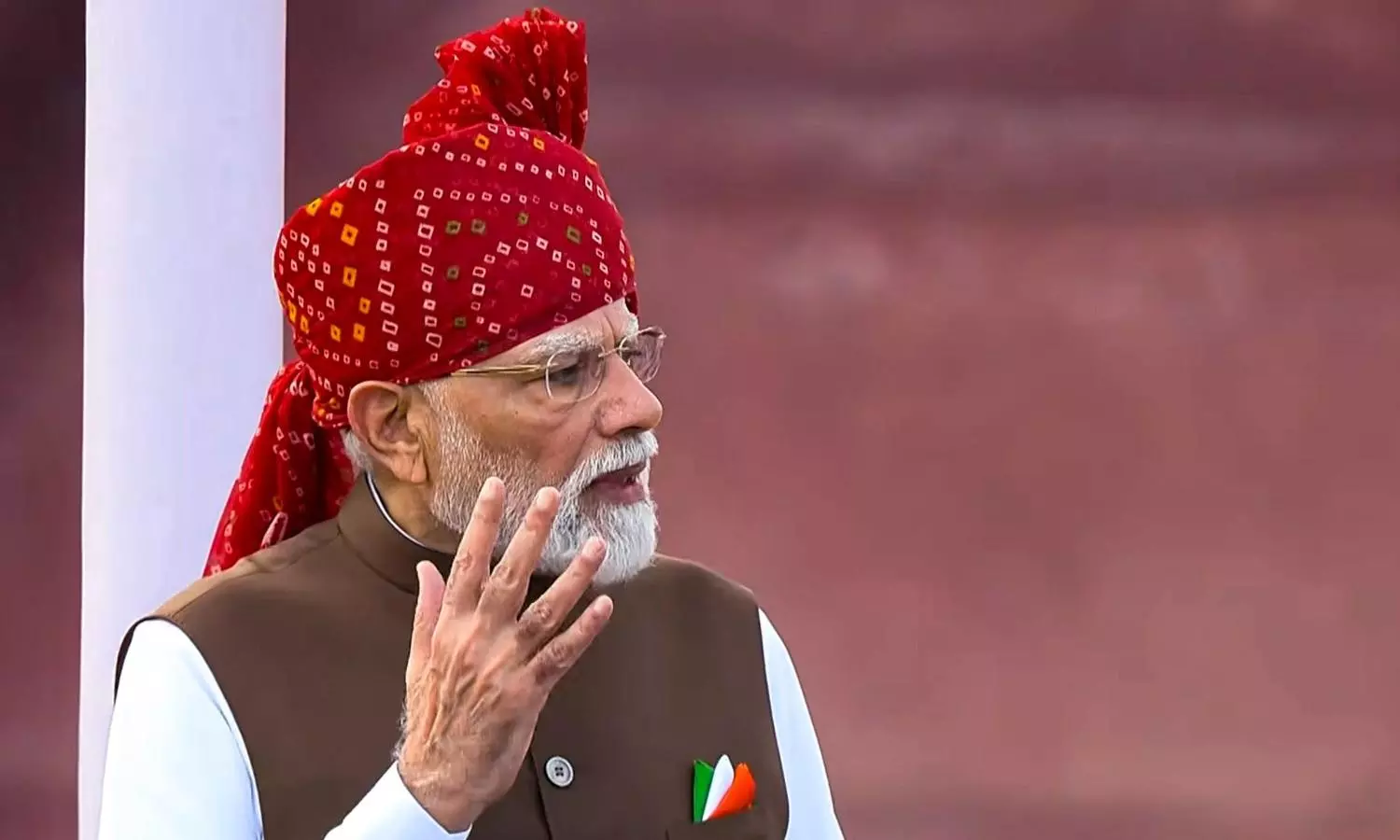
Prime Minister Narendra Modi addresses the nation during the 80th Independence Day celebrations, at Red Fort in New Delhi, on Saturday (August 15). (@narendramodi/YT via PTI Photo)
80th I-Day LIVE | Congress hits back at PM Modi over 'dimaagi Naxals' attack
Addressing the nation from the ramparts of the Red Fort after hoisting the national flag, Modi said Naxalism and Maoism destroyed the future of several youth

The nation is commemorating the 80th Independence Day today (August 15), with Prime Minister Narendra Modi leading the celebrations at the Red Fort complex in Delhi amid patriotic fervour and multi-layer security.
For the first time, the National Song, 'Vande Mataram', was rendered during the Independence Day celebrations at the Red Fort.
Also read: Gen Z vs Gen Z: Ideological war looms as India celebrates 80th I-Day
Addressing the nation, Prime Minister Modi exhorted Indians to dream big to achieve the goal of a developed India by 2047, saying the world will be forced to look at the country differently as "we work towards achieving this dream".
Tributes to freedom fighters
He said 'Vande Mataram' was echoing from the ramparts of Red Fort for the first time since independence. He also paid rich tributes to freedom fighters, including Mahatma Gandhi, and remembered their sacrifices.
Also read: A tale of two Indias: How the country has evolved in the decades following Independence
“Small dreams are not sufficient anymore… we should dream big… India has a big dream to become ‘Viksit Bharat’ by 2047. When the world’s most populous nation resolves to become developed, the world will look at us differently,” he said.
“Our dreams, resolves should be big as this takes capabilities to greater heights,” he said.
Also read: A tale of two Indias: How the country has transformed in the past two-and-a-half decades
Powered by 140 crore Indians, India is scaling new heights of progress across different sectors, Modi said.
Modi sports red tie-and-dye turban
“Every heart is vibrating with Vande Mataram. There is a tricolour in every house, every heart. With a new energy, the nation is moving ahead with new resolve,” he said.
Modi sported a traditional tie-and-dye red turban for his 13th consecutive address to the nation from the historic ramparts of the Red Fort. He paired his white kurta and chocolate brown vest with the traditional turban, common in Rajasthani and Gujarati culture. He also sported three pocket squares of saffron, green and white colours.
Earlier in the morning, he hoisted the tricolour at the Red Fort after receiving a guard of honour.
An Army band played the tune of Vande Mataram as guests present on the occasion sung the national song. Flower petals were showered at the venue by two Mi-17 helicopters of the Indian Air Force - one trooping the national flag and the other carrying a flag depicting 'Vande Mataram'.
Follow live updates here.
Live Updates
- 15 Aug 2026 8:53 AM IST
PM Modi invokes 'Sapta Dhara' (Power of 7)
PM Modi says, "Today I want to remind you of 'Sapta Sindhu'. Now, to build a Viksit Bharat, we need a new current. The first 'shakti' of the Sapta Dhara (Power of 7) is - manufacturing sector. For this, we need to need to focus on three things - Cost, quality and scale. There should be no compromise with quality. This will be our brand value. The second 'shakti' is food processing. With the new FTAs, we have access to greater global markets now. The third 'shakti' is technology and innovation and digital technologies."
1. Manufacturing
2. Agriculture & Food Processing
3. Technology & Innovation
4. Infrastructure & Gati-Shakti
5. Defence
6. Green & Blue Economy
7. Soft Power
- 15 Aug 2026 8:47 AM IST
PM Modi calls for big leap in defence manufacturing
PM Modi pitched for making India a global hub for defence manufacturing, placing special emphasis on self-reliance in advanced capabilities such as hypersonic technology and drone systems.
Modi said expanding domestic production is critical to boosting India's strategic strength.
"We have to become a global supplier by leveraging next-generation defence technology," he said.
The prime minister underlined the importance of India achieving expertise in the production of drones, counter-drone systems, and hypersonic technologies.
Modi also mentioned the country's rising volume of defence production.
In the last few years, the government has rolled out a series of policy initiatives to boost domestic defence manufacturing.
The volume of India's domestic defence production was recorded at Rs 1.78 lakh crore in the financial year 2025-26 as against Rs 46,000 crore in 2014, according to the latest government data.
The defence exports reached Rs 38,424 crore in the financial year 2025-26.
Defence Minister Rajnath Singh on Friday said that military projects worth over Rs 8.75 lakh crore have been approved in the last one year as the Modi government is committed to modernising the armed forces.
- 15 Aug 2026 8:46 AM IST
Modi warns of weaponisation of resources, sea routes; urges energy self-reliance
PM Modi warned that the weaponisation of resources and strategic sea routes by some countries posed risks to India's economic security, calling for greater self-reliance in energy to reduce the country's vulnerability to overseas supplies.
Modi said India needed to strengthen domestic capacity in critical areas, including energy and minerals, as geopolitical tensions increasingly exposed the risks of dependence on external sources.
Without naming any country, Modi said resources ranging from fuel and medicines to technology were increasingly being used as instruments of geopolitical pressure, while strategic geographical routes were also being weaponised.
His remarks come against the backdrop of the US-Israeli war with Iran and Tehran's retaliation, which has severely disrupted shipping through the Strait of Hormuz, a key conduit for global energy supplies.
The narrow waterway between Iran and Oman handled about 20 million barrels per day of oil and petroleum products in 2025, equivalent to roughly a quarter of global seaborne oil trade, according to the International Energy Agency. It also carried almost 20 per cent of global LNG trade, leaving major Asian importers particularly exposed to any prolonged disruption.
The conflict has sharply reduced maritime traffic through the strait and pushed up energy and shipping costs. Renewed tanker attacks have stalled efforts to resolve the conflict.
For India, the disruption has highlighted the risks posed by its dependence on imported energy. The country has had to seek alternative LNG supplies from countries including Oman, the United States, Nigeria and Angola after uncertainty over Gulf shipments, while Indian refiners have also moved to diversify crude purchases.
India has already broadened its energy sourcing, importing crude from 41 countries and LNG from 15, up from 27 and six respectively, as New Delhi seeks to insulate the economy from geopolitical shocks.
The Strait of Hormuz is particularly important to India because much of the energy passing through it is bound for Asia. The IEA estimates that India received nearly half of its crude oil that transited the strait in 2025. It also obtained almost two-thirds of its LNG supplies through the waterway.
Modi said the geopolitical conflicts have underscored the importance of becoming self-reliant in energy.
India, which imports nearly 90 per cent of its crude oil requirements and about half of its natural gas needs, is seeking to tap its largely underexplored offshore reserves as part of a broader push to strengthen energy security, he said, citing the recently approved the Rs 84,084-crore Samudra Manthan National Offshore Exploration Scheme, aimed at accelerating exploration for oil and gas in deepwater and ultra-deepwater areas over the next five years.
The programme will support seismic surveys, exploratory drilling and shared offshore infrastructure, with the government seeking to attract greater investment and technology into India's offshore basins.
He said the government has also opened up 99 per cent of India's sedimentary basins for oil and gas exploration and production, expanding access to areas that were previously largely off-limits to commercial exploration. The move is intended to unlock domestic hydrocarbon resources and reduce India's exposure to global energy-price and supply shocks.
The Prime Minister went on to list achievements of his government in the last 12 years - expansion of piped cooking gas coverage from 70 cities to 700 cities, with the fuel - an alternate to LPG which is largely imported from the Middle East - now being supplied to 1.75 crore households as against 22 lakh in 2014.
Also, generation of electricity from the sun's solar energy has jumped to 160 gigawatt from 2 GW a decade back, he said.
Energy security has emerged as a central element of Modi's broader push for an "Atmanirbhar Bharat", or self-reliant India. The government has also sought to expand domestic exploration of critical minerals and increase the role of nuclear power and other non-fossil energy sources.
In 2024-25, crude oil imports were valued at about USD 137 billion, while petroleum products and LNG imports were worth USD 24 billion and USD 15 billion respectively.
- 15 Aug 2026 8:45 AM IST
PM announces 5-8 more semiconductor plants coming up in 7-8 years
PM Modi said India has already begun production at three semiconductor plants, and five to eight more plants are expected to come up in the coming years.
The prime minister said India's semiconductor journey reflects its growing technological self-reliance.
Semiconductor chips are essential to electronics, healthcare, transport and virtually every modern technology.
Modi noted that for years, the country discussed semiconductors, but lacked large-scale semiconductor manufacturing facilities.
Recognising the strategic importance of chips, the prime minister said India has taken decisive steps towards self-reliance in semiconductors.
Production has already started at three semiconductor plants, with exports also underway, he said.
Over the next seven-eight years, five-eight more plants are expected to come up, strengthening India's path towards Aatmanirbhar Bharat and Viksit Bharat, the prime minister announced.
- 15 Aug 2026 8:44 AM IST
India must become self-reliant, not dependent on others: Modi
Prime Minister Narendra Modi said India must move towards self-reliance and not remain dependent on other countries.
He asserted that the country needs to strengthen its own capabilities and protect its national interests.
"We have to become self-reliant," Modi said.
"There are many things in the world; they are cheaper, they are readily available. But that does not build our capabilities, nor does it test our capabilities," he said.
Modi said India must enhance its capabilities and ensure that the responsibility of protecting its interests rests with the country, as he mentioned the government's initiatives such as Make in India.
- 15 Aug 2026 8:44 AM IST
Centre, state, industry must work together for Viksit Bharat: Modi
The Centre, the state, and the industry must work together for reforms, Prime Minister Narendra Modi said on Saturday.
In his address to the nation from the ramparts of the Red Fort, Modi said that society, government, and industry must change their traditional ways, thinking, and targets to achieve Viksit Bharat by 2047.
"Things that have not been done in the last five or six decades, we have to do them in the next five to seven years. I have faith in my country's youth, farmers, labourers, daughters, and mothers to be able to do this," he said.
- 15 Aug 2026 8:41 AM IST
PM Modi highlights trade agreements
"India has a stable political mandate, a stable government, a vibrant democracy, a strong judicial system and a Constitution that guides us all. The recent trade agreements we have signed provide a great opportunity for us. I want to tell our MSMEs that we must not miss this opportunity," says PM Modi.
- 15 Aug 2026 8:36 AM IST
Our aim should be to have 50 Indian companies in Fortune 500: PM
PM Modi says, "India has stable political mandate, stable govt, vibrant democracy, strong judicial system, Constitution that guides us on."
"India is giving strength to green movement."
"Our aim should be to have 50 Indian companies in Fortune 500."
"Banking sector in India is flourishing; one Indian bank should be among the top five globally."
"Indian companies should strive to be among top 5 pharma companies of world."
- 15 Aug 2026 8:29 AM IST
PM Modi highlights railway electrification, green hydrogen train
Prime Minister Narendra Modi on Saturday highlighted the pace of railway electrification under his government, saying 70 per cent of the network was electrified in 10 years compared with 30 per cent in the previous 90 years.
Addressing the nation from the ramparts of the Red Fort on the occasion of the 80th Independence Day, Modi said railway electrification had begun in 1925 but only 30 per cent of the network was electrified in the next 90 years.
"We completed 100 per cent electrification in just one decade. Thirty per cent in 90 years and 70 per cent in 10 years -- this is the pace of work," he said.
He said electrification has helped save imported diesel and benefited the environment as trains are increasingly powered by electricity.
Modi also highlighted India's entry into the green hydrogen train sector, saying the country had started a train powered by green hydrogen.
"What is special is that it is the longest and most powerful train, and India has also made its mark in the field of hydrogen trains in the world," he said.
India's first indigenous hydrogen powered train was flagged off by Modi on July 17, 2026, marking a step towards adopting hydrogen-based technology in the railways. The service runs on an 89-km Jind-Sonipat section of the Northern Railways in Haryana.
- 15 Aug 2026 8:26 AM IST
PM Modi: 'Some people gain joy in keeping the nation terrified by spreading rumours'
PM Modi says, "In the last 20-12 years, we have faced many dangers. As soon as we emerged from Covid, there was news of wars that started to arise from Ukraine side and West Asia. An atmosphere of tension prevailed. God knows what all the predictions the predictors made! Some people gain joy in keeping the nation terrified by spreading rumours that vaccines will not be available, petrol, diesel, and fertiliser will not be available in the country. Some people were gaining joy from creating an atmosphere of anxiousness in the country."


