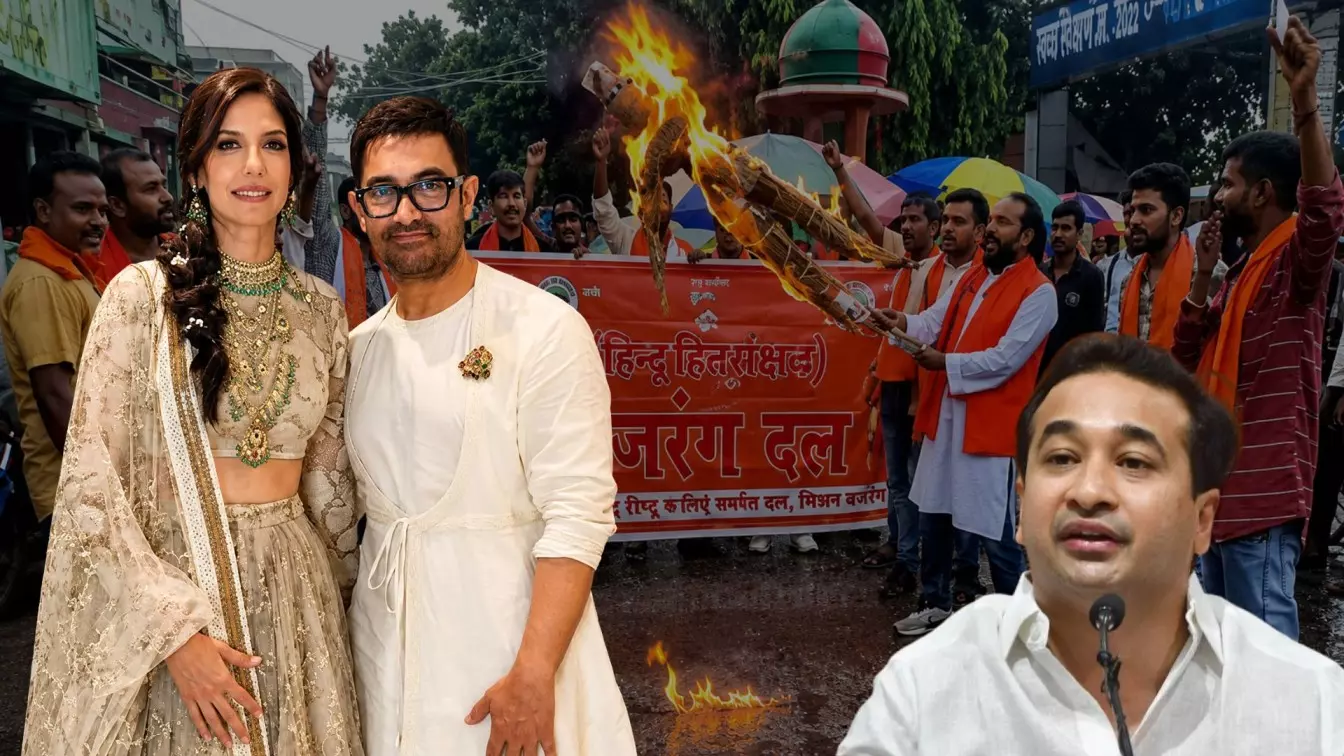
Aamir Khan's marriage sparks 'love jihad' row, revives old controversies
Khan's third marriage to Gauri Spratt reignites political attacks, with critics raking up past controversies around PK and Khan’s ‘intolerance’ remarks

Aamir Khan's reported marriage to longtime partner Gauri Spratt has triggered a fresh political controversy, with Maharashtra minister Nitesh Rane accusing the actor of becoming a "brand ambassador" for what he called "love jihad". The controversy has also revived memories of earlier protests against the actor over his films and public remarks.
The 61-year-old actor married Spratt in a private ceremony in Mumbai. This is Khan's third marriage. He was previously married to Reena Dutta and later to filmmaker Kiran Rao, from whom he divorced in 2021.
Also read: Bhuvan weds Gauri: Aamir Khan marries partner Gauri Spratt at homely ceremony
Reacting to the marriage, Nitesh Rane said celebrities should be mindful of the message they send to society.
“It is not for me to decide who should attend whose wedding. However, the time has truly come for Hindu youth, who regard him as a celebrity, to reflect on what kind of inspiration they should draw from this. I believe that when celebrities make such decisions regarding their personal lives, Hindu society ought to give it some thought. Aamir Khan is effectively becoming a brand ambassador for 'love jihad'," Rane said.
Fresh protests
The controversy soon spilled onto the streets, with Bajrang Dal workers staging protests in Bihar's Forbesganj. Demonstrators burned an effigy of Khan, raised slogans against the actor and repeated allegations of "love jihad".
However, this is far from the first confrontation between Khan and right-wing organisations. Nor is it the first time Bajrang Dal has targeted a Bollywood production over claims that it hurt Hindu sentiments.
Also read: How Bollywood hides its representation crisis, bigotry behind superstardom of Khans
Back in 2017, Bajrang Dal joined the Karni Sena in demanding a ban on Deepika Padukone-starrer Padmavati, which was later released as Padmaavat. The protests, centred on the film's portrayal of Rajput queen Rani Padmavati, escalated into violence in several states.
Earlier clashes
Khan himself faced a similar backlash in 2014 after the release of PK, a film that questioned blind faith and the commercialisation of religion.
Bajrang Dal and the Vishwa Hindu Parishad accused the film of hurting Hindu sentiments, leading to protests in several cities. Despite the controversy, PK went on to become one of Bollywood's biggest box-office successes.
Also read: ‘Love jihad’ is not about luring women, it’s about controlling them: Sameena Dalwai
The actor also drew criticism from Hindu right-wing groups in 2015 after speaking about what he described as a "growing disquiet" over the "rise in intolerance" in the country. During the discussion, Khan had said that his then wife, Kiran Rao, had suggested they consider leaving India – a comment which continues to draw flak even today.
'Love jihad'
More than a decade later, Khan has once again found himself at the centre of an ideological debate—this time over his personal life rather than his work on screen.
The term "love jihad" remains politically contentious. It is used by some political leaders and right-wing groups to allege that Muslim men marry Hindu women as part of an organised effort to convert them.
Also read: Aamir Khan at 60: The ‘perfectionist’ who remains Bollywood’s grandmaster of surprises
However, courts, including the Supreme Court, have not recognised "love jihad" as a legal category, and investigations into several such cases have found no evidence of any organised conspiracy.
Neither Khan nor Spratt has publicly responded to the allegations.
For now, what began as a personal milestone for the actor has evolved into a national political talking point.
The content above has been transcribed from video using a fine-tuned AI model. To ensure accuracy, quality, and editorial integrity, we employ a Human-In-The-Loop (HITL) process. While AI assists in creating the initial draft, our experienced editorial team carefully reviews, edits, and refines the content before publication. At The Federal, we combine the efficiency of AI with the expertise of human editors to deliver reliable and insightful journalism.