








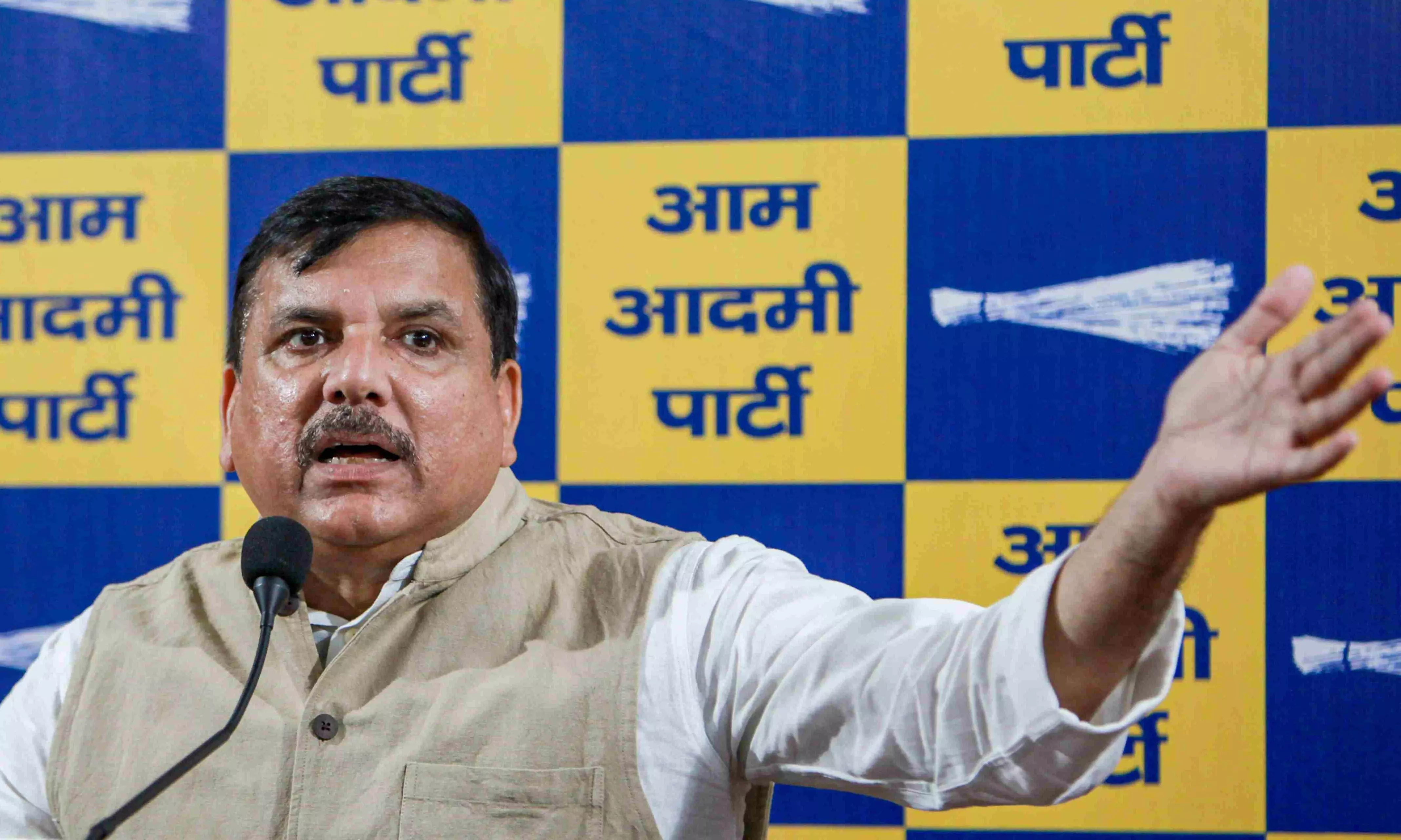
Singh argued that the Anti-Defection Law does not provide any exemption to any split or faction in either the Lower or the Upper House. Photo: PTI
AAP calls Raghav Chadha-led MPs’ exit ‘unconstitutional’, seeks their disqualification
Sanjay Singh cites anti-defection law as seven AAP MPs announce merger with BJP, prompting questions over the Tenth Schedule’s two-thirds rule.

A day after Rajya Sabha MP Raghav Chadha, along with six other Aam Aadmi Party (AAP) MPs, left the party to “merge” with the BJP, the AAP on Saturday (April 25) dubbed the move as “unconstitutional”, adding that it would approach the Upper House Chairperson seeking disqualification of the MPs.
AAP terms move unconstitutional
Speaking to reporters, senior AAP leader Sanjay Singh argued that the Anti-Defection Law does not provide any exemption to any split or faction in either the Lower or the Upper House.
Also Read: Why Chadha-led exodus presents an existential crisis for AAP and Kejriwal
"Anti-defection law clearly states that any type of split or faction cannot happen in the Rajya Sabha and Lok Sabha. It does not carry any legal recognition, even if it's a two-thirds majority," Singh said.
‘No legal basis for splits’
Elaborating further, Singh claimed that the AAP leader said that neither the anti-defection law nor the Tenth Schedule of the Constitution recognises any kind of split, breakaway faction, or group in the Rajya Sabha or Lok Sabha, two-thirds majority notwithstanding.
Also Read: Chadha, others’ exit was a disaster waiting to happen for AAP
The move by seven MPs to join the BJP is completely "unconstitutional" and "illegal," he said. "I am writing to the vice president of India, and chairman of Rajya Sabha, to disqualify them," Singh added.
Tenth Schedule and merger provisions
However, under the Tenth Schedule, which lays down the provisions governing disqualification on grounds of defection, a merger is recognised only under a specific numerical threshold.
Also Read: Raghav Chadha leads AAP MPs' exit to BJP: What Anti-Defection Law’s two-thirds rule says
The law makes it clear that such a move is treated as valid when at least two-thirds of the members of the concerned legislature party consent to it. In that situation, those lawmakers are protected from disqualification under the Anti-Defection framework.
The provision draws a firm line between individual defections and group decisions that meet this requirement.
“For the purposes of sub-paragraph (1) of this paragraph, the merger of the original political party of a member of a House shall be deemed to have taken place if, and only if, not less than two-thirds of the members of the legislature party concerned have agreed to such merger,” the Tenth Schedule states.
The backdrop
AAP Rajya Sabha MPs Raghav Chadha and Sandeep Pathak on Friday announced that they are joining the BJP along with five other MPs of the party.
Addressing a press conference, Chadha had said that seven out of 10 Rajya Sabha MPs of AAP are set to merge with the BJP.
(With agency inputs)