'Build ethics into AI from day one, or risk paying for it later'
At India AI Impact Summit, global experts warn that commercial pressures and geopolitical rivalry are pulling AI away from its key purpose of serving people

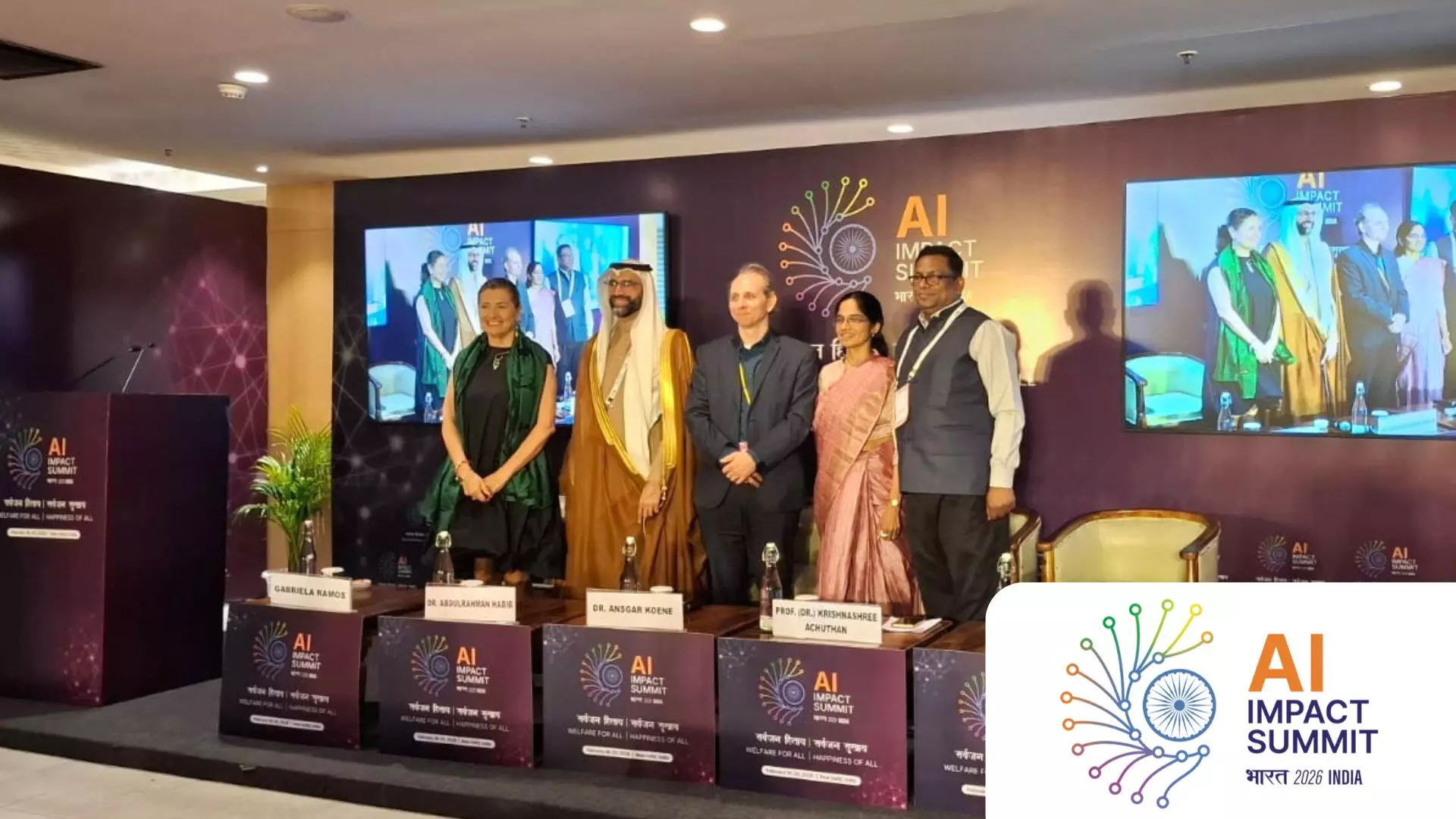
Artificial intelligence built without ethical guardrails is not a technology problem — it is a design choice. That was the central message at the India AI Impact Summit, where global policy experts warned that embedding ethics into AI systems cannot be an afterthought; it must begin at the drawing board.
As governments race to regulate AI and corporations pour billions into it, experts at the summit cautioned that commercial pressures and geopolitical rivalry are increasingly shaping the technology's direction — often at the expense of the people it is meant to serve. The antidote, they argued, lies not in slowing down AI development, but in building fairness, accountability, and societal impact into its very architecture from day one.
Abdulrahman Habib, Center Director at ICAIRE, said the summit offered a major opportunity for collaboration among countries in the Global South. “We believe this is a good opportunity for Global South collaboration so we can work together and improve different areas and show what we can do together,” he noted.
“I believe that ethical AI should be from the design. If we design our AI applications to be ethical by design, then we are moving forward in the right direction,” Habib added.
He warned that many AI projects begin as proof-of-concept experiments without sufficient consideration for long-term deployment or societal impact. According to him, this lack of foresight often leads to challenges once the technology is implemented at scale.
Profit vs ethics
Another key issue discussed at the summit was the influence of commercial interests on AI development. Experts acknowledged that large investments in AI are often driven by expectations of profit, but they believe the hype around the technology will eventually settle.
“AI is in a hype right now and there is a lot of investment in it. But when the hype slows down, the applications that truly benefit us will stay and everything else will fade away,” said Habib. He added that, like any other industry, AI development must be guided by ethical business practices.
The discussion also highlighted the need to anticipate how AI systems might be misused even before they are built.
Early safeguards
Ansgar Koene, Global AI Ethics & Regulatory Leader at EY, emphasised that ethical considerations must be included when defining the technical requirements of AI systems.
“We need to think about the outcomes and impacts the technology is going to have not just after we develop the product, but at the beginning of the process,” he said. He argued that developers cannot treat bias and accuracy as trade-offs. “If you say there’s a trade-off between removing bias and having accuracy, it means your definition of accuracy was wrong,” he said.
According to him, ethical design means ensuring AI systems perform fairly for all groups rather than delivering strong performance only for certain sections of society.
Government role
The panel also debated whether governments or industry should take the lead in regulating AI.
Experts concluded that both sides must work together. While governments look at the broader societal impact of technology, companies understand the technical details and specific use cases.
“There needs to be a constructive tension between both sides pushing each other towards better outcomes,” said Koene.
Governments, they argued, must ensure that efficiency and profitability do not come at the cost of excluding certain parts of society.
India’s approach
Gabriela Ramos, former Assistant Director General at UNESCO, praised India’s approach to AI, especially its focus on real-world impact rather than purely technological development. She said India’s emphasis on digital public infrastructure and applications that improve access to services could serve as a model for other countries.
“It’s not about the technology, but what kind of impact it has on society,” she said. She pointed to digital public infrastructure initiatives that have enabled banking access, financial inclusion, and improved service delivery for millions.
The content above has been transcribed from video using a fine-tuned AI model. To ensure accuracy, quality, and editorial integrity, we employ a Human-In-The-Loop (HITL) process. While AI assists in creating the initial draft, our experienced editorial team carefully reviews, edits, and refines the content before publication. At The Federal, we combine the efficiency of AI with the expertise of human editors to deliver reliable and insightful journalism.