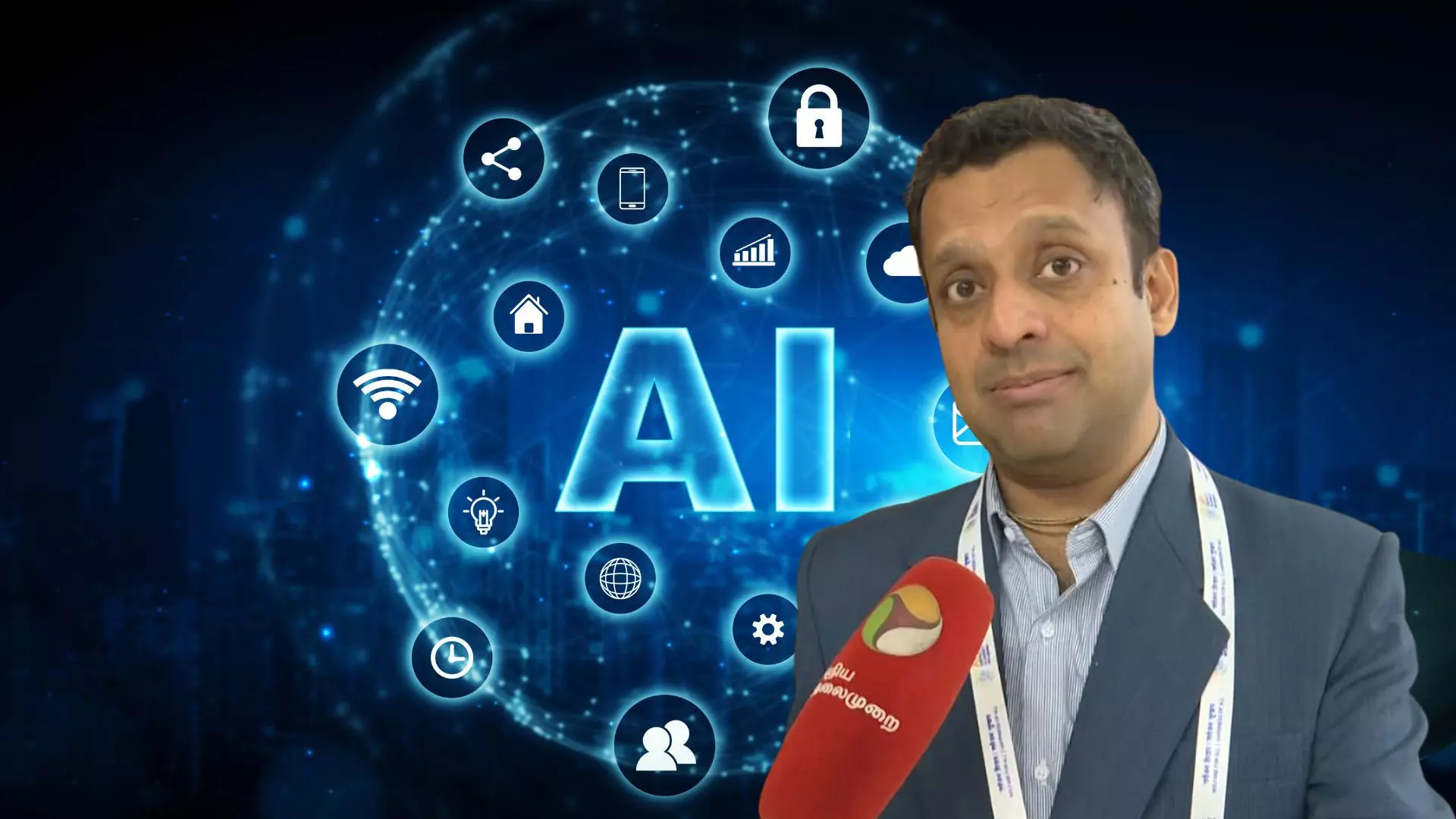
Prof Ganesh Ramakrishnan outlines a bold push to build sovereign AI rooted in Indian languages, data transparency, and domestic capability.
India’s focus shifting from AI adoption to production: IIT Prof Ramakrishnan
Prof Ganesh Ramakrishnan explains how BharatGen is building sovereign AI for India with multilingual foundational models, data provenance, and trillion-parameter ambitions

As India positions itself at the India AI Impact Summit 2026 at New Delhi, the focus is shifting from adoption to production. The Federal spoke to Prof Ganesh Ramakrishnan of IIT Bombay, who leads BharatGen, about building India’s foundational AI models, benchmarking globally, and preparing for trillion-parameter systems.
"We must treat large language models as glass boxes, not black boxes," says Prof Ganesh Ramakrishnan, outlining a bold push to build sovereign AI rooted in Indian languages, data transparency, and domestic capability.
What are the primary objectives and goals of BharatGen?
The primary goal of BharatGen is to create a strong ecosystem in the country where we start looking at generative AI and large language models as glass boxes. The bricks required to create this ecosystem — from education, engineering, and research points of view — must be well-oiled.
For example, we released a 17-million parameter mixture-of-experts foundational model, Param 2, in 22 Indian languages, including Tamil. Tamil is my mother tongue, though my Tamil has a Malayalam background because I was born in Palakkad.
In our foundational models — both text and speech — we have leveraged Indian language commonality. The text-to-speech model is based on phonetic similarity across Indian languages. Whether I speak Palakkad Tamil or Chennai Tamil, you will find phonetic similarity — even with Malayalam.
Also Read: Top things that global leaders said at India AI Impact Summit 2026
We are making the system completely cross-lingual and faithful to India — Indian context, Indian data, and the Indian ecosystem. We initially partnered with five vendors for speech data and have now created a strong pipeline for speech data at the pin code level.
This requires ensuring data provenance — knowing where the data came from and whether there were duplicates. This is part of sovereignty. The more transparency there is, the more sovereignty there is.
With a consortium of nine academic institutions, we are building this ecosystem for the country. We have released models and are embedding sovereignty into the DNA of the system.
Will BharatGen become the foundation for India’s AI progress and innovation?
Yes. BharatGen works on foundational models, recipes, and the broader ecosystem.
We have close to 60 full-time engineers. It is structured as a Section 8 company based out of IIT Bombay with IndiaAI Mission representation. We are funded by the Department of Science and Technology and the IndiaAI Mission to the tune of more than Rs 1,235 crore.
Also Read: India must take a sectoral approach to AI regulation: AI scientist
This is a whole-of-government, whole-of-nation approach. We have nine academic institutions involved, including IIT Madras. Professor V Kamakoti has been a strong champion of this work.
The substratum here is visibility — observability into the entire stack — so that there can be attribution. When we met the Prime Minister on January 8, he asked how we could bring more Indian thought process into the AI stack and how to build observability and attribution into it. That is central to a sovereign ecosystem.
How will this help Indian companies and applications become more effective?
A classic example is our collaboration with Amrita Hospitals. They have built a state-of-the-art stack for electronic medical health records.
We work with them on MedSum — going from speech to text to summary — while keeping patient privacy and consent at the centre. We are integrating MedSum, powered by BharatGen, into their EMR system for the generative AI component.
Also Read: Sundar Pichai quips about driverless cars in India: 'Still working on that, Dad'
We are doing similar work with several state governments, financial institutions, ministries, and for-profit institutions. The idea is to build deep tech for India in collaboration. Co-design is critical. With Amrita, it has been an amazing co-design process.
How will this accelerate AI adoption in public services?
It can improve governance — making navigation through government records and regulations conversational. We can use longitudinal data to ease citizen grievances.
From the governance perspective, we can bring provenance into drafting. The Chief Secretary of Maharashtra gave an example — if I draft something new, I should know how it relates to all previous drafts.
So we are working with state governments from both the citizen’s and the administration’s perspective.
How does India compare globally in AI adoption for public services?
The Prime Minister made a profound point during our January 8 interaction — Indians have not been scared of AI. That is a big strength. The credit goes to Indians. That is how UPI happened — because we were not scared. It became a game changer.
The question is how to turn this into an advantage. Instead of just being consumers, Indians must become producers of technology. That is why building an ecosystem is important.
Our models are profiled against global benchmarks. In the same league of parameters, we are doing very well. Our Param 2 17-billion model is performing strongly. Our speech and text-to-speech models are state of the art.
Also Read: All you need to know about Sarvam AI, the AI Summit ‘rockstar’
However, existing benchmarks do not represent Indian languages well. So we are evolving our own benchmarks while moving the frontiers of our models. Architecturally, we are cutting edge. Sometimes we are late in certain areas, but being a late mover has advantages — we learn from others and avoid traps.
Our runway is towards one-trillion-parameter models. That is the mandate under the IndiaAI Mission. A lot more will happen.
Quality also matters. Quality reflects in partnerships. India is a place where 1 plus 1 can become 11. That is why co-design is important. Many innovations in China have come from co-design, and we can adapt that principle differently.
Are we up to speed in data centres and semiconductor capability?
There is a lot of work happening. There was an announcement today involving L&T and NVIDIA.
The National Semiconductor Mission has been moving very fast. The National Supercomputing Mission is also facilitating the ecosystem. It is encouraging to see major players rising to the occasion.
Also Read: PM Modi calls for human-centric AI, cautions against 'directionless' use
From BharatGen's side, what we can offer is workload. When we build large models, the footprint and logs we generate can help improve hardware design. We are ready to partner with any sovereign player to make this happen for India.
(The content above has been transcribed from video using a fine-tuned AI model. To ensure accuracy, quality, and editorial integrity, we employ a Human-In-The-Loop (HITL) process. While AI assists in creating the initial draft, our experienced editorial team carefully reviews, edits, and refines the content before publication. At The Federal, we combine the efficiency of AI with the expertise of human editors to deliver reliable and insightful journalism.)