








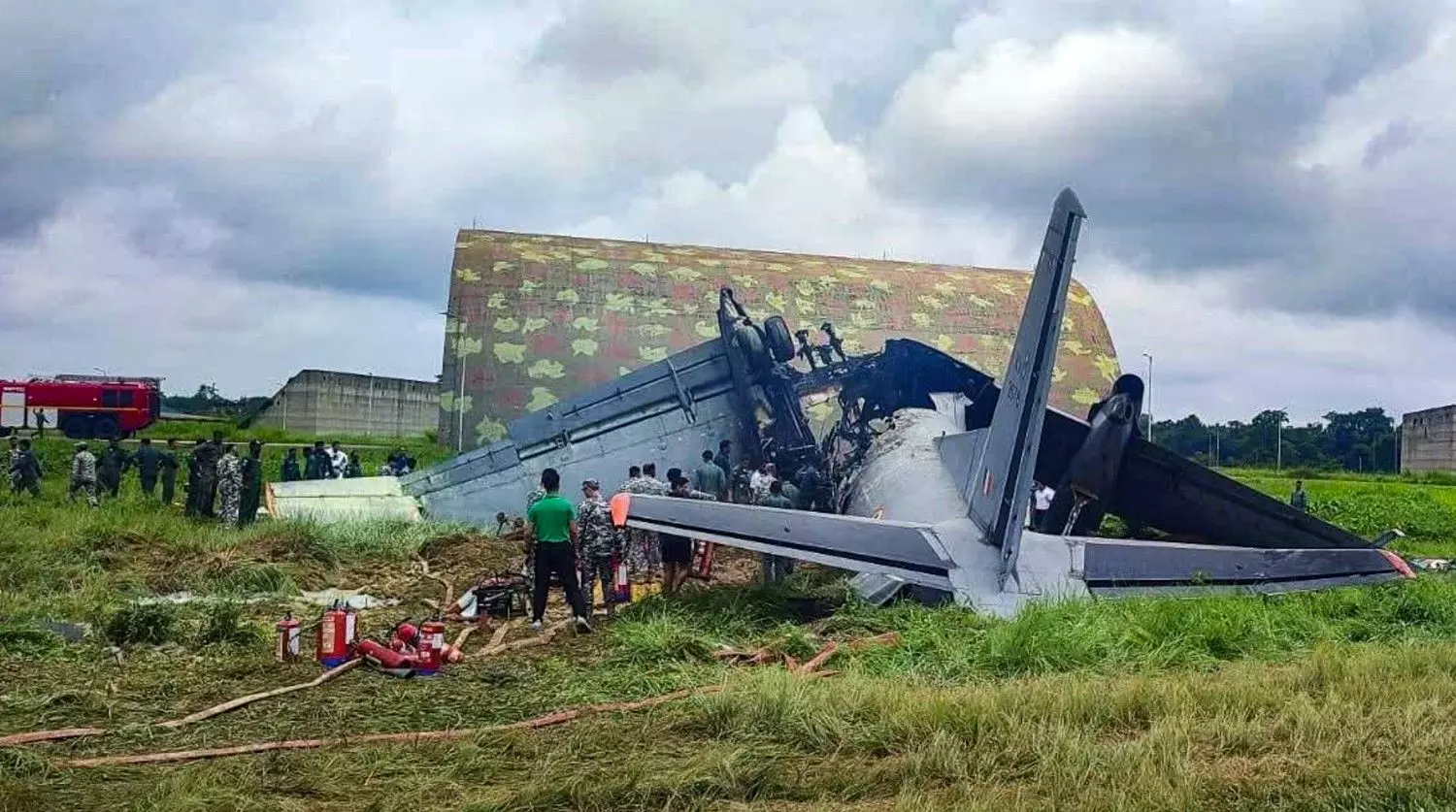
Security personnel and others stand near damaged remains of an AN-32 transport aircraft of the Indian Air Force that crashed while landing, in Jorhat district, Assam, on June 13, 2026. (Photo: @AjayTamtaBJP /X via PTI
AN-32 crash in Assam: What ails the Soviet-era military jet?
The fatal accident re-ignites a fierce debate over the operational viability of India’s 4-decade-old logistical fleet

The Indian Air Force (IAF) touched one of its darkest chapters on Sunday (June 13) when an (Antonov) AN-32 transport aircraft crashed at the Jorhat Air Force Station in Assam, resulting in the deaths of five personnel. The incident brought the aircraft, one of the military’s most-relied upon but also troubled, back into spotlight.
Also read: Lt Gen Dhiraj Seth to be next Chief of Army Staff
It is not the first time that the ‘flying veteran’ has faced such consequences and a grim pattern of incidents fuel urgent questions about whether the ageing Soviet-era fleet should be put out to pasture. It may be mentioned here that India retired its iconic MiG-21, the country’s first supersonic fighter jet, last September after six decades in service. Like the AN-32, the MiG-21 is also a Soviet-era product.
About AN-32
♦ Antonov AN-32 is a Soviet-era twin-engine transport jet developed by Antonov Design Bureau in Ukraine, then part of the USSR
♦ It was designed as an enhanced, high-altitude variant of AN-26, to operate in hot and high conditions
♦ AN-32 completed its maiden flight in July 1976 and entered production in the early 1980s.
♦ India acquired its first AN-32 aircraft in 1984
♦ AN-32 became the workhorse of IAF's military logistics in difficult terrain
♦ Production of the plane officially concluded in 2012. A total of 373 jets were manufactured
Five personnel lose lives, one injured
Saturday’s incident happened when the ill-fated jet reportedly caught fire shortly after landing at Rowriah Air Force Station during what was called a routine sortie. The deceased were identified as Squadron Leader Prashant Singh, Flight Lieutenant Shubham Kumar, Sergeant Jitendra Sharma, Agniveer Vayu Khemaram Kumawat, and Agniveer Vayu Danish Alam. The co-pilot, however, survived and was receiving treatment. A court of inquiry was ordered to ascertain the cause.
AN-32s were especially made for IAF
India procured 125 AN-32 planes from the erstwhile Soviet Union between 1984 and 1991. The planes were specially customised to suit the IAF's requirements. The twin-engine transport jet can carry up to 6.7 tonnes of cargo or 50 paratroopers and is capable of operating from short runways and high-altitude bases. It is frequently used to ferry troops, ammunition, engineering equipment, and rations to landing areas that are inaccessible by road for most of the year. Despite the IAF inducting the C-130J Super Hercules and C-17 Globemaster III fleets, the old warhorse continued to bear a substantial share of the force’s daily logistical operations.
Several accidents in 4 decades
But several instances of the AN-32 fatally going down over the last four decades have now raised serious questions over its viability. More than 18 incidents have been recorded during this time, including crashes in Jammu Kashmir (1986), Uttar Pradesh (1988), Kerala (1990), Punjab (1992), Delhi (1999), Arunachal Pradesh (1999), Bay of Bengal (2016) and Arunachal Pradesh (2019). In 2025, an AN-32 crash-landed and overshot the runway at Bagdogra Airport in Siliguri, West Bengal, but no casualties occurred.
Age, operational challenges
Among the reasons that lead to these crashes are age, operational stress and systemic neglect. Since the aircraft is used for highly demanding missions, their maintenance becomes a major challenge.
With airframes exceeding 40 years of service, maintaining the AN-32 fleet has become a mounting challenge. A 2017 Comptroller and Auditor General report flagged serviceability rates as low as 40 per cent, citing critical spare shortages, The New Indian Express reported.
Also read: AAIB says ‘significant progress’ made in Air India crash probe, a year after tragedy
The Russia-Ukraine conflict compounded the crisis, disrupting the supply of spares and navigation aids and forcing India to pursue indigenous alternatives.
In an attempt to extend the fleet's life after the 2009 disaster, India signed a $400 million upgrade deal with Ukraine’s Antonov (the plane’s manufacturer in Kyiv, which was in unified Russia) in 2009, covering avionics modernisation for 40 aircraft in Ukraine and technology transfer for the remaining 64 to be overhauled domestically at the IAF's base repair depot in Kanpur.
When Ukraine lost 5 planes that India sent
Something unusual happened around this time. As a batch of 40 AN-32s was sent to Ukraine's state-owned Ukrspetsexport for refurbishment, only for Ukraine to lose five of the planes, which were eventually traced to a civil aviation plant and flown back to India, Business Today reported.
In early 2024, Defence Minister Rajnath Singh told Parliament that upgrades were well underway, with the oldest airframes expected to retire around 2032 and upgraded aircraft remaining in service until 2037-2040.
Meanwhile, procurement of replacement engines was also bungled. According to a Deccan Herald report in 2014, the Comptroller and Auditor General criticised the IAF for wasting Rs 227 crore of taxpayers' money by failing to properly plan an engine replacement order — buying 30 engines at one rate and another 100 at a significantly higher rate two years later, resulting in avoidable additional expenditure, the report added.
Also read: Russia renews Sukhoi Su-57 stealth fighter offer, invites India to co-manufacture
Delayed replacement of the ageing fleet has also increased the dangers. ThePrint reported on Saturday that the IAF is inching closer to issuing a Request for Proposal for its long-delayed Medium Transport Aircraft programme — a process that has dragged on for nearly two decades. The programme, if finalised, would set in motion the gradual replacement of the ageing AN-32 fleet.
But with crashes continuing to claim lives, the question hanging over India's military establishment is no longer simply one of procurement timelines — it is whether the replacement will arrive before the AN-32 exacts yet another fatal toll.