Anjel Chakma murder: 'Hand over case to CBI' | Capital Beat
The discussion examined the murder of Tripura student Anjel in Dehradun, the delayed police response, and wider concerns over racial discrimination faced by people from the Northeast

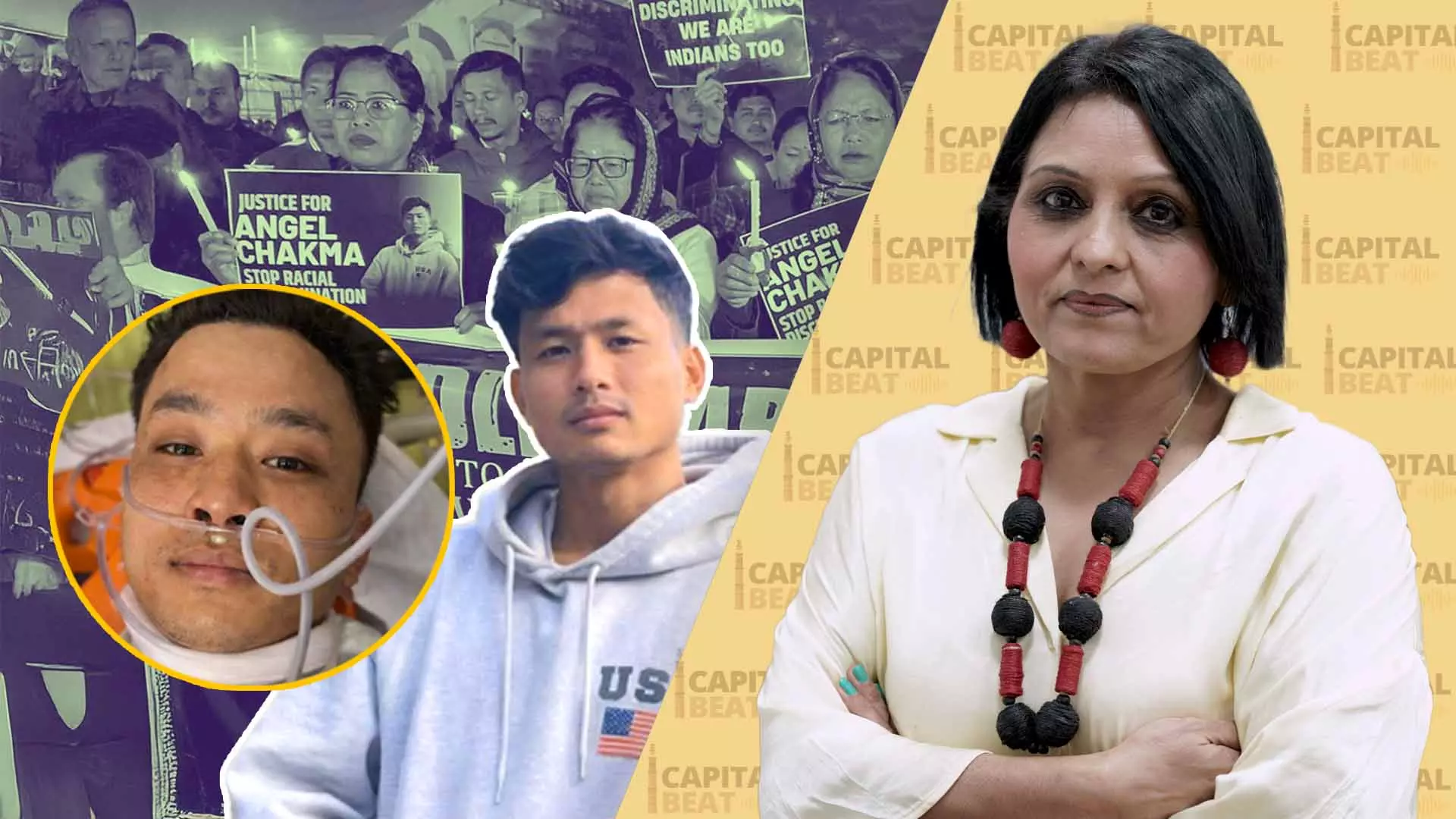
A Capital Beat episode featuring Congress spokesperson Sujata Paul, Samir K Purkayastha of The Federal, and Suhas Chakma, Director of the Rights and Risks Analysis Group (RRAG), focused on the brutal killing of 24-year-old Tripura student Anjel Chakma in Dehradun and the official denial of racial motivation by Uttarakhand Police. The discussion examined the murder, the delayed police response, and wider concerns over racial discrimination faced by people from the Northeast.
The killing triggered national outrage after the victim’s family alleged that Anjel was subjected to racial slurs such as “Chinki”, “Momo”, and “Chinese” before being assaulted. Dehradun Senior Superintendent of Police Ajay Singh publicly denied racial motivation, stating the incident stemmed from a dispute among friends, including one accused from Manipur.
Also read: Anjel Chakma's murder: Uttarakhand has promised strict action, says Tripura CM
The National Human Rights Commission (NHRC) sought a report on the incident and directed the Uttarakhand government to ensure the safety of students from the Northeast studying in the state.
Police response
Paul described the police response as a failure to acknowledge the gravity of the incident. She questioned the official denial of racism and the delay in registering a First Information Report (FIR). “It is abominable that the SSP has said that this is not a racial crime. Why was Anjel saying, ‘I am Indian’, if there was no provocation?”
Paul said she attended a condolence meeting at the Doon Library Research Centre, where former civil servants and students expressed concern over the incident’s impact on Dehradun’s reputation as an education hub.
She stated that the murder was unprecedented in its severity, despite earlier instances of racial slurs in the city. “This is the first time ever that this has reached this stage. It does not happen in a day. When you start spreading hatred, this is the result.”
Also read: Tripura rages over Anjel Chakma's killing; protesters demand students' safety
Paul also highlighted the presence of approximately 25,000 students from the Northeast studying in Dehradun and questioned their safety following the police stance.
Concerns over investigation
Paul raised questions over the handling of the case. “If this isn’t a racial crime, why was the FIR not registered on time? Why was no arrest made immediately?”
She alleged that the state government was attempting to manage public outrage rather than address the incident transparently.
Paul criticised Uttarakhand Chief Minister Pushkar Singh Dhami for releasing a recorded video of a phone call with Anjel’s father.
“This is extremely shameful. He should have gone to Tripura and paid his condolences instead of indulging in this kind of histrionics,” she said.
She also questioned statements suggesting one of the accused had fled to Nepal. “If the Chief Minister knows someone escaped to Nepal, what was the police doing?”
Systemic racism and institutional failure
Suhas said racial discrimination against people from the Northeast was not new and cited experiences dating back decades. “From the beggar to the Brahmins of this country, systemic racial discrimination is there.”
He referred to historical examples from Delhi University and media reporting in the 1990s to show that such prejudice has long existed.
He emphasised India’s international role in fighting racism, including its opposition to apartheid and contribution to global anti-discrimination frameworks. “The problem arises when institutions and society refuse to recognise that racial discrimination exists in this country.”
He said provisions addressing racism exist under the Bharatiya Nyaya Sanhita (BNS), but awareness among law enforcement remains low. “The SSP does not know what racism is all about. He is trying to cover up something indefensible.”
Medical handling and family treatment
Suhas detailed alleged lapses in handling the case after the assault. “The FIR was not registered for three days. The father was not allowed to see his son even when he was declared clinically dead.”
He stated that the FIR was registered only after intervention by Pradyot Manikya DebBarma, the Maharaja of Tripura, and protests by Tripuri students.
He questioned why charges such as attempt to murder were not invoked earlier despite severe injuries. “Spinal injuries, head injuries, and the victim was hospitalised for 17 days. No one was arrested until public outrage grew.”
Demand for independent probe
He argued that the investigation should be taken away from Uttarakhand Police. “This is no longer something that can be investigated by the Uttarakhand Police. The state is hostile.”
He expressed concern for the safety of witnesses, particularly Anjel’s younger brother, Michael Chakma. “How will a younger brother testify when the system and police are against the family?”
He called for the case to be handed over to the Central Bureau of Investigation (CBI) and suggested invoking provisions of the Scheduled Castes and Scheduled Tribes (Prevention of Atrocities) Act against officials for dereliction of duty.
Impact across Northeast
Purkayastha said the killing resonated deeply across the Northeast but was not viewed as an isolated incident. “This is not the first time people from the Northeast have faced such attacks.”
He recalled past instances of stereotyping and harassment, including remarks made in legislative spaces and by security forces.
Purkayastha pointed to recent incidents where Bengali-speaking migrant workers were harassed after being labelled as Bangladeshis. “Is this not stereotyping? Is this not racial?”
He said normalisation of such language by people in power worsened the problem. “When ministers call communities termites, what message does it send?”
Purkayastha linked the police claim that racial slurs were used “in jest” to broader social attitudes. “We take it casually to call someone Bangladeshi or Chinki. That is the problem.”
He said such normalisation makes violent outcomes more likely.
Responsibility of governments and political parties
Paul placed responsibility on the Uttarakhand government and the ruling political establishment. “The Chief Minister is responsible for this hate crime having happened.”
She cited earlier controversial remarks made by political figures in Dehradun and linked them to a culture of impunity. “This supremacist attitude is why this hate is spreading.”
Paul argued that civil society must respond collectively. “Unless citizens speak out and hold them responsible, this will not stop.”
Debate on a separate anti-racism law
Suhas addressed calls for a separate law to combat racism. “Separate laws can create awareness. We already have laws to address specific problems.”
He said education and curriculum reform were equally important. “School syllabi barely go beyond individual states. They do not capture the diversity of the country.”
He stressed that responsibility extended beyond one political party. He urged states to enact their own anti-discrimination laws.
(The content above has been transcribed from video using a fine-tuned AI model. To ensure accuracy, quality, and editorial integrity, we employ a Human-In-The-Loop (HITL) process. While AI assists in creating the initial draft, our experienced editorial team carefully reviews, edits, and refines the content before publication. At The Federal, we combine the efficiency of AI with the expertise of human editors to deliver reliable and insightful journalism.)