








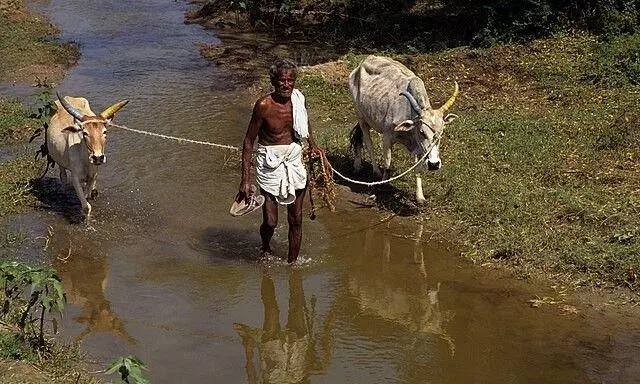
About 54 per cent of respondents said it is 'extremely important' to consider animal welfare while making purchases. Representative image: Wikimedia Commons
Young Indians show shift in animal welfare attitudes, but gap remains: Survey
The report noted that despite growing awareness, more than 1.5 billion farmed animals remain part of India’s food system, with their conditions largely invisible to consumers

A recent survey on public attitudes towards animals has highlighted a significant shift in how young Indians perceive farmed animals and approach animal welfare, pointing to growing awareness but persistent gaps in understanding.
The study, conducted by YouGov and commissioned by India Karuna Collaborative (IKC), found that seven out of 10 young respondents recognise that farmed animals are capable of feeling pain and fear. Around 70 per cent said animals such as cows, goats, and chickens can experience pain, fear, or discomfort.
Also read: Animal welfare should be guided by reason, not emotion: Activist Muralidharan
The nationwide survey, titled ‘Public Attitudes to Farmed Animals, Their Welfare and Plant-Forward Consumption in India (2026)’, covered 3,010 individuals aged between 18 and 30. It revealed that concern for animal welfare is increasingly influencing behaviour, with four in five respondents saying they had already changed something about how they shop or eat because of concern for animals.
India’s food system
However, the report noted that despite this growing awareness, more than 1.5 billion farmed animals remain part of India’s food system, with their conditions largely invisible to consumers. It also pointed out that while young Indians are willing to act, current food systems have not kept pace with evolving attitudes.
Animal welfare, the report said, lies at the intersection of climate change, public health, and sustainable development, yet continues to receive limited attention in policy and public discourse. About 54 per cent of respondents said it is “extremely important” to consider animal welfare while making purchases, while 81 per cent considered it at least moderately important.
Also read: SC notes surge in stray dog pleas, says human cases see fewer filings
At the same time, the survey highlighted the persistence of myths about animals in agriculture. While nearly half of respondents acknowledged practices such as confinement, routine antibiotic use, and separation of calves from cows, many still held idealised views, with 44 per cent believing dairy cows graze freely and 41 per cent thinking chickens are typically raised outdoors. This, the report said, reflects a disconnect between concern and awareness.
Behavioural shift
The findings also pointed to a strong willingness among consumers to support higher welfare standards, particularly in dairy. As many as 91 per cent of dairy consumers said they would be willing to pay a premium for higher-welfare products, with 69 per cent ready to pay 10 per cent or more.
Despite this, trust remains a concern. Three in five respondents said claims of “humane treatment” without certification are exaggerated or unreliable. Awareness of labels such as “free-range” and “cage-free” remains limited, though terms like “cruelty-free” are better understood.
Also read: Should animals also be ‘persons’ in law?
Behavioural changes are already visible. Over the past year, 37 per cent of respondents said they had started checking labels more carefully, 33 per cent opted for plant-based alternatives, and 25 per cent reported reducing meat consumption. Platforms like YouTube have emerged as key sources of information, with 68 per cent relying on it to learn about farm animals.
Plant-based dietary habits
According to Edward Hutasoit, General Manager (India & Indonesia) of YouGov, today’s Indian consumers are increasingly informed and value-driven, expecting greater transparency from brands and stronger standards across supply chains.
Prashanth Vishwanath, India Director, Veganuary, said the findings show that while concern for animals is growing, misconceptions about farming practices persist. He added that India’s already plant-leaning dietary habits present an opportunity to make plant-forward choices more accessible.
Also read: Why eco-friendly diet may not be health-friendly
The survey also found that 63 per cent of respondents believe the movement to improve the treatment of farmed animals will continue to grow. With 34 per cent identifying as vegetarian, 21 per cent as flexitarian, and 6 per cent as vegan, the report suggests that young India is increasingly aligning consumption choices with ethical concerns.
The findings underscore a clear trend that while young Indians are not waiting to be convinced about the importance of animal welfare, bridging the gap between awareness and systemic change remains the key challenge.