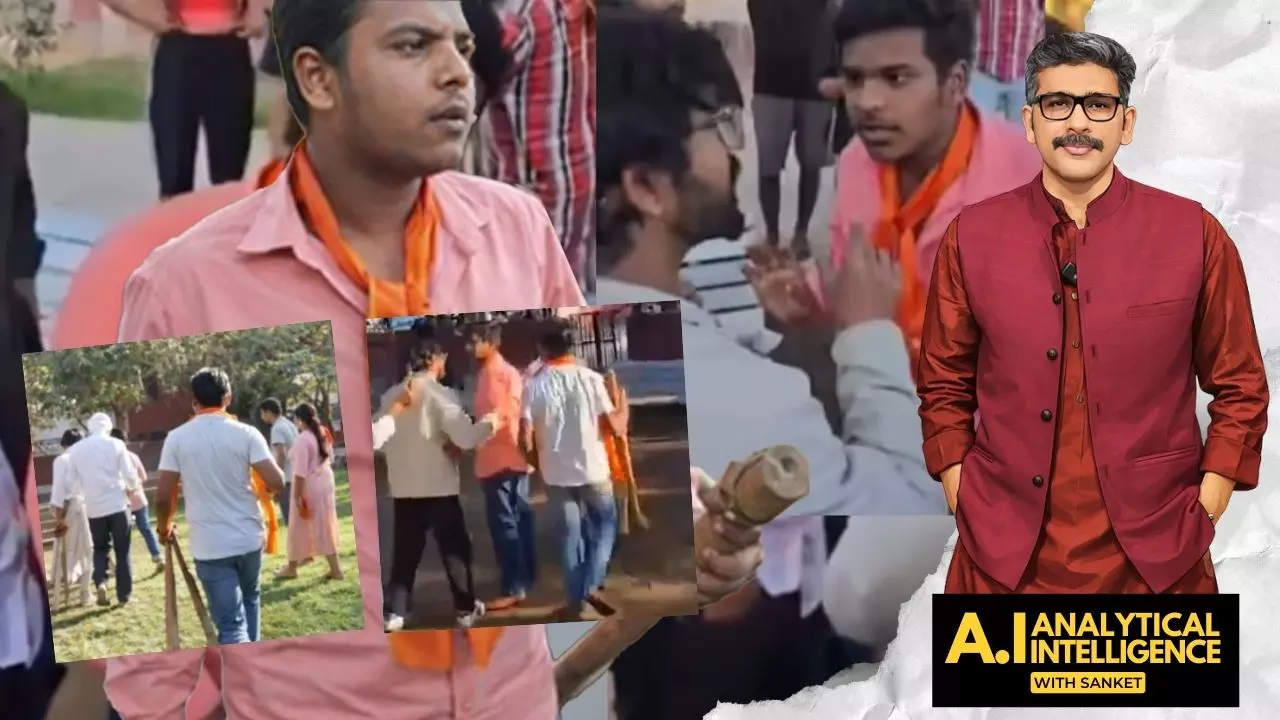
Did Jaipur citizens set a model by confronting moral policing squad?
Former IPS officer Yashovardhan Azad, activist Brinda Adige say viral Valentine's Day video shows courage, could inspire others to defend constitutional rights

“Don’t submit to this kind of gundagardi (hooliganism). This is mob violence.”
That was former IPS officer Yashovardhan Azad’s sharp message after a group of young citizens in Jaipur calmly confronted alleged Bajrang Dal activists attempting moral policing on Valentine’s Day. The incident, which has gone viral, has sparked debate over vigilantism, constitutional rights, and police accountability.
The Federal spoke to Brinda Adige, women’s rights activist, and Yashovardhan Azad, former IPS officer, about what the Jaipur episode signifies for India’s democracy and whether citizen-led pushback is becoming the new norm. The focus of the discussion: Bajrang Dal Valentine’s Day politics and the broader culture of moral policing.
Citizen pushback
The Jaipur episode unfolded at a public park on February 14. A group of men allegedly associated with the Bajrang Dal entered the park carrying sticks and scarves and began questioning young couples. They reportedly demanded names, phone numbers, and addresses — a form of public shaming.
At that moment, a young man began recording the interaction and turned the questions back on the vigilantes — "Who are you? What is your ID? Why are you carrying a stick? On what authority are you asking for personal details in a public park?"
Adige described the visuals as “real people’s power” and “active citizenship.” She said the young citizens’ calm but firm response showed that “we can still save ourselves and our country.”
She added that what stood out was not aggression but courage. “They stood up to these people who got all kinds of powers from lots of different other powers… and let us not forget the political patronage that these vigilante groups have,” she said.
Model response
Azad said he admired the restraint shown by the young man who questioned the group “in a very, very polite fashion.”
He said the right to freedom of movement and expression is constitutionally guaranteed, yet citizens are forced to display extraordinary courage to exercise it. “For something that should be available to me as a constitutional right… you have to take so much courage,” he observed.
According to him, the Jaipur incident could become a model. When the police fail to act decisively against harassment, ordinary citizens may feel compelled to defend their rights — but within the framework of law.
“Doing it in such a restrained, democratic fashion is something amazing,” Azad said, adding that such videos also serve to remind law enforcement of their duty.
Legal remedies
When asked what legal provisions could apply in such situations, Azad said the actions described amount to harassment, public nuisance, intimidation, and potentially unlawful assembly. Citizens, he noted, have the right to report wrongdoing and invoke self-defence where necessary.
He argued that disturbing couples in public parks amounts to breaking public order and peace. Such acts, he said, should be treated as “zero tolerance crimes.”
Adige added that if women were present, provisions related to sexual harassment, outraging modesty, and stalking could also be invoked. She questioned why local beat police were not present, especially given that Valentine’s Day has frequently seen such confrontations.
“In Karnataka, police stepped up everywhere — theatres, parks, public places — because they anticipated trouble,” she said, suggesting that preventive policing is part of the state’s responsibility.
Social media role
Both panelists agreed that social media played a crucial role in amplifying the Jaipur incident.
“We know social media amplifies everything,” Adige said. “Earlier, it amplified hatred, enmity and intolerance. Today we are looking at people promoting citizens standing up.”
Azad echoed that sentiment, saying the video gaining praise online may pressure authorities to act. He also said he would personally raise the issue with senior officials, including the chief minister and director general of police, to ask why no action had been taken despite clear visuals.
The discussion also turned to the broader question of vigilantism and political patronage. The host questioned whether groups such as Shri Ram Sena in Karnataka or Karni Sena in Rajasthan could operate with such impunity without tacit support.
Adige insisted that moral policing by non-state actors is not policing at all. “That is not what your police manual talks about. That is not what you are getting paid for,” she said, referring to the responsibilities of law enforcement.
Police mindset
The conversation broadened to include instances of alleged moral policing by police personnel themselves. The panel recalled an incident in Uttar Pradesh where a woman police officer reportedly reprimanded a girl sitting with her brother in a park, assuming misconduct.
Adige said India remains “deeply patriarchal, sexist and misogynistic,” and that even consensual public interaction between adults is often viewed with suspicion.
She criticised past initiatives such as “Romeo squads” in Uttar Pradesh, arguing that protection framed in patriarchal terms does not enhance women’s safety.
Azad, drawing from his own experience in the police, said harassment outside women’s colleges was once treated with seriousness. “There can be no two ways about this,” he said, stressing that harassment must be firmly dealt with by authorities.
Constitutional rights
At the heart of the discussion was the assertion that citizens have the constitutional right to move freely, assemble peacefully, and express themselves within the bounds of law. Sitting together on a park bench, holding hands, or talking in a public space, the panelists said, cannot be grounds for intimidation.
Adige emphasised that educating young people about their rights is crucial. “The youth are not our tomorrow. The youth are today,” she said. She urged colleges and institutions to empower students to understand and defend their freedoms.
Azad concluded with a broader appeal. “India is ours and how we keep it is also our responsibility,” he said. “Respond with courage and all of us will support you.”
The Jaipur episode, according to the panelists, demonstrates that non-violent, legally aware citizen action can push back against vigilantism. Whether authorities will follow through with legal action remains an open question.
The content above has been transcribed from video using a fine-tuned AI model. To ensure accuracy, quality, and editorial integrity, we employ a Human-In-The-Loop (HITL) process. While AI assists in creating the initial draft, our experienced editorial team carefully reviews, edits, and refines the content before publication. At The Federal, we combine the efficiency of AI with the expertise of human editors to deliver reliable and insightful journalism.