Monideepa Banerjie
BJP faces Bengal reality check after anti-infiltration poll plank
After BJP’s historic Bengal win, questions are emerging over illegal infiltration claims as official deportation figures remain far lower than campaign rhetoric

West Bengal has entered a new political chapter after the BJP ended Mamata Banerjee’s 15-year rule in the 2026 Assembly elections, but the party’s biggest campaign narrative is already facing tough scrutiny.
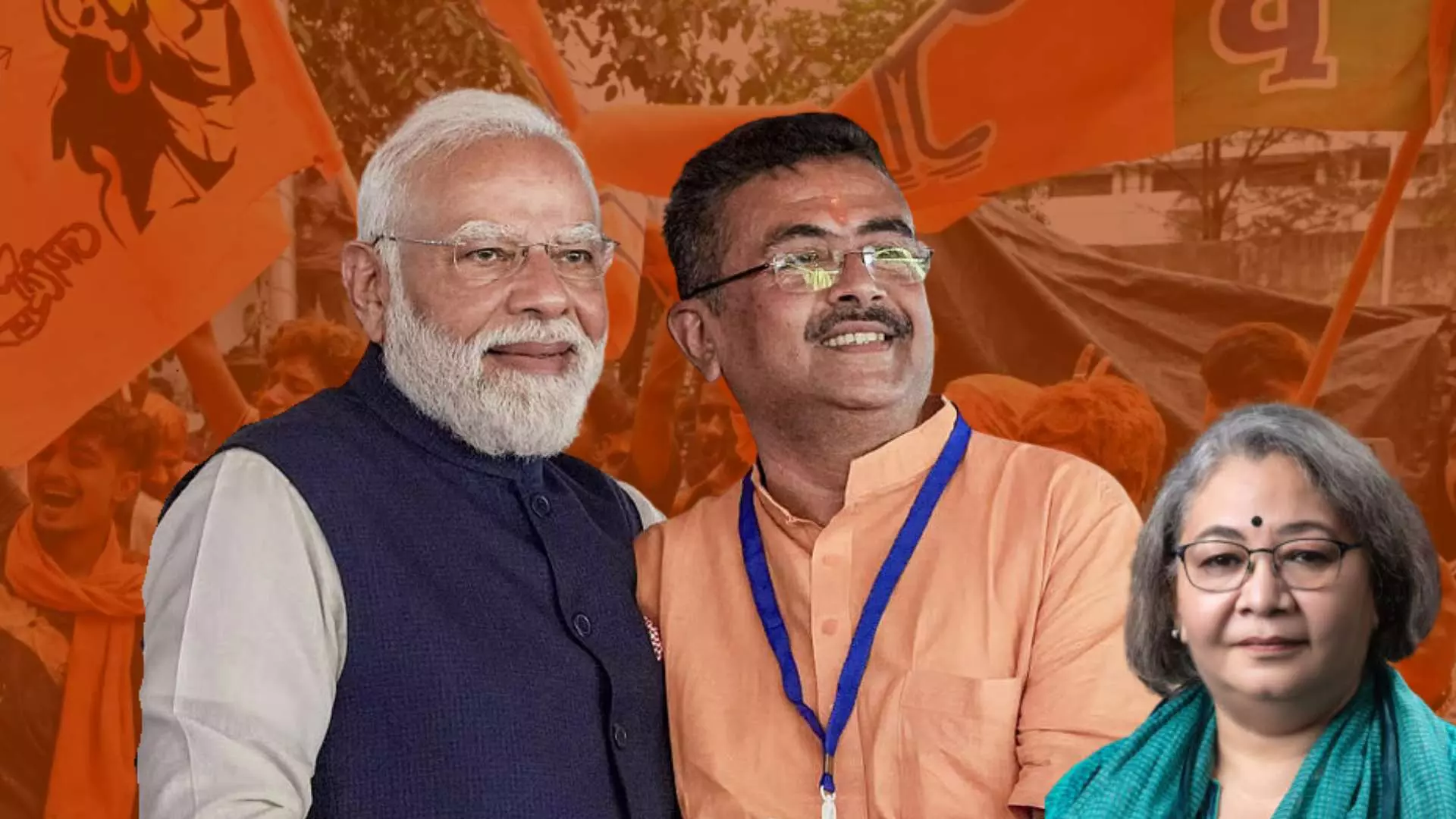
The BJP, led by Prime Minister Narendra Modi and Union Home Minister Amit Shah, swept to power by winning 207 of 293 seats in the Assembly election. The campaign focused heavily on governance, corruption, women’s safety and allegations of illegal Bangladeshi infiltration altering Bengal’s demography.
Former Trinamool Congress leader Suvendu Adhikari, once considered a close aide of Mamata Banerjee, was sworn in as Chief Minister on May 9 at Kolkata’s Brigade Parade Ground in the presence of Narendra Modi.
Deportation gap
However, the BJP’s campaign promise to crack down on illegal infiltrators is now being questioned after official figures from the Ministry of External Affairs reportedly placed the number of Bangladeshis pending deportation at just over 2,360.
The figures stand in sharp contrast to the political rhetoric during the campaign, where infiltration was projected as a large-scale demographic threat facing West Bengal.
“One can clearly see a big gap between political rhetoric and ground reality,” said Samir K Purkayastha, Associate Editor with The Federal, while discussing the issue.
He further pointed out that even over a five-year period, the expected deportation numbers remain below 3,000, raising questions over the scale of the infiltration narrative pushed during the elections.
Assam parallel
Purkayastha drew parallels with neighbouring Assam, where the BJP has been in power for more than two terms and where the issue of illegal migration has also dominated politics for years. He referred to the National Register of Citizens (NRC) exercise and noted that “more Hindus got left out than Muslims” during the process.
Questions were also raised over the lack of official clarity from institutions like the Election Commission of India regarding the number of alleged illegal migrants. “Neither the Government of India nor the Election Commission is actually coming out with any figure. They are maintaining strict silence,” said Purkayastha.
He further stated that this silence helped political narratives around infiltration gain momentum during the election campaign.
Purkayastha argued that the Election Commission could have clarified that exclusion from electoral rolls did not automatically mean a person was an illegal migrant or not an Indian citizen.
Big challenge
Purkayastha also highlighted that around 27 lakh cases are still pending before tribunals, adding further uncertainty to the debate over illegal migration and citizenship verification.
While the BJP secured a historic mandate, expectations from the new government are now extremely high on issues ranging from jobs and development to law and order and corruption.
“There are great expectations of this new government,” Purkayastha said. “But when expectations are so huge, it is going to be a huge challenge for the BJP and Suvendu Adhikari to meet them," he added.
He concluded by noting that Bengal’s political transition would ultimately be judged not by electoral promises or political symbolism, but by governance and delivery. “A new chapter has begun in Bengal, but history will judge this government not by the saffron it wore on oath day, but by the promises it keeps,” he added.
The content above has been transcribed from video using a fine-tuned AI model. To ensure accuracy, quality, and editorial integrity, we employ a Human-In-The-Loop (HITL) process. While AI assists in creating the initial draft, our experienced editorial team carefully reviews, edits, and refines the content before publication. At The Federal, we combine the efficiency of AI with the expertise of human editors to deliver reliable and insightful journalism.